
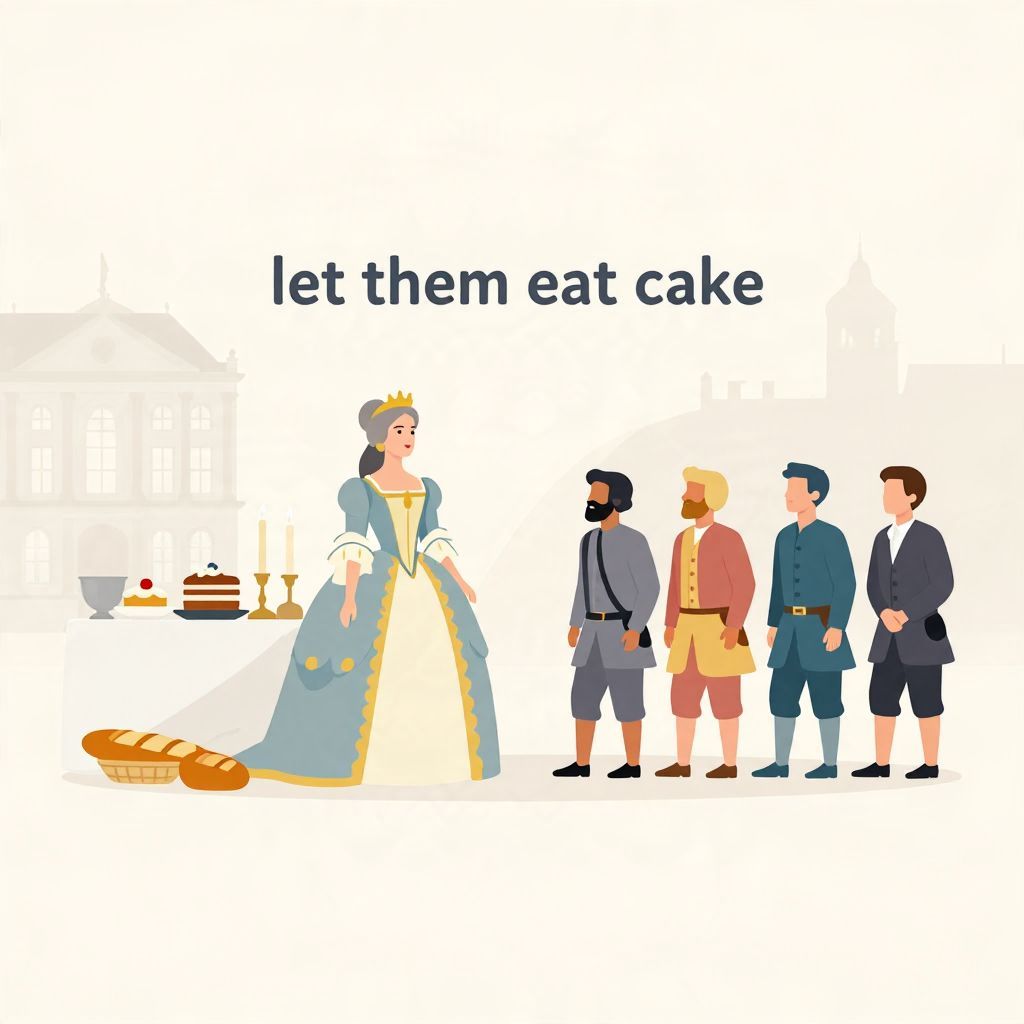
“Let them eat cake” is one of the most famous political quotations in history, but it is almost certainly not something Marie Antoinette actually said. The phrase is best understood as a symbol of elite indifference: a way of expressing the idea that rulers were so detached from ordinary hardship that they could not imagine hunger or poverty.
The story became attached to the French queen during and after the French Revolution, when criticism of the monarchy was intense. In reality, the line appears in older sources and was later linked to Marie Antoinette as part of a wider effort to portray her as careless, frivolous, and out of touch.
What does “let them eat cake” mean?
“Let them eat cake” means “if people cannot afford bread, let them eat something else instead,” a cruel or clueless response to poverty. Historically, it is less a verified quotation than a political myth used to criticize aristocratic privilege, especially the French monarchy in the revolutionary era.
Did Marie Antoinette really say it?
Probably not. There is no reliable evidence that Marie Antoinette ever said “let them eat cake,” and historians generally treat the attribution as false. The phrase predates her association with it and appears in earlier French writings, which strongly suggests it was later pinned to her because she became a convenient symbol of royal excess.
The older French phrase behind the legend
The expression is often linked to a line in Jean-Jacques Rousseau’s Confessions, written in the 1760s and published later, where he mentions “a great princess” who supposedly said that if peasants had no bread, they should eat brioche. Even this is not proof of a real conversation; Rousseau was using a literary anecdote, not documenting a verified statement. Over time, “brioche” in the story was replaced in popular memory by “cake,” which sounded even more decadent and insulting in English.
Why Marie Antoinette became the target
Marie Antoinette, the Austrian-born queen of France, was already unpopular in some circles before the Revolution. She was foreign, wealthy, and associated with court luxury at Versailles. During the political crisis of the late 1780s and the Revolution that followed, pamphleteers and critics used exaggerated stories to turn her into a symbol of everything wrong with the monarchy. The “cake” quote fit that purpose perfectly, even if it was not true.
Where did the phrase come from historically?
The exact origin of the modern English phrase is difficult to pin down, but its roots lie in older European discussions about bread, privilege, and social inequality. The idea reflects a real historical tension: in pre-revolutionary France, bread was the staple food for many people, and shortages or rising prices could be devastating. A dismissive remark about “cake” captured the gulf between elite comfort and popular suffering.
Bread, hunger, and the French Revolution
To understand why the phrase became so powerful, it helps to know how central bread was to everyday life. For many French families in the 18th century, bread made up a huge share of daily calories. When harvests failed or prices rose, people suffered immediately. In that context, a story about a queen casually suggesting cake instead of bread was politically explosive, whether or not it was factual.
Mythmaking in revolutionary politics
Revolutions do not only change governments; they also create stories. Supporters and opponents use memorable anecdotes to explain blame, justify action, and shape public memory. The “let them eat cake” story survived because it was simple, vivid, and morally satisfying to people angry at the old regime. It condensed a complex economic and political crisis into one unforgettable line.
What is the historical evidence?
The evidence points away from Marie Antoinette and toward a broader tradition of anti-elite storytelling. The phrase is not found in trustworthy contemporary records of the queen speaking those words. Instead, it appears in literary and anecdotal forms, then later becomes attached to her in popular retellings. That is a classic pattern in historical legend: a real social complaint gets personalized into a dramatic quote.
Why historians are skeptical
- No solid contemporary source records Marie Antoinette saying “let them eat cake.”
- The idea appears in earlier writings in a different form, showing it was already circulating.
- Revolutionary-era propaganda often exaggerated or invented stories about the royal family.
- Later generations repeated the quote because it neatly fit Marie Antoinette’s public image.
“Brioche” versus “cake”
One reason the story is often misunderstood is the translation issue. The original French anecdote uses brioche, a rich bread-like pastry. In English, it became “cake,” which sounds even more extravagant and absurd. That shift helped the phrase endure, but it also moved it farther from the historical context of French food culture.
Why does the quote still matter today?
Even though it is probably fake, “let them eat cake” remains historically important because it captures a real social truth: rulers can become dangerously disconnected from the lives of ordinary people. The phrase has lasted because it is useful shorthand for privilege, arrogance, and indifference to suffering. It is often used in politics, journalism, and popular culture for that reason.
A lesson about historical memory
The quote also shows how history and memory are not the same thing. A statement can be false and still become influential if it expresses a widely believed idea. In this case, the legend about Marie Antoinette mattered more than the facts to people who wanted a symbol of royal failure. That is why historians must separate evidence from reputation.
How the meaning has broadened
Today, people use “let them eat cake” far beyond French history. It can describe any leader, wealthy person, or institution that seems blind to hardship. The phrase has become a cultural shorthand for tone-deaf responses to inequality, whether in politics, business, or celebrity culture. Its survival shows how a historical myth can outlive the regime that produced it.
Marie Antoinette in historical context
Marie Antoinette was not the only cause of France’s problems, and she was not the sole symbol of the monarchy’s collapse. The French Revolution grew out of deep financial crisis, social inequality, political conflict, and public anger over food prices and taxation. Still, she became one of the most visible faces of the old order, and that made her especially vulnerable to rumor and caricature.
From queen to symbol
As the Revolution radicalized, public opinion hardened. Marie Antoinette was portrayed not just as a queen, but as an outsider, spendthrift, and enemy of the people. Some accusations were exaggerated; others were invented. The “let them eat cake” story belongs to this larger pattern of demonization. It tells us as much about revolutionary politics as it does about the queen herself.
So what does “let them eat cake” mean in one sentence?
It means a rich or powerful person is so detached from the struggles of ordinary people that they offer a cruel, absurd, or useless solution to poverty. Historically, the phrase is a myth attached to Marie Antoinette, not a verified quotation from her.
The enduring lesson is that famous historical sayings are not always true, but they can still reveal real social tensions. “Let them eat cake” survived because it perfectly captured resentment toward privilege in a time of crisis. If you want to explore the woman behind the legend, see who Marie Antoinette was and why Marie Antoinette was executed.