
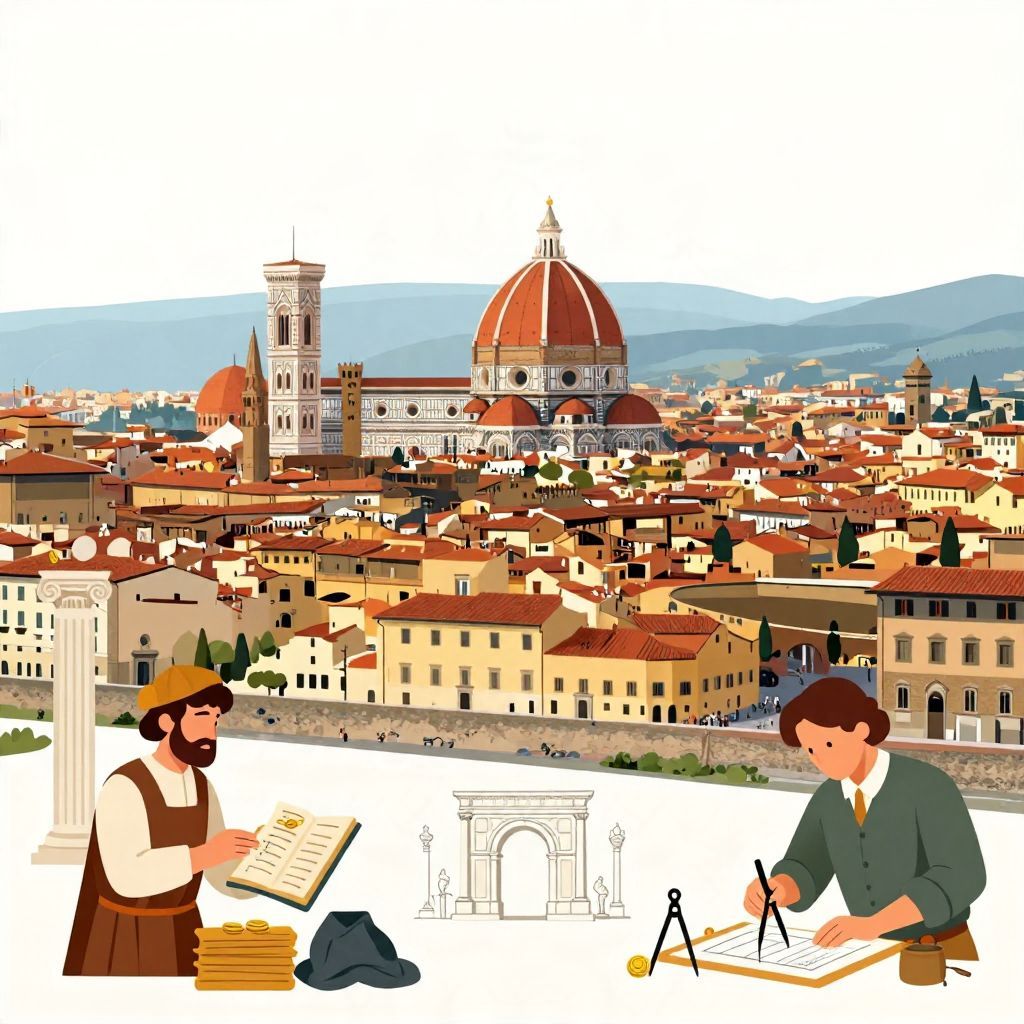
The Renaissance began in Italy because the peninsula had the right mix of wealth, urban life, classical heritage, and political competition to encourage new ways of thinking. It did not appear overnight, and it was not a sudden break from the Middle Ages. Instead, it grew gradually in the city-states of northern and central Italy during the 14th and 15th centuries.
Italian merchants, bankers, and rulers had the money to support artists and scholars, while the ruins and texts of ancient Rome were all around them. That combination made Italy the most likely place for a cultural revival that later spread across Europe.
Why did the Renaissance start in Italy?
The Renaissance started in Italy because Italian city-states were unusually wealthy, urban, and connected to the classical past. Trade brought in money and ideas, political rivalry encouraged patronage, and scholars could study Roman remains and rediscovered Greek and Latin texts. These conditions made Italy the first place where humanist learning and artistic innovation flourished together.
The economic strength of Italian city-states
One of the main reasons the Renaissance began in Italy was money. Cities such as Florence, Venice, Genoa, Milan, and later Rome became rich through trade, banking, shipping, and manufacturing. Wealthy merchant families and civic governments could pay for painters, sculptors, architects, libraries, and public buildings.
Trade routes and urban prosperity
Italy sat at the crossroads of Mediterranean commerce. Italian merchants traded with the Byzantine Empire, the Islamic world, North Africa, and northern Europe. Venice and Genoa profited from maritime trade, while Florence became a center for banking and textile production. This economic activity created a large urban middle class with the means and motivation to sponsor culture.
Unlike many parts of Europe, where wealth was concentrated in landholding aristocracies, Italian cities had powerful merchants and bankers who wanted to display status through art and learning. Patronage was not just generosity; it was also a way to gain political influence, family prestige, and public honor.
Patronage and competition
Families such as the Medici in Florence used their wealth to support artists and scholars. City governments, religious institutions, and guilds also commissioned works. Because Italian states were often rivals, they competed for beauty, fame, and cultural distinction. That rivalry helped drive artistic experimentation and ambitious public projects.
Italy’s connection to ancient Rome
Italy was the heartland of the Roman Empire, and that mattered enormously. Renaissance thinkers admired ancient Rome and sought to revive its literature, architecture, civic ideals, and language. The physical remains of Roman civilization were visible in Italian cities, from ruins and inscriptions to roads, arches, and monuments.
Classical ruins as inspiration
Artists and architects could study ancient buildings directly. Roman columns, domes, and inscriptions were not distant relics hidden in foreign lands; they were part of the Italian landscape. This made classical antiquity feel immediate and usable. Architects such as Filippo Brunelleschi and later Leon Battista Alberti drew on Roman forms while adapting them to new purposes.
The presence of Roman remains did not automatically create the Renaissance, but it gave Italian artists a living connection to antiquity. In places like Florence and Rome, the past was not only remembered in books; it was visible in stone.
Humanism and the recovery of texts
Renaissance humanism began with the study of classical literature, history, rhetoric, and moral philosophy. Scholars searched for manuscripts by Cicero, Livy, Virgil, and other ancient authors. Some texts had been preserved in monasteries, while others reached Italy through Byzantine scholars and the wider Mediterranean world.
Humanists believed that careful study of language and history could improve civic life and personal virtue. Their work encouraged a new educational ideal centered on grammar, rhetoric, history, poetry, and moral reasoning. This was not a rejection of religion, but it did shift attention toward human experience, civic responsibility, and the achievements of the classical world.
Political fragmentation encouraged creativity
Italy was not a unified kingdom in the 14th and 15th centuries. It was divided among city-states, republics, lordships, papal territories, and foreign influences. This fragmentation often caused conflict, but it also created opportunities for experimentation. No single ruler controlled the entire peninsula, so different centers could compete for prestige.
Many courts, many patrons
Florence, Venice, Milan, Ferrara, Mantua, Urbino, and Rome each developed distinct cultural environments. Rulers and elites wanted to advertise legitimacy through architecture, painting, and scholarship. A successful court needed not only soldiers and diplomats but also poets, architects, and artists.
This competition helped spread innovation. If one city commissioned a striking dome, another might seek an even grander palace or chapel. If one patron supported a learned humanist, another might do the same. The result was a culture of comparison and emulation that rewarded originality.
Civic identity and public culture
Italian city-states also had strong civic identities. Citizens often saw their city as a political community with a proud history. Public art, monuments, and ceremonies reinforced that identity. Renaissance art was therefore not only decorative; it was tied to politics, memory, and civic pride.
The role of the Church and papal Rome
The Catholic Church was not separate from the Renaissance; it was one of its major patrons. Popes, bishops, and religious institutions commissioned churches, frescoes, sculptures, and manuscripts. Rome became especially important in the later Renaissance, when the papacy sought to restore the city’s grandeur and authority.
Religious patronage and artistic opportunity
Church commissions created demand for highly skilled artists and architects. Religious themes remained central to Renaissance art, even when the style became more naturalistic and classical. Artists such as Michelangelo, Raphael, and others worked for popes who wanted to express spiritual power through monumental art and architecture.
The Church also preserved learning. Monasteries and cathedral schools had long safeguarded books and scholarship, and church networks helped circulate texts and ideas. So while some later narratives portray the Renaissance as a rebellion against religion, its early development was deeply embedded in Christian institutions.
Byzantine influence and the fall of Constantinople
Italy’s Renaissance was strengthened by contact with the eastern Mediterranean. Greek scholars, manuscripts, and artistic traditions reached Italy through trade and diplomacy long before 1453, but the fall of Constantinople to the Ottomans in that year intensified the movement of people and texts into Italy.
Greek learning in the West
Many Italian scholars wanted to read Greek works in the original language. Byzantine intellectuals helped transmit Greek philosophy, science, and literature. This was especially important for the study of Plato and other ancient authors whose works were less familiar in western Europe.
It is worth being precise here: the Renaissance did not begin only because Constantinople fell. The movement was already underway in Italy before 1453. But the arrival of more Greek scholars and manuscripts helped deepen and accelerate the intellectual revival.
Why Italy and not somewhere else first?
Other parts of Europe also had learning, art, and court culture, but Italy had a unique combination of advantages. It had more urban centers, more direct access to Roman antiquity, stronger commercial wealth, and intense competition among neighboring states. Those factors made the peninsula especially fertile ground for change.
A comparison with northern Europe
Northern Europe had important universities, monasteries, and royal courts, but the balance of power was different. In many regions, feudal structures and rural economies remained stronger for longer. Italian cities, by contrast, were densely populated and commercially sophisticated, with elites eager to invest in visible cultural projects.
That does not mean Italy was more “advanced” in a simple sense. It means the social and political conditions there favored an early flowering of the Renaissance. Later, printing, travel, and intellectual exchange carried Renaissance ideas northward, where they were adapted to local conditions.
How the Renaissance developed in Italy
The Renaissance did not begin on a single date. Historians usually trace its early stages to the late 13th and 14th centuries, with major growth in the 15th century. Writers such as Petrarch are often associated with early humanism, while Florence in particular became a leading center of artistic and intellectual innovation.
A simple chronology
- Late 1200s to 1300s: early humanist interest in classical texts grows in Italian intellectual circles.
- 14th century: city-states accumulate wealth and patronage expands; artists begin experimenting with more naturalism and classical forms.
- 15th century: Florence, Venice, and other centers become major Renaissance hubs; humanism spreads widely.
- Late 15th to early 16th century: Rome emerges as a major artistic center, and the Renaissance reaches its high point in Italy.
This gradual development matters. The Renaissance was not a sudden invention, but a long transformation in art, education, politics, and self-understanding.
What the Renaissance changed
Because it began in Italy, the Renaissance first transformed Italian culture, but its influence soon spread across Europe. Artists developed new techniques in perspective, anatomy, proportion, and realism. Writers and scholars emphasized classical style and historical criticism. Patrons used art to project power, piety, and civic identity.
Lasting significance
The Italian Renaissance helped shape modern ideas of artistic genius, individual achievement, and secular learning, though these ideas should not be exaggerated or detached from their religious and social context. It also changed how Europeans thought about the past: not merely as something to preserve, but as something to study, imitate, and renew.
In the end, the Renaissance started in Italy because Italy offered the ideal environment for cultural revival: wealth from trade, competition among city-states, visible remains of ancient Rome, access to classical texts, and patrons eager to turn learning and art into public power. For related reading, see how architecture preserves culture.