
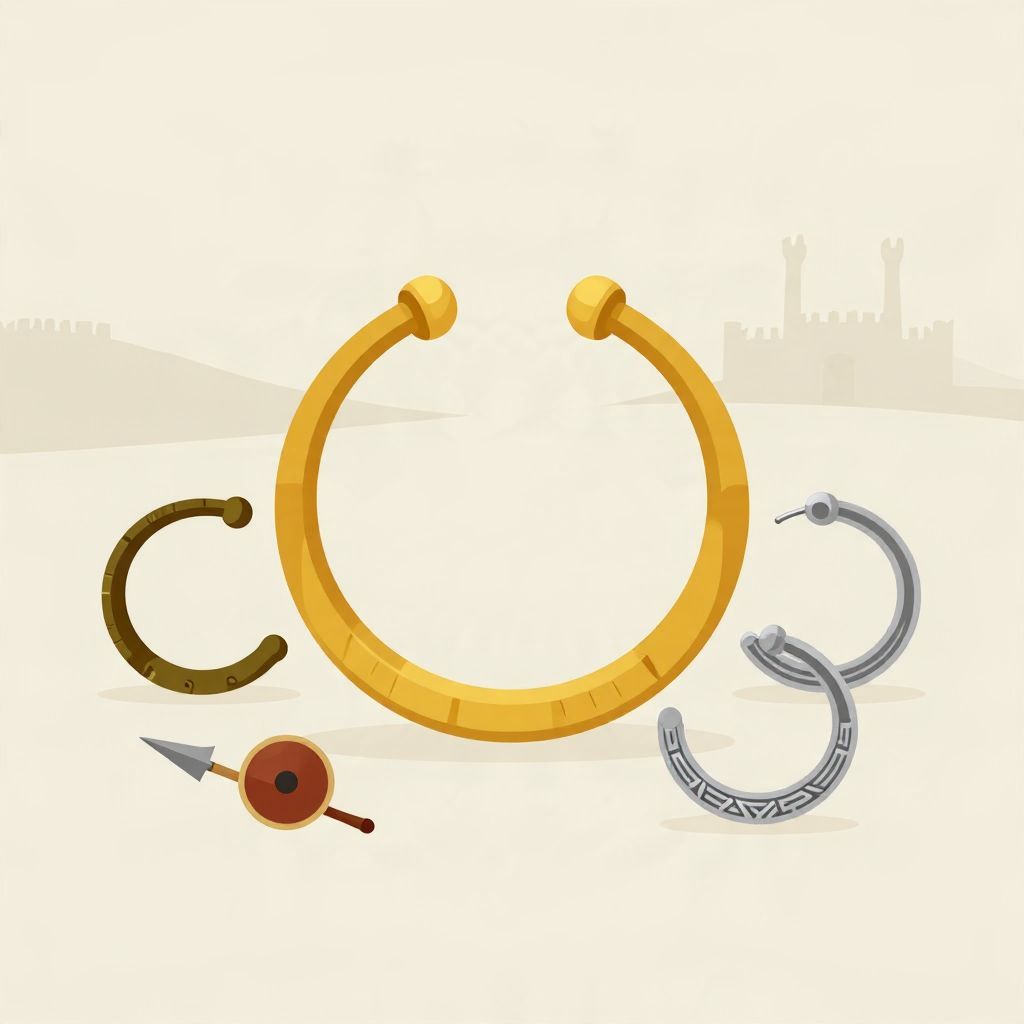
What is a torc? In historical terms, a torc is a rigid neck ring, usually made of metal, that was worn as a piece of jewelry and a symbol of status. It is most closely associated with the Iron Age peoples of Europe, especially the Celts, but examples also appear in other ancient cultures.
Torcs were not merely decorative. They could signal rank, wealth, religious meaning, martial identity, or elite membership, and they remain one of the most recognizable forms of ancient personal ornament.
What Is a Torc?
A torc is an open or closed neck ring, typically made from bronze, iron, silver, or gold, worn around the neck or sometimes the upper arm. The best-known torcs come from Iron Age Europe, where they were worn by men and women of high status and often buried as prestige objects.
Background and Origins of the Torc
Ancient roots
The torc is an ancient form of jewelry with roots in the Bronze Age and early Iron Age, roughly from the second and first millennia BCE. Archaeologists have found torc-like ornaments across parts of Europe and the Mediterranean, though the form became especially prominent among Celtic-speaking communities in the centuries before the Roman conquest.
Why the torc developed
The torc’s shape made it both practical and visually striking. Unlike a flexible necklace, it held its form and could be worn as a bold display object. In societies where metalworking was a mark of skill and where elite identity was often expressed through dress and ornament, a torc served as a portable sign of power, generosity, and distinction.
The Torc in Celtic and Iron Age Europe
The torc is most strongly associated with the Iron Age cultures of Gaul, Britain, Ireland, and parts of central Europe, especially from about the 5th century BCE to the Roman period. Surviving examples show extraordinary craftsmanship: twisted rods, hollow tubes, animal-head terminals, and intricate decoration in gold or bronze.
Elite identity and symbolism
In many archaeological contexts, torcs appear in elite burials, hoards, and votive deposits. That pattern suggests they were more than everyday accessories. A torc could mark social rank, warrior prestige, or sacred status. Some may have been inherited, gifted, or used in ceremonial settings rather than worn constantly.
Women and men wearing torcs
Modern popular culture often imagines torcs as male warrior ornaments, but the evidence is broader. Both men and women could wear them, and some of the most elaborate examples are associated with high-status female burials. The torc was not tied to one gender alone; its meaning depended on local custom and the social role of the wearer.
How Were Torcs Made?
Materials and techniques
Torcs were made from a range of metals, from bronze and iron to silver and gold. Craftspeople used techniques such as twisting, hammering, casting, soldering, and repoussé decoration. Some torcs were simple in design, while others required advanced metallurgical knowledge and considerable labor.
Common forms
- Twisted torcs: made from multiple strands of metal twisted together.
- Bar torcs: formed from solid rods bent into a neck ring.
- Hollow torcs: made from sheet metal over a core, allowing large-looking but lighter objects.
- Terminal torcs: ends finished with knobs, animal heads, or decorative caps.
The terminals were often the most elaborate part. They could be plain, flared, or shaped like stylized beasts, reflecting the artistic traditions of the region and period in which the torc was made.
What Did a Torc Mean in the Ancient World?
The meaning of a torc varied by place and time, but several interpretations are well supported. It could indicate wealth, military achievement, noble birth, religious dedication, or a special relationship to a ruler or deity. In some societies, it may also have functioned as a gift exchanged to build loyalty or cement alliances.
Warrior prestige
Classical writers sometimes linked Celtic peoples with conspicuous personal adornment, including torcs. While these accounts should be read critically, archaeological evidence does show that torcs could be part of elite warrior display. A torc worn in battle or in public ceremony would have made the wearer immediately visible and memorable.
Religious and ritual uses
Some torcs were deposited in sanctuaries, wetlands, rivers, or hoards, suggesting ritual offering. In such cases, the object may have been dedicated to a deity or placed in a sacred context as part of a religious act. This is one reason torcs are often studied not just as jewelry but as evidence of belief and ritual practice.
Famous Torcs in Archaeology
The Snettisham torcs
Among the most famous finds are the gold torcs from Snettisham in Norfolk, England, discovered in a series of hoards. Dating to the late Iron Age, these objects demonstrate exceptional craftsmanship and are among the finest surviving examples of British Iron Age metalwork. Their careful burial suggests deliberate concealment or ritual deposition.
The Trichtingen torc
Another celebrated example is the large gold torc found at Trichtingen in what is now Germany. Objects like this show that torcs were not limited to one island or one tribe; they belonged to a wider Iron Age world in which elite metalwork circulated across regions and cultural boundaries.
Torcs in museums and collections
Many torcs are now held in national museums, where they are studied for clues about technology, trade, identity, and burial practice. Their survival is uneven: precious metal torcs were often melted down in antiquity, so each preserved example is especially valuable to historians and archaeologists.
Torcs in Roman Accounts and Later Tradition
Roman authors noticed torcs because they were visually dramatic and culturally distinctive. In Roman art, torcs could appear as markers of “barbarian” identity, especially in depictions of Gauls and other non-Roman peoples. At the same time, Romans themselves adopted and adapted many forms of elite jewelry, showing that cultural boundaries were never simple.
The legend of the warrior torc
Later storytelling often turned the torc into a symbol of heroic Celtic resistance. While that image has some basis in ancient evidence, it can become oversimplified if treated as the whole story. Torcs were not only warrior trophies; they were also luxury objects, ritual gifts, and signs of social hierarchy.
How the Torc Differs from Other Neck Ornaments
A torc is not just any necklace. Its defining feature is its rigid or semi-rigid form, usually open at the front or finished with decorated terminals. Unlike a chain necklace, a torc keeps its shape and often has a heavier, more monumental appearance. That physical presence is part of why it carried such strong symbolic force.
Related objects
- Necklace: usually flexible, made of linked or strung components.
- Collar: a broad neck ornament, sometimes rigid, but not always in torc form.
- Arm ring: a similar prestige object worn on the arm rather than the neck.
Because ancient terminology is inconsistent, some objects described as torcs in modern scholarship may have been worn differently or served overlapping functions. Archaeologists therefore rely on form, context, and comparative evidence rather than a single ancient label.
Why Torcs Matter to Historians
Torcs matter because they reveal how ancient societies expressed identity through material culture. They show the importance of craftsmanship, metal supply, exchange networks, and symbolic display. They also help historians understand how status worked in societies that left few written records of their own.
In addition, torcs remind us that ancient art was not separate from social life. A torc could be worn, gifted, buried, offered, inherited, or displayed in ceremony. Each use gave the object a different meaning, and those meanings changed over time.
Key Facts About Torcs
- Definition: a rigid or semi-rigid neck ring, sometimes worn on the arm.
- Best-known association: Iron Age Europe, especially Celtic cultures.
- Materials: bronze, iron, silver, and gold.
- Function: status symbol, elite ornament, and sometimes ritual object.
- Historical range: examples appear from the Bronze Age onward, with peak prominence in the Iron Age.
Conclusion
A torc is one of the most distinctive ornaments of the ancient world: a neck ring that combined beauty, craftsmanship, and social meaning. Best known from Iron Age Europe, it was far more than jewelry. It could express rank, identity, ritual power, and prestige, which is why it continues to fascinate historians and archaeologists today. For related reading, see what a torc is and explore another historical term such as what is a buccaneer.