
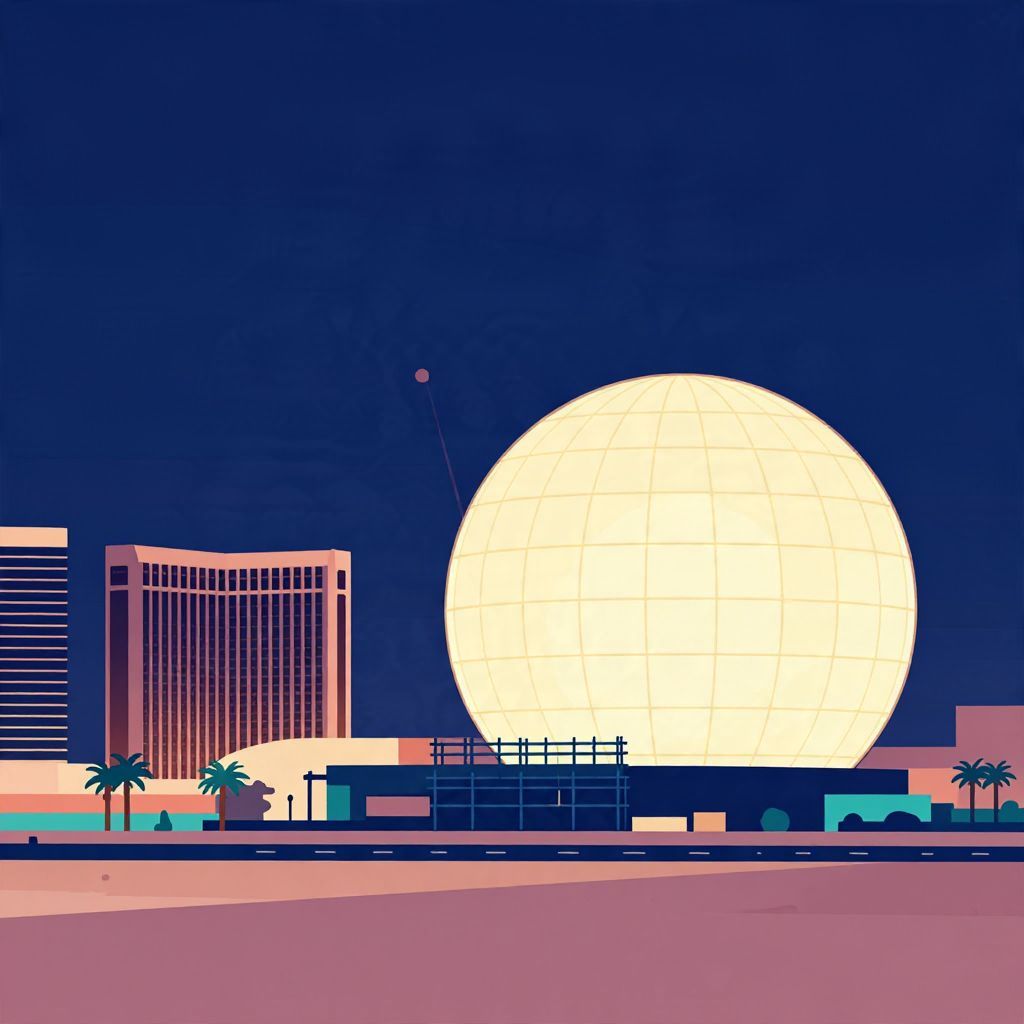
The Sphere in Las Vegas is one of the most recognizable new landmarks in the city, but its history is surprisingly recent. If you are asking when it was built, the short answer is that construction began in 2018 and the venue officially opened in 2023.
Its story is tied to the evolution of Las Vegas itself: from a casino-centered entertainment capital to a place where architecture, technology, and live spectacle are part of the attraction. The Sphere was not built all at once, and its opening came after years of planning, delays, and redesigns.
When Was The Sphere In Las Vegas Built?
The Sphere in Las Vegas was built between 2018 and 2023. Groundbreaking took place in September 2018, major construction continued through the pandemic years, and the venue opened to the public in September 2023. In historical terms, that makes it a very recent addition to the Las Vegas Strip.
The Timeline of the Sphere’s Construction
The Sphere did not appear overnight. It was developed over several years as a large-scale entertainment project that required new engineering methods, a massive steel frame, and an exterior designed to function as a digital display. The most important dates are easy to summarize:
- 2018: Groundbreaking and early construction begin.
- 2020–2021: Work continues through the disruptions of the COVID-19 era.
- 2022: The structure becomes one of the most visible new features on the Strip.
- 2023: The Sphere opens to the public, with its first major performances and events.
This timeline matters because the Sphere was not simply “built” in the sense of raising a building shell. It was created as a highly specialized performance venue, meaning the structure, the screen, the acoustics, and the audience experience all had to be developed together.
Why the Sphere Took Years to Build
Large entertainment projects in Las Vegas often take years, but the Sphere was especially complex. It was designed to be both a concert hall and a visual landmark, and that required unusual construction on a very large scale. The building’s curved shape, enormous LED exterior, and immersive interior technology made it far more complicated than a standard arena.
A new kind of venue
The Sphere was conceived as a place for immersive entertainment rather than a conventional sports arena. That meant the developers had to think about sound quality, screen resolution, seating geometry, and the way audiences would experience performances from every angle. In other words, the building itself was part of the show.
Engineering on a massive scale
The structure’s distinctive globe shape required a steel framework and a skin capable of supporting one of the largest LED displays ever built. The exterior alone became an engineering challenge, since it had to be both visually striking and durable in the desert climate of Las Vegas.
Construction during a changing era
Like many major projects begun in the late 2010s, the Sphere’s construction unfolded during a period of economic and logistical disruption. The COVID-19 pandemic slowed or complicated many public-facing developments, but work on the Sphere continued until the venue could open in 2023.
Who Built the Sphere in Las Vegas?
The Sphere was developed by Sphere Entertainment Co., the company associated with the project’s long planning and execution. The venue was built as part of a broader effort to create a next-generation entertainment space in Las Vegas, a city known for constantly reinventing itself to attract visitors.
The project also reflects the role of major corporate investment in modern Las Vegas history. Unlike the city’s earlier era of small, themed casinos, the Sphere belongs to a phase in which large companies finance landmark attractions that can serve as both entertainment venues and global advertising images.
What Was on the Site Before the Sphere?
Before the Sphere rose near the Las Vegas Strip, the site was associated with earlier development plans and land use connected to the city’s entertainment corridor. Like much of Las Vegas, the area changed hands and purposes over time as the Strip expanded and new projects replaced older ones.
This is a familiar pattern in Las Vegas history. The city has long been shaped by demolition, redevelopment, and reinvention. Older properties are often cleared to make room for larger or more profitable attractions, and the Sphere is part of that continuing process.
Why the Sphere Matters in Las Vegas History
The Sphere is important not just because it is new, but because it represents a shift in what Las Vegas is trying to be. For much of the 20th century, the city’s identity centered on casinos, hotel towers, and stage entertainment. In the 21st century, it has increasingly emphasized spectacle, branding, and immersive technology.
From casino city to experience city
Las Vegas has always sold entertainment, but the form of that entertainment has changed. The Sphere shows how the city now competes not only through gambling and live shows, but through architecture itself. Visitors come to see the building as much as the performances inside it.
Architecture as attraction
In earlier eras, famous Las Vegas landmarks were often themed hotels or neon signs. The Sphere extends that tradition in a modern way. Its glowing exterior has made it a visual icon, especially at night, and its design has helped turn it into a destination even for people who are not attending a show.
Opening in 2023: The Public Debut
The Sphere officially opened in September 2023, marking the end of its construction phase and the beginning of its life as a working venue. Its debut drew attention because the building had already become famous before opening, thanks to its unusual shape and illuminated exterior.
The opening also confirmed something important about modern Las Vegas: the city’s newest landmarks are often created not only to host events, but to generate worldwide attention. The Sphere’s launch was as much a media event as an architectural one.
What Makes the Sphere Different from Earlier Las Vegas Venues?
The Sphere differs from older performance spaces in several ways. Traditional theaters and arenas are designed primarily to support the audience’s view of the stage. The Sphere was designed to surround the audience with sound and image, making the venue itself part of the performance environment.
- Exterior display: The outside can function as a giant illuminated screen.
- Immersive interior: The inside is built for wraparound visual and audio experiences.
- Modern scale: It is among the most ambitious entertainment structures ever built in Las Vegas.
This combination makes the Sphere historically significant as a product of the digital age. It reflects a moment when entertainment architecture became increasingly dependent on advanced media technology.
How the Sphere Fits into the Broader History of Las Vegas
Las Vegas has repeatedly reinvented itself. In the mid-20th century, it became known for casinos, resort hotels, and celebrity entertainment. Later, it expanded into large-scale conventions, family attractions, and elaborate themed properties. The Sphere belongs to the newest stage in that evolution.
Its construction also shows how the Strip continues to grow upward and outward through landmark projects. Each generation of Las Vegas development has tried to outdo the last, whether through larger hotels, brighter lights, or more elaborate spectacles. The Sphere is a 21st-century version of that long pattern.
So, When Was The Sphere In Las Vegas Built?
If you want the simplest historical answer, the Sphere in Las Vegas was built from 2018 to 2023, with construction beginning in 2018 and the venue opening in 2023. That is the most accurate date range for its construction and public debut. Its significance lies not only in when it was built, but in what it says about modern Las Vegas: a city that continues to turn architecture into entertainment.
For readers interested in the city’s larger past, the Sphere is best understood alongside the broader history of the Las Vegas Strip and the rise of modern entertainment architecture in the American West.