
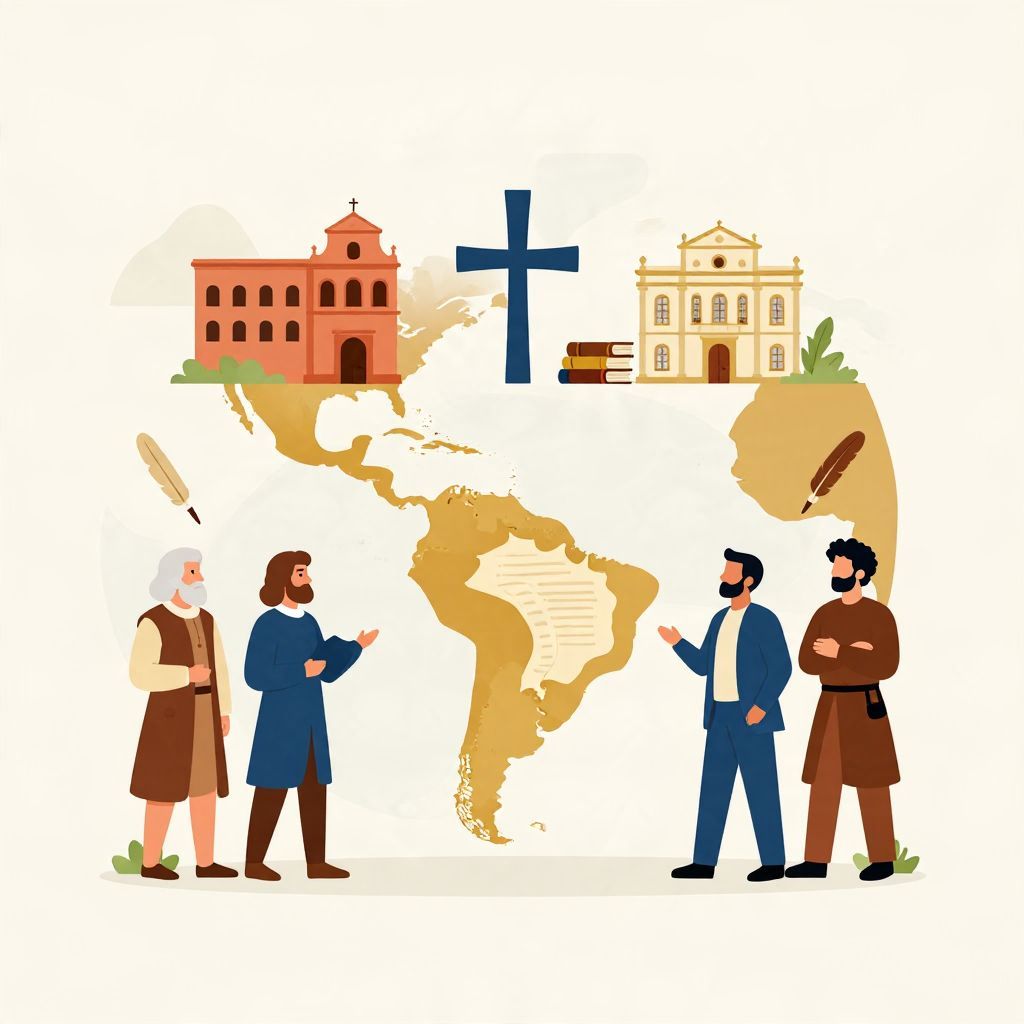
Why is Latin America called Latin America? The short answer is that the name refers to the region’s Romance languages—especially Spanish and Portuguese, and in a broader sense French—spoken in the Americas after European colonization. It is a cultural and linguistic label, not an ancient geographic one, and it emerged in the 19th century as people tried to describe a new postcolonial world.
The term also reflected politics. It helped distinguish the Spanish- and Portuguese-speaking parts of the Americas from the “Anglo” world, especially the United States and British Canada, while also suggesting a shared identity among countries with similar colonial histories.
Why is Latin America called Latin America?
Latin America is called “Latin” because its dominant languages—Spanish, Portuguese, and sometimes French—descend from Latin, the language of ancient Rome. The name was popularized in the 1800s to group together the parts of the Americas shaped by Iberian and, in some contexts, French colonization. It is a modern historical label, not a colonial-era official name.
The linguistic reason behind the name
The most direct explanation is language. Spanish, Portuguese, and French are Romance languages, meaning they evolved from Latin after the fall of the Roman Empire. When Europeans colonized much of the Americas, these languages became dominant in large territories from Mexico to Argentina and from the Caribbean to parts of North America.
Why “Latin” and not “Roman”?
In 19th-century Europe, “Latin” was a convenient way to refer to peoples and languages descended from the Roman world without saying “Roman” in a political or imperial sense. The phrase “Latin America” therefore pointed to linguistic heritage. It did not mean the region was culturally identical to Europe or that its peoples were simply “Latin” in some fixed ethnic sense.
Where the term came from historically
The phrase was not used by the first Spanish and Portuguese conquerors. It became common in the 19th century, especially as intellectuals and politicians in Europe and the Americas searched for a name that could describe the Spanish- and Portuguese-speaking republics emerging after independence. The term gained wider circulation in the mid-1800s, particularly in French political and intellectual circles.
France and the politics of the 19th century
French thinkers and officials helped popularize the expression “Latin America” because it supported a broader geopolitical idea: that France shared a “Latin” civilizational connection with Spanish- and Portuguese-speaking America. This was useful during an era of European rivalry and imperial ambition. It also helped justify French influence in the region, most famously during Napoleon III’s intervention in Mexico in the 1860s.
That said, the term was not invented for one single purpose. Different writers used it in different ways. Some meant to emphasize cultural kinship among the region’s countries; others used it to contrast them with the “Anglo-Saxon” world, especially the United States and Britain.
How colonization shaped the region’s identity
The name makes sense only in light of European colonization. From the late 15th century onward, Spain and Portugal conquered vast territories in the Americas. They imposed their languages, legal systems, religious institutions, and colonial administrations on Indigenous societies, while also reshaping the region through African slavery and later immigration from Europe and elsewhere.
Spanish and Portuguese empires in the Americas
Spain established enormous colonial holdings across most of mainland Latin America and the Caribbean. Portugal built its own empire in Brazil. Because these empires used related languages derived from Latin, the postcolonial nations that emerged in the 19th century shared a linguistic foundation that distinguished them from English-speaking North America.
French colonization also mattered, though more selectively. French became dominant in places such as Haiti and parts of the Caribbean, and French cultural influence remained strong in some regions. In broader usage, this is why some definitions of Latin America include French-speaking territories, while others focus mainly on Spanish- and Portuguese-speaking countries.
What the term includes—and what it leaves out
“Latin America” is a useful historical label, but it is also imperfect. It groups together countries with very different histories, populations, and political systems. Brazil, Mexico, Haiti, Argentina, and Peru all fall under the term in many contexts, yet each has a distinct colonial past and national development.
Common definitions
- Broad definition: all countries in the Americas where Romance languages dominate, including Spanish-, Portuguese-, and sometimes French-speaking areas.
- Narrower definition: Spanish- and Portuguese-speaking countries of the Americas, especially in everyday academic and popular usage.
- Most common practical use: the countries of Latin America plus the Caribbean when discussing culture, politics, or history, though the exact list can vary.
What it excludes
The term usually excludes English-speaking countries and territories in the Americas, such as the United States, Canada, and much of the English-speaking Caribbean. It also does not describe Indigenous languages or identities, which remain central to the region’s history even when they are not visible in the name itself.
Why the name became so influential
The phrase endured because it solved a real historical problem: how to describe a large and diverse region that shared colonial languages and many post-independence experiences. After the wars of independence in the early 19th century, new states needed ways to define themselves in relation to Europe and to one another. “Latin America” offered a broad identity that could unite countries with similar colonial legacies.
A shared postcolonial experience
Many Latin American countries experienced similar patterns after independence: political instability, struggles over central authority, debates over race and citizenship, foreign intervention, export economies, and uneven social change. The term became attractive because it captured these commonalities, even if it sometimes obscured local differences.
At the same time, the name helped intellectuals and leaders argue that the region was not simply an extension of Europe or the United States. It suggested a distinct civilization with its own history, even though that civilization was built through conquest, forced labor, migration, and cultural blending.
Was “Latin America” always accepted?
No. The term has always had critics. Some people have argued that it overemphasizes European heritage and downplays Indigenous, African, and mixed-race histories. Others note that the label can make the region seem more culturally uniform than it really is. These are valid criticisms, especially because the word “Latin” can hide the violence of colonization and slavery that helped create the region.
Why historians still use it
Despite its limitations, historians continue to use “Latin America” because it remains a practical category for discussing shared colonial origins, language, and many political developments. The key is to use it carefully, knowing that it is a historical construct rather than a timeless identity.
The deeper historical meaning of the name
“Latin America” is more than a language label. It reflects the layered history of conquest, empire, independence, and identity-making. The name emerged when elites and intellectuals tried to explain a region transformed by European colonization but also shaped by Indigenous resistance, African diaspora communities, and local political struggles.
In other words, the term tells us as much about the 19th century as about the Americas themselves. It was a way of naming a postcolonial region in a world increasingly organized by nations, empires, and ideas of civilization.
Conclusion
Latin America is called Latin America because its major colonial languages—Spanish, Portuguese, and sometimes French—descend from Latin, and because 19th-century writers and politicians used that linguistic connection to define a shared regional identity. The term is historically useful, but it is also selective, since it cannot fully capture the Indigenous, African, and mixed histories that shaped the region. For related context, see why Mexicans speak Spanish and why Brazilian Portuguese developed separately.