
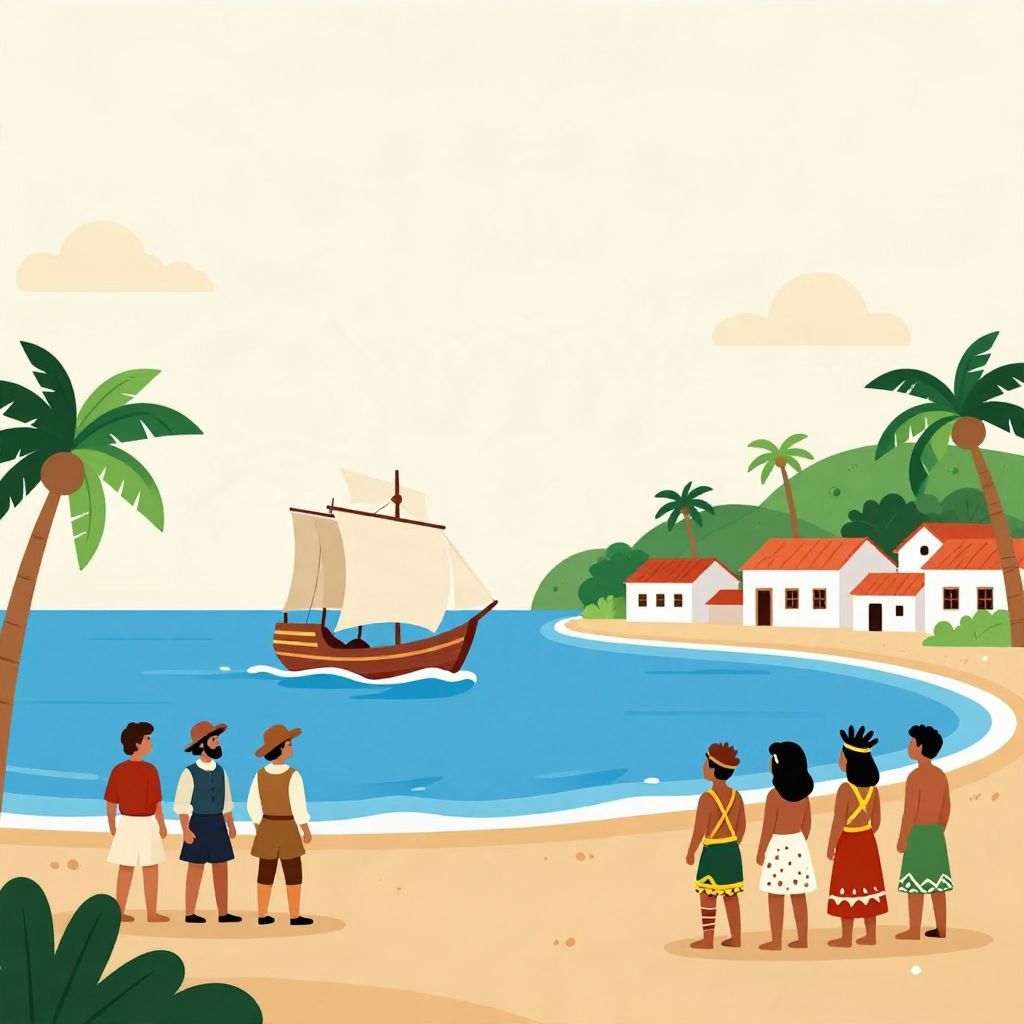
Why do Brazilians speak Portuguese? The short answer is that Brazil was colonized by Portugal beginning in the early 1500s, and Portuguese became the language of government, settlement, trade, and eventually national identity. Unlike most of Spanish-speaking Latin America, Brazil developed under Portuguese rule for more than three centuries, which gave Portuguese a lasting advantage over Indigenous and African languages.
That outcome was not automatic. Brazil’s language history was shaped by conquest, migration, religion, slavery, and state policy. The Portuguese language spread unevenly at first, then gradually became dominant as colonial institutions expanded and the independent Brazilian state later made it the shared public language of a vast and diverse population.
Why do Brazilians speak Portuguese?
Brazilians speak Portuguese because Portugal claimed Brazil in 1500 and ruled it as a colony until 1822. Over time, Portuguese became the language of administration, landholding, Catholic missions, commerce, and education. After independence, Brazil kept Portuguese as its national language, and it spread across a huge territory through settlement, schooling, and state power.
How Portugal came to Brazil
The story begins with the Portuguese arrival in 1500, when the expedition of Pedro Álvares Cabral reached the Brazilian coast. Portugal’s claim to the region was later reinforced by the Treaty of Tordesillas (1494), which divided newly explored lands between Portugal and Spain in theory, though the realities on the ground were far more complicated.
At first, Portugal did not immediately control all of Brazil. Early colonial presence was limited to coastal settlements, trading posts, and extraction of valuable resources such as brazilwood. But over the 1500s and 1600s, Portugal built a more durable colonial system. That system brought Portuguese-speaking settlers, officials, clergy, and merchants into permanent contact with Indigenous peoples and, later, enslaved Africans.
Colonization was slow, but language followed power
In many colonies, the dominant language is not simply the one spoken by the first Europeans to arrive; it is the one tied to institutions that endure. In Brazil, Portuguese was the language of colonial law, land grants, church administration, and imperial authority. Even where most people did not speak it at home, it mattered in public life.
That pattern is important because Brazil was never linguistically uniform. Indigenous languages remained widely used for generations, and many enslaved Africans brought to Brazil spoke different languages among themselves. Portuguese spread because it became the language people needed to use in order to deal with colonial authorities, urban life, and later the national state.
The role of Indigenous peoples and the “general language”
Before Portuguese became dominant, Brazil was home to hundreds of Indigenous languages. Many communities belonged to the Tupi-Guarani language family, especially along the coast. In the first centuries of colonization, some missionaries and settlers even used an Indigenous-based lingua franca, often called Língua Geral or “general language,” to communicate across groups.
This is one reason the language history of Brazil is more complex than a simple “Portugal arrived and everyone immediately spoke Portuguese” story. In some regions, particularly in the early colonial period, Indigenous languages were very influential. Jesuit missionaries often learned local languages to evangelize and administer missions, and in some areas Indigenous speech remained dominant for a long time.
Why Portuguese eventually won out
Portuguese gradually displaced other languages because it had state backing. As settlements expanded inland, as mixed communities formed, and as colonial institutions became more centralized, Portuguese increasingly became the language of social advancement. Indigenous languages survived, and many still do today, but they were pushed to the margins of official life.
In the 18th century, the Portuguese crown took stronger steps to standardize language use. The most famous example is the Marquês de Pombal, whose reforms in the mid-1700s promoted Portuguese and restricted the use of Indigenous languages in colonial administration and education. These policies did not erase linguistic diversity, but they did strengthen Portuguese as the language of the state.
Slavery and the making of Brazilian Portuguese
Another major reason Brazilians speak Portuguese is the history of the Atlantic slave trade. From the 1500s through the 1800s, Brazil received the largest number of enslaved Africans in the Americas. People brought from different African regions spoke many languages, and in Brazil they had to communicate across ethnic and linguistic boundaries as well as with Portuguese speakers.
This contact shaped Brazilian society and the Portuguese language itself. Brazilian Portuguese absorbed many words from Indigenous and African languages, especially in food, music, religion, daily life, and place names. So while Portuguese became dominant, the version spoken in Brazil was not identical to the Portuguese of Lisbon. It developed in a colonial society deeply marked by Indigenous and African influence.
A language of domination, but also of mixing
It is important not to imagine Portuguese as simply “imposed” in a neat way. Colonial Brazil produced widespread linguistic mixing. Enslaved people, free people of color, Indigenous communities, settlers, and mixed-heritage populations all interacted in different settings. Portuguese became the common language not because Brazil was culturally uniform, but because it was the most useful shared language in a hierarchical colonial world.
Over time, this produced a large Portuguese-speaking population that was socially diverse. By the late colonial period, Portuguese was no longer just the language of a small European elite. It had become the main language of urban centers, regional administration, and much of everyday life.
Why Brazil did not become Spanish-speaking like most of Latin America
Many people ask why Brazil speaks Portuguese while neighboring countries speak Spanish. The answer lies in European imperial rivalry. Spain and Portugal divided the non-European world between them through papal agreements and later treaties, but those lines were often contested. Brazil fell within Portugal’s sphere of influence, so Portuguese officials, settlers, and institutions shaped the colony.
This does not mean the boundary was fixed from the start. In practice, colonial borders shifted over time as settlers moved, expeditions pushed inland, and rival claims overlapped. But because Portugal held Brazil, the language of the colonial state was Portuguese rather than Spanish.
Different empires, different language outcomes
- Portuguese Brazil: ruled by Portugal, so Portuguese became the official and dominant language.
- Spanish America: ruled by Spain, so Spanish became the main language of government and settlement.
- Border regions: often multilingual, with Indigenous, African, Portuguese, and Spanish influences overlapping.
Language in the Americas often followed empire more than geography. Brazil is the clearest example in South America of how colonial borders could produce a different linguistic map from the one we might expect based on proximity alone.
Independence did not change the language
Brazil became independent in 1822, but independence did not replace Portuguese with another language. In fact, keeping Portuguese made practical sense. It was already the language of government, law, print culture, and elite education. Changing the national language would have been nearly impossible in a country as large and regionally varied as Brazil.
Instead, the new Brazilian Empire preserved Portuguese as the language of the state. Over the 19th century, schools, newspapers, courts, and national institutions helped make Portuguese even more central. As immigration increased later in the century, new language communities arrived, but Portuguese remained the common national language.
The nation-building effect
After independence, Portuguese became more than a colonial inheritance. It turned into a symbol of Brazilian unity across a vast territory. That mattered because Brazil was, and remains, enormous, with many regional identities and a long history of internal diversity. A single official language helped the state govern, educate, and communicate across distance.
At the same time, the national language did not erase regional accents, vocabulary, or local speech patterns. Brazilian Portuguese developed its own character, distinct from European Portuguese in pronunciation, grammar, and everyday usage, while still remaining clearly the same language.
How Brazilian Portuguese became distinct
Brazilian Portuguese is not just Portuguese spoken with a different accent. It reflects centuries of contact with Indigenous languages, African languages, and later immigrant languages such as Italian, German, Japanese, and Arabic in particular regions. The result is a national language with strong internal variation and a rich vocabulary shaped by Brazil’s history.
Some differences from European Portuguese are easy to hear, especially in pronunciation and rhythm. Others appear in vocabulary and everyday expressions. These differences developed gradually, not through a single event. They are the product of long separation, local innovation, and the social history of Brazil itself.
Examples of historical language influence
- Indigenous influence: words for plants, animals, foods, and places.
- African influence: vocabulary connected to religion, cuisine, music, and daily life.
- European immigration: regional language contact in the 19th and 20th centuries.
This is why Brazilian Portuguese is both a colonial legacy and a distinctly Brazilian creation. It came from Portugal, but it was remade in Brazil.
What the language history of Brazil tells us
The fact that Brazilians speak Portuguese is a reminder that language follows history, not just geography. Brazil’s linguistic identity was formed by empire, slavery, missionary activity, settlement, and state-building. Portuguese became dominant because it was attached to power, and it remained dominant because the independent nation kept using it.
At the same time, Brazil’s language history should not be reduced to a simple European story. Indigenous languages were there first and remain important today in many communities. African peoples profoundly shaped Brazilian society and speech. The Portuguese language in Brazil is therefore the result of conquest and survival, but also of adaptation and cultural mixing.
Conclusion
Brazilians speak Portuguese because Brazil was colonized by Portugal, and Portuguese became the language of colonial rule, public life, and later national unity. Over centuries, it spread across a diverse society shaped by Indigenous peoples, enslaved Africans, and immigrants. The result is a Portuguese-speaking nation with a language history unlike any other in the Americas. For related background, see why Brazil speaks Portuguese and why Mexicans speak Spanish.