
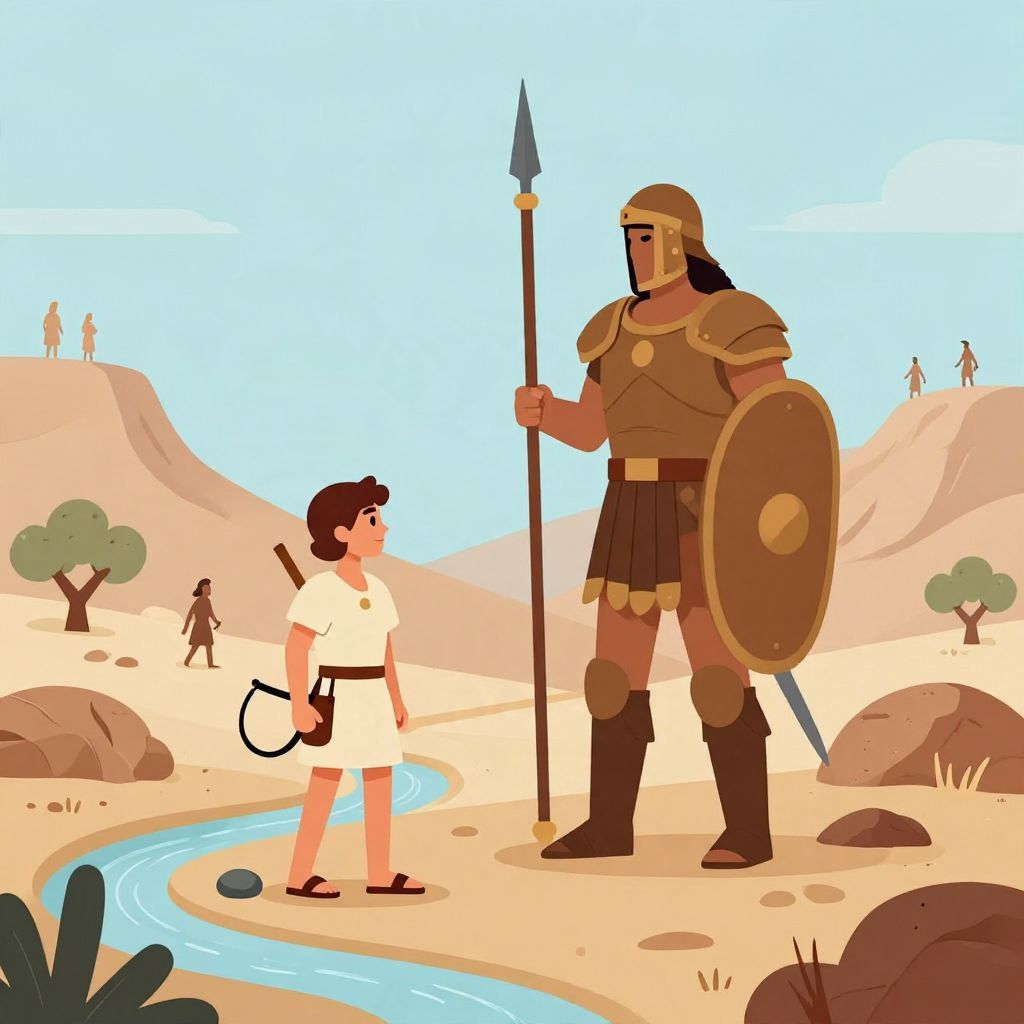
How old was David when he fought Goliath? The Bible does not give a precise age, so historians and readers have to infer it from the story’s timeline. The most common estimate is that David was a teenager, likely in his mid-teens, though some traditions imagine him as a young adult.
That uncertainty matters because the David and Goliath story is not just about a dramatic battle. It is also about how biblical texts present youth, courage, kingship, and divine favor in ancient Israel.
How old was David when he fought Goliath?
David was probably a teenager, often estimated at about 15 to 17 years old, when he fought Goliath. The biblical text never states his exact age, so this is an informed approximation based on the narrative context, his role as a shepherd boy, and the age range implied by his later rise to public life.
Why historians cannot give an exact age
The Book of Samuel does not say, “David was X years old.” Instead, it describes him as the youngest son of Jesse, tending sheep and bringing supplies to his brothers at the front. In the ancient world, that kind of work often fell to adolescents or young men who were not yet established adults.
Because the text is literary and theological as well as historical, scholars are careful not to force a precision the source does not provide. The safest conclusion is that David was young enough to be underestimated, but old enough to travel, carry provisions, and act independently.
Why “teenager” is the most common estimate
Several clues point toward a teenage David. First, he is repeatedly identified as the “youngest” son. Second, Saul treats him as inexperienced compared with a trained warrior. Third, the story emphasizes his youth in contrast to Goliath’s size, armor, and battlefield reputation.
In many ancient societies, the transition from childhood to adulthood did not follow modern age categories. A boy could be expected to work, guard animals, or serve his family while still being considered young. That makes a mid-teen estimate plausible, even if it cannot be proven.
The biblical timeline behind David and Goliath
The David and Goliath episode appears in 1 Samuel 17, within the larger narrative of Israel’s move from the judges to the monarchy. David is introduced as a shepherd in Bethlehem, then brought to Saul’s camp, where he defeats Goliath in single combat. The text presents this as the moment David first becomes widely known.
Key events in sequence
- David is introduced as the youngest son of Jesse and a shepherd.
- Samuel anoints David as the future king in an earlier chapter.
- Saul’s army faces the Philistines in the Valley of Elah.
- Goliath challenges Israel to send a champion.
- David volunteers, rejects Saul’s armor, and uses a sling and stone.
- David defeats Goliath, and the Philistine army flees.
This sequence is important because David’s age is tied to his social position. He is not yet a king, a commander, or even a fully recognized warrior. He is the overlooked youngest son whose victory reverses expectations.
How long after the anointing did the battle happen?
That is another point of uncertainty. The biblical books do not provide a clean, continuous chronology. In some readings, David’s anointing and his fight with Goliath happen relatively close together. In others, there may be a longer gap, with David already serving at Saul’s court by the time of the battle.
Because the text was compiled from traditions with different emphases, scholars debate how to harmonize the timeline. What remains consistent is the narrative logic: David’s rise begins while he is still very young and socially insignificant.
What the story suggests about David’s age and status
David’s age in the Goliath story is less about a birthdate than about status. The text wants readers to see him as small, inexperienced, and underestimated. His youth heightens the contrast with Goliath, whose strength, armor, and battlefield role symbolize conventional military power.
Shepherd, youth, and vulnerability
Ancient shepherding was not a romantic pastime. It was labor, often done by the young or by those with limited status in the household. David’s work with sheep helps explain both his skill with a sling and his outsider position in his family and in Saul’s army.
That does not mean he was a child in the modern sense. He could have been physically capable, hardened by outdoor work, and accustomed to danger from predators. Still, the story clearly frames him as too young or too low-ranking to be taken seriously by others.
Why Saul’s reaction matters
Saul initially doubts David because he is “but a youth” in comparison with Goliath. This reaction is one of the strongest textual clues that David was not yet an adult soldier in the usual sense. The narrative deliberately uses Saul’s skepticism to sharpen the drama of the victory.
In literary terms, the story is built around reversal: the youngest defeats the giant, the shepherd defeats the warrior, and the one who seems least qualified becomes the instrument of Israel’s deliverance.
Was David a child, teenager, or young man?
Among readers, David is sometimes imagined as a child because the story is often told in simplified form. Historically and textually, that is probably too young. He was more likely an adolescent or young man—old enough for responsibility, but still clearly “young” by the standards of the narrative.
Why a child reading is less likely
A child would be less consistent with the tasks David performs. He travels to the battlefield, speaks confidently to Saul, handles weapons, and later becomes a figure of military and political importance. The text portrays him as young, not helpless.
That said, the Bible’s language about “youth” can be broad. It may refer to a person who is not yet fully established, rather than to a specific age bracket. This flexibility is one reason estimates vary.
Why some traditions picture him as older
Some later retellings make David older to emphasize his warrior status or to avoid the impression that a very young person defeated Goliath. But the original narrative works precisely because David is not yet a seasoned fighter. His age is part of the theological and literary message.
So while “young man” is possible, “teenager” remains the most widely accepted modern estimate for the historical question behind the story.
Historical context: Israel, the Philistines, and ancient warfare
The David and Goliath story belongs to the early Iron Age setting of Israel and the Philistines, roughly in the period often associated with the 11th century BCE, though exact dating is debated. The account reflects a world of tribal conflict, local kingship, and prestige battles between champions.
The Philistines and their military strength
The Philistines were one of Israel’s main rivals in the southern Levant. In biblical tradition, they are associated with organized military power and iron weapons. Goliath represents that advantage in exaggerated form, standing as a symbol of enemy intimidation.
Whether Goliath was literally as large as later tradition suggests is also debated. The biblical text presents him as extraordinarily tall, but ancient manuscripts preserve slightly different measurements. Even so, the story’s main point is clear: he is meant to appear overwhelming.
Single combat as a dramatic device
Ancient literature often used champion combat to symbolize larger conflict. One representative warrior could stand for an entire people. In that setting, David’s age matters because it makes the victory even more surprising: the least likely candidate becomes the decisive champion.
This does not mean the story is only symbolic. It is rooted in the historical memory of conflict between Israel and the Philistines. But the narrative is shaped to teach more than battlefield facts.
How David’s youth shaped his later rise
The Goliath episode becomes a turning point in David’s life. After the victory, he enters a new stage of public recognition. His reputation grows, Saul becomes increasingly threatened, and David’s path toward kingship begins to unfold.
From obscure son to national figure
Before the battle, David is known mainly within his family. Afterward, he becomes a figure of national importance. The story uses his youth to highlight that his rise is unexpected and, in the biblical interpretation, divinely guided.
This is one reason the question of age remains so popular. Readers want to know how young David was because his age helps explain the magnitude of the transformation: from shepherd boy to celebrated warrior and future king.
Why the age question still matters
For historians, the exact number is less important than what the narrative reveals about ancient ideas of leadership. David’s youth underscores a recurring biblical theme: legitimacy does not always come from age, status, or appearance. It can come from courage, skill, and divine election.
For modern readers, that theme explains why the story continues to resonate. David’s age is not merely trivia; it is part of the story’s meaning.
So what is the best answer?
The best historically careful answer is that David was probably a teenager, likely in his mid-teens, when he fought Goliath. The Bible does not provide an exact age, and later tradition sometimes imagines him differently, but the strongest reading of the text points to a young shepherd on the edge of adulthood.
In other words, David was old enough to act with confidence, but young enough that his victory felt astonishing. If you want to place the event in David’s broader life story, you may also find it useful to read about when King David lived and how old David was when he became king. The Goliath story begins with a youth, but it ends with the making of a king.