
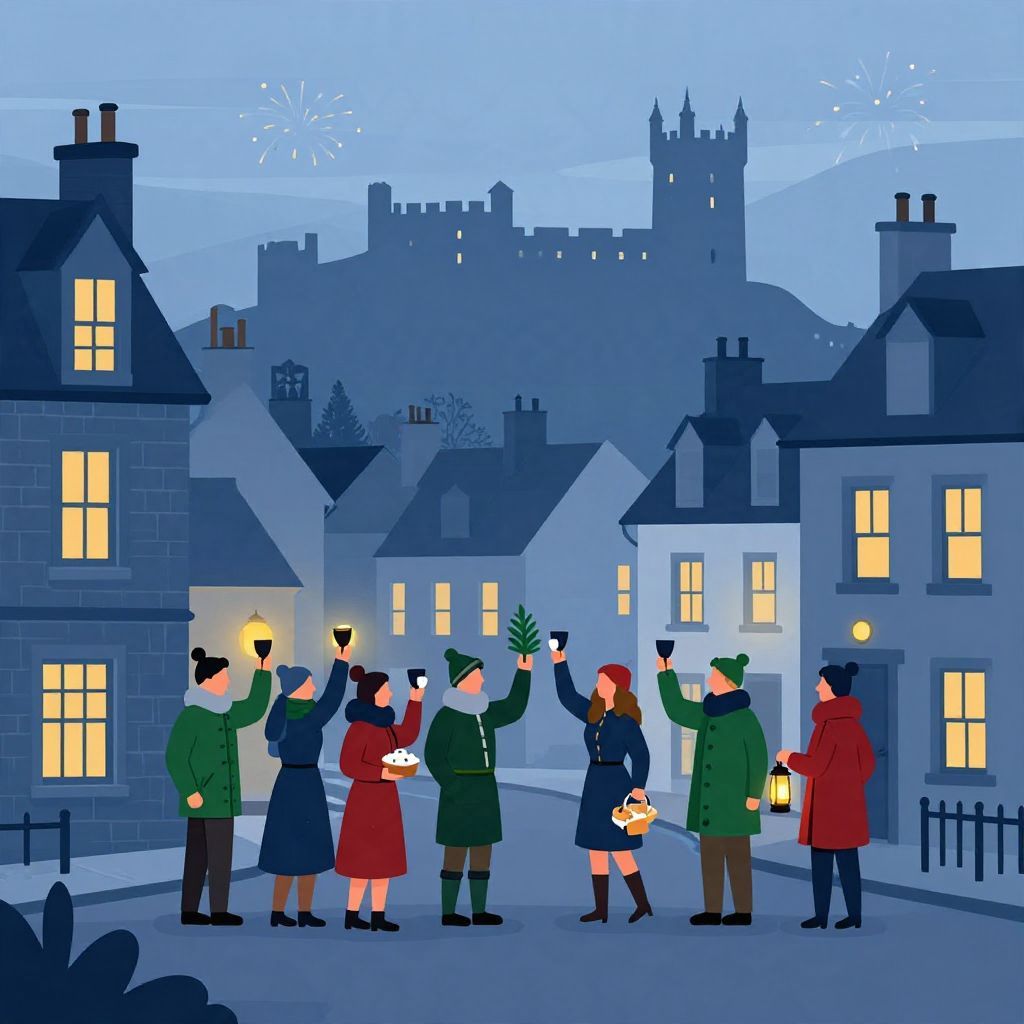
What is Hogmanay? It is the Scottish name for the celebrations that mark the end of the old year and the beginning of the new, especially on New Year’s Eve and New Year’s Day. Today it is associated with fireworks, street parties, music, and customs such as first-footing, but its roots are older and more complex than any single festival.
Hogmanay blends local Scottish tradition, wider British New Year customs, and influences from the Norse, Gaelic, and later Christian calendar. Its exact origin is debated, but its long history shows how communities shaped the turning of the year into a public ritual of welcome, luck, and renewal.
What is Hogmanay?
Hogmanay is the Scottish term for New Year’s Eve and the celebrations surrounding the New Year. It is both a date and a set of customs, including visiting neighbors, exchanging good wishes, singing “Auld Lang Syne,” and the practice of first-footing, when the first visitor after midnight is thought to bring luck for the year ahead.
Where does the word “Hogmanay” come from?
The word’s origin is uncertain, and historians and linguists have proposed several explanations. The term appears in Scottish records by the late 16th and 17th centuries, but it may be older. No single origin has been universally accepted, which makes Hogmanay a good example of how popular traditions can survive even when their names remain partly mysterious.
Possible linguistic roots
- French influence: Some scholars connect it to Norman French or other French New Year expressions, possibly brought through medieval contact with France.
- Gaelic or Scots forms: Others suggest a development from words used in Scots or Gaelic-speaking areas.
- Norse connections: Because parts of Scotland had strong Norse influence, some have looked for Scandinavian links, though the evidence is not decisive.
In short, “Hogmanay” likely reflects centuries of cultural contact in Scotland rather than a single clear source. The uncertainty itself is historically important: it shows how oral custom can outlast precise documentation.
How old is Hogmanay?
Hogmanay as a named celebration is early modern, but its deeper roots may reach back much further. Scotland’s New Year customs developed over time from a mixture of seasonal observance, local social practice, and religious change. The festival became especially important after the Protestant Reformation, when Christmas was downplayed in Scotland and New Year gained greater public prominence.
The impact of the Reformation
In Scotland, the Reformation of the 16th century reshaped the religious calendar. Christmas was not celebrated with the same public emphasis as in some other European countries, and New Year customs became more significant in domestic and communal life. This helped make Hogmanay a major seasonal occasion.
New Year after the calendar change
Another key development was the shift from the Julian to the Gregorian calendar. Britain and its dominions adopted the Gregorian calendar in 1752, which altered the dating of the new year and everyday timekeeping. By then, however, Hogmanay customs were already established in Scottish life, and they continued to evolve rather than disappear.
What are the main Hogmanay customs?
Hogmanay is not one fixed ceremony but a cluster of traditions. Some are household customs, others are public festivities. Their shared purpose is to symbolically clear away the old year and welcome the new one with warmth, hospitality, and good fortune.
First-footing
One of the best-known customs is first-footing. After midnight, the first person to enter a home is believed to influence the household’s luck for the year. Traditionally, a “good” first-footer was often a dark-haired man carrying symbolic gifts such as coal, bread, salt, whisky, or shortbread. These items represented warmth, food, prosperity, and hospitality.
“Auld Lang Syne”
Many people around the world sing “Auld Lang Syne” at midnight, but it is strongly associated with Scotland and Hogmanay. The song was collected and popularized by Robert Burns in the late 18th century, though the phrase itself was older. It expresses remembrance, friendship, and the idea of old acquaintances being honored as the year turns.
House cleaning and “redding up”
In some Scottish households, people traditionally cleaned the house before New Year’s Eve. This was more than practical tidying; it was a symbolic clearing away of the old year’s disorder. In parts of Scotland, this was called “redding up,” meaning putting things in order.
Visiting and gifts
Hogmanay has long involved visiting friends and neighbors, sharing food and drink, and exchanging good wishes. In older rural communities, this social round could be especially important because winter was a time when communal ties mattered deeply. The custom reinforced neighborliness and mutual support.
How did Hogmanay become such a major celebration?
Hogmanay grew in importance because it filled a social and cultural space that Christmas did not fully occupy in post-Reformation Scotland. Over time, it became a major public holiday, especially in the 19th and 20th centuries, when urban celebrations, railway travel, and later mass media helped spread and standardize the festival.
Urbanization and public festivities
As Scottish towns and cities expanded, Hogmanay moved beyond the home. Public gatherings, concerts, and street celebrations became more common. Edinburgh, in particular, developed a strong modern reputation for large-scale Hogmanay events, though celebrations also took place across the country in different local forms.
The role of migration and identity
Scottish migrants carried Hogmanay customs abroad, especially to places with Scottish communities in North America, Australia, and New Zealand. In these settings, the festival became a marker of cultural identity as well as a New Year observance. Like many traditions, it adapted to new places while retaining recognizable elements.
Is Hogmanay the same as New Year’s Eve?
Not exactly. Hogmanay refers to the Scottish New Year celebration, but it is broader than a single evening. It includes the lead-up to midnight, the first moments of the new year, and sometimes New Year’s Day itself. In practice, it can mean both the festival and the social customs attached to it.
How it differs from other New Year traditions
- It has a distinctly Scottish name and cultural identity.
- It emphasizes hospitality and first-footing more than some other New Year customs.
- It is closely tied to songs, visits, and symbolic household rituals.
At the same time, Hogmanay is not entirely separate from wider European New Year traditions. Many societies mark the year’s turning with feasting, purification, gift-giving, or symbolic luck rituals. Hogmanay is Scotland’s distinctive version of a very old human habit.
What is the historical significance of Hogmanay?
Hogmanay matters because it shows how traditions survive by changing. It is not an ancient festival frozen in time. Instead, it is a living custom shaped by religion, language, migration, and modern celebration. Its history reveals how Scots adapted the New Year into a powerful expression of community and continuity.
Why historians find it interesting
Hogmanay is useful to historians because it sits at the intersection of folklore and documented social history. Some parts, such as first-footing and household visits, may be older than the written record. Others, such as modern public festivals and televised celebrations, are recent developments. Together they show how traditions are built layer by layer.
Folklore and evidence
It is important to separate what is well documented from what is popularly repeated. We know that Hogmanay has been celebrated in Scotland for centuries and that customs like first-footing and New Year visiting are real and longstanding. But the precise origin of the word, and the exact age of some customs, remain uncertain. That uncertainty does not weaken the tradition; it makes it historically richer.
Hogmanay today
Today, Hogmanay is both a family-centered and a public celebration. Many Scots still observe it at home with food, music, and visits, while cities host concerts, fireworks, and large gatherings. Edinburgh’s modern Hogmanay events have become internationally known, but the festival remains rooted in local custom and personal hospitality.
In contemporary Scotland, Hogmanay also serves as a cultural symbol. It connects modern life to older patterns of seasonal celebration, while allowing each generation to reinterpret what the New Year should mean. That combination of continuity and change is one reason the tradition remains so powerful.
Key facts about Hogmanay
- Meaning: Scottish New Year celebrations, especially New Year’s Eve and New Year’s Day.
- Main customs: first-footing, visiting, singing, gift-giving, and welcoming the new year.
- Famous song: “Auld Lang Syne,” associated with Robert Burns.
- Historical context: strengthened by Scotland’s post-Reformation culture and later urban celebration.
- Word origin: uncertain, with several competing theories.
So, what is Hogmanay? It is Scotland’s distinctive New Year tradition: a blend of old customs, social ritual, and national identity that has endured because it keeps adapting. For readers interested in the broader setting of customs and social life, see also what is a culture and what is a tradition.