
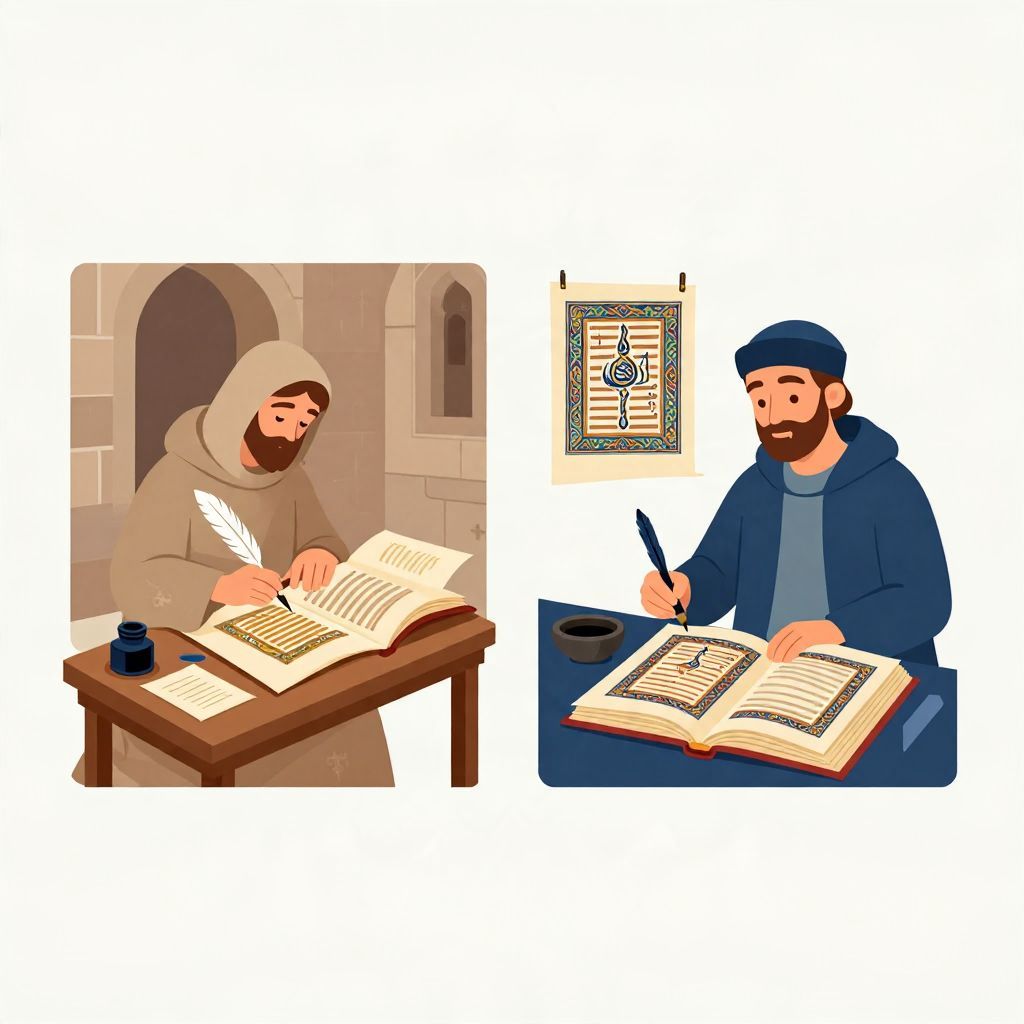
Illuminated manuscripts are among the most beautiful hand-made books in history, famous for gold leaf, vivid pigments, and intricate decoration. But when people ask which two religious faiths most historically created and used them, the answer points above all to Christianity and Islam.
These traditions developed rich manuscript cultures for sacred texts, prayer books, scholarship, and courtly display. While other religions also produced decorated manuscripts, Christianity and Islam are the two faiths most closely associated with the great historical traditions of illumination in Europe, the Middle East, and beyond.
Illuminated manuscripts have historically been created and used by which two religious faiths?
The two religious faiths most historically associated with illuminated manuscripts are Christianity and Islam. Christian scribes and artists illuminated Bibles, psalters, and prayer books, while Muslim bookmakers decorated Qur’ans and other devotional and scholarly works. Both traditions treated the written word as sacred and worthy of exceptional artistic care.
Why these two faiths developed manuscript illumination
Illuminated manuscripts grew out of religious cultures that valued texts as carriers of divine truth. In both Christianity and Islam, careful copying was an act of devotion, learning, and prestige. Decoration helped honor the sacred text, guide reading, and signal the importance of the book’s owner, whether a monastery, mosque, ruler, or wealthy patron.
The role of sacred texts
In Christianity, the Bible and liturgical books were central to worship, teaching, and monastic life. In Islam, the Qur’an held unique authority as the revealed word of God, and its transcription became a highly respected art. In both cases, manuscripts were not merely practical objects; they were spiritual artifacts meant to embody reverence.
Materials and craftsmanship
Illumination usually involved expensive materials and specialized labor. Scribes copied the text by hand, then artists added initials, borders, miniature scenes, geometric patterns, or gold highlights. The work could take months or years. Because the process was so labor-intensive, illuminated manuscripts were often produced for churches, courts, mosques, and elite private libraries rather than ordinary households.
Illuminated manuscripts in Christianity
Christian manuscript illumination became especially important in late antiquity and the Middle Ages, roughly from the 4th century onward. Monasteries, cathedral schools, and later urban workshops produced lavishly decorated Bibles, Gospel books, psalters, missals, and books of hours. These books supported worship, private devotion, and the preservation of learning across medieval Europe.
Early Christian and medieval traditions
One of the earliest major Christian manuscript traditions developed after the Roman Empire embraced Christianity. As parchment replaced papyrus and the codex replaced the scroll, Christian books became larger, more durable, and more visually elaborate. Gospel books were often the most richly decorated because they contained the words of Christ and the evangelists.
By the early Middle Ages, illuminated manuscripts had become a defining feature of Christian artistic culture. Insular manuscripts from Ireland and Britain, such as the Book of Kells and the Lindisfarne Gospels, are famous for their complex knotwork, animal forms, and brilliant color. Later, Romanesque and Gothic manuscript art expanded the range of imagery, from biblical scenes to marginal humor and elaborate initials.
What Christian manuscripts were used for
- Bibles for reading and study
- Gospel books for liturgical use
- Psalters for prayer and devotion
- Missals and breviaries for church services
- Books of hours for lay private devotion
Illumination in Christian manuscripts was not only decorative. It organized the text, marked important passages, and helped readers navigate long books in an age before printed indexes and standardized page design. Richly decorated manuscripts also reflected the authority of the Church and the status of patrons who could afford them.
Illuminated manuscripts in Islam
Islamic manuscript culture also produced extraordinary illuminated books, especially from the 8th century onward. The most important of these were Qur’ans, copied with great precision and decorated with geometric, vegetal, and calligraphic ornament. Over time, Islamic manuscript art also flourished in works of poetry, science, history, and court literature.
The Qur’an and the art of calligraphy
Because the Qur’an is the revealed word of God in Islam, its written form received exceptional reverence. Calligraphy became one of the highest arts in Islamic civilization, and manuscript decoration often emphasized the beauty of the script itself. Gold medallions, illuminated chapter headings, and intricate page borders helped distinguish sacred text from ordinary writing.
Unlike many Christian manuscripts, Islamic illumination often avoided figural imagery in Qur’anic manuscripts, especially in sacred contexts. Instead, artists developed sophisticated abstract and floral designs. This was not a single universal rule across all times and places, but it was a strong and influential trend in the decoration of religious manuscripts.
Beyond sacred texts
Islamic illuminated manuscripts were not limited to the Qur’an. Courts and scholars commissioned richly decorated copies of poetry, astronomy, medicine, philosophy, and history. Persian manuscript painting, for example, became famous for its miniatures, while Ottoman, Mamluk, and Mughal workshops produced highly refined books that combined calligraphy, ornament, and narrative illustration.
Common uses in Islamic societies
- Qur’ans for recitation and devotion
- Prayer and devotional texts
- Poetry collections for elite literary culture
- Scientific and historical works for teaching and scholarship
- Royal and court manuscripts as symbols of patronage and power
How Christian and Islamic manuscript traditions differed
Christian and Islamic illuminated manuscripts shared a respect for sacred writing, but their artistic styles and functions often differed. Christian manuscripts frequently included narrative scenes from the Bible, portraits of evangelists, and decorated initials. Islamic manuscripts, especially Qur’ans, often emphasized calligraphy and non-figural ornament, though secular books could be richly illustrated.
Different visual priorities
Christian illumination often used images to teach biblical stories and support devotion. In many Islamic manuscripts, the beauty of the script itself carried the primary visual weight, especially in religious texts. Both traditions, however, used color, gold, and design to elevate the book beyond ordinary writing.
Different centers of production
Christian manuscript production was closely tied to monasteries, cathedral scriptoria, and later urban workshops in Europe. Islamic manuscript production flourished in courts, madrasas, libraries, and commercial workshops across the Middle East, North Africa, Central Asia, and South Asia. In both traditions, patronage mattered: rulers, bishops, scholars, and wealthy donors helped finance the work.
What illuminated manuscripts reveal about religious history
Illuminated manuscripts show that books were once handcrafted objects of enormous value. They reveal how religion shaped literacy, art, and power. In both Christianity and Islam, the act of copying and decorating a text could be devotional, educational, and political at the same time. Manuscripts were tools of worship, but also symbols of authority and cultural refinement.
Preservation of knowledge
These manuscripts helped preserve sacred and secular learning through centuries of change. Christian monasteries copied classical and religious texts that survived the fall of the Western Roman Empire. Islamic scholars and scribes preserved and expanded knowledge in theology, medicine, mathematics, astronomy, and literature. The manuscript tradition was therefore central to the transmission of ideas across generations.
Art, faith, and status
Illuminated manuscripts also remind us that religious art was never only about belief. It was shaped by economics, court culture, technology, and access to skilled labor. A manuscript might serve worship in a church or mosque, but it could also display the wealth and sophistication of its owner. That dual purpose helped drive the creation of some of the finest books ever made.
Other religious traditions and the broader context
Although Christianity and Islam are the two main faiths historically linked to illuminated manuscripts, they were not the only ones to produce decorated sacred books. Jewish manuscript art, including illuminated Hebrew Bibles and Haggadot, is also significant, especially in medieval Europe and the Islamic world. Buddhist, Hindu, and other traditions likewise developed manuscript arts in different regions.
Still, if the question is which two religious faiths are most historically associated with illuminated manuscripts, the clearest answer remains Christianity and Islam. Their manuscript cultures were vast, long-lasting, and deeply influential in the history of art and religion.
Lasting significance of illuminated manuscripts
Today, illuminated manuscripts are treasured in museums, libraries, and religious collections around the world. They are studied for their calligraphy, pigments, iconography, and historical context. More importantly, they remind us that before printing, books were made by hand and could take on profound spiritual meaning. In both Christianity and Islam, the illuminated manuscript became a meeting point of devotion, knowledge, and artistic excellence.
The historical answer is therefore clear: illuminated manuscripts were most prominently created and used by Christianity and Islam. If you want to explore related religious text history, you may also find it useful to read about the original language of the Bible.