
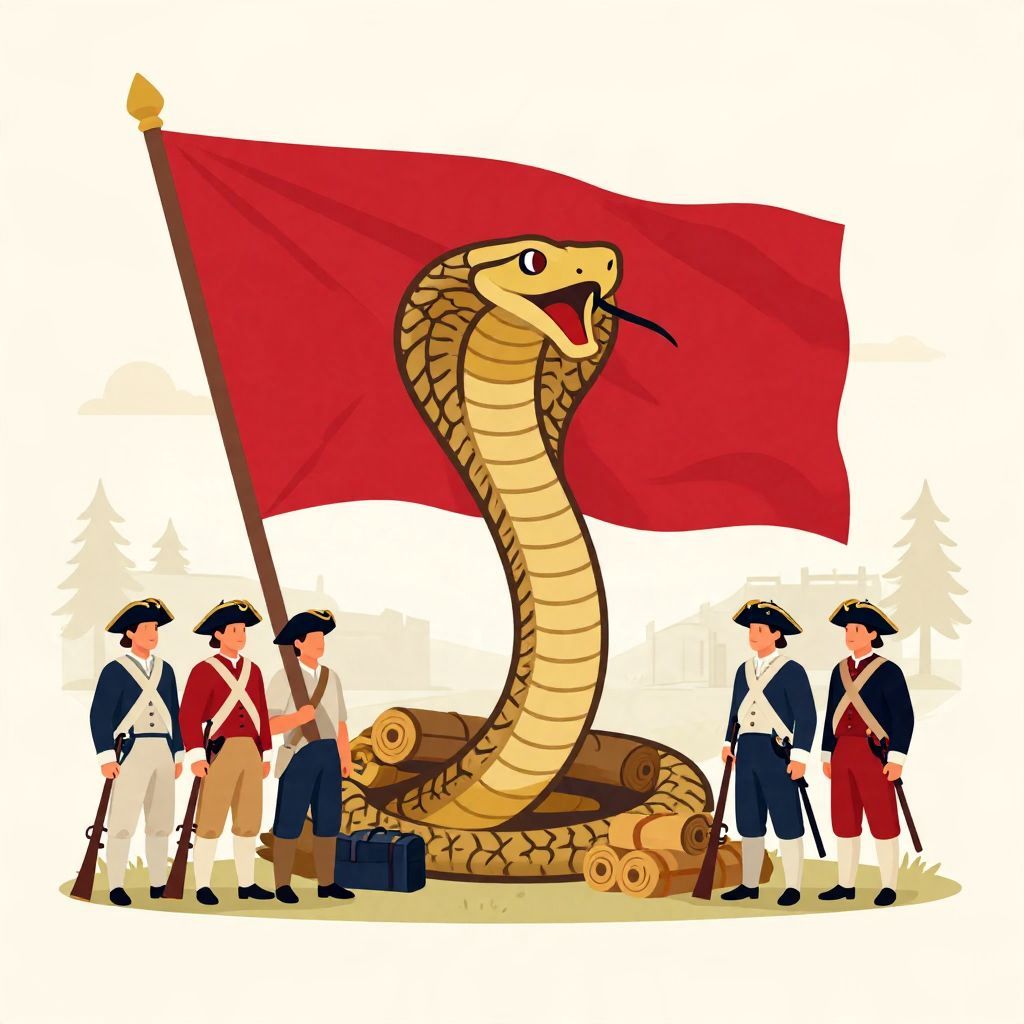
“Don’t Tread on Me” is a warning, a political slogan, and a symbol of resistance. Most people know it from the Gadsden flag: a coiled rattlesnake on a yellow field with the words beneath it. Historically, it expressed the American colonists’ determination not to be bullied by Britain during the Revolutionary era.
Its meaning has changed over time. Today it can signal patriotism, anti-government sentiment, individual liberty, or, in some contexts, political protest. To understand it well, you have to look at its origins in the 18th century and how later generations reused it.
What does “Don’t Tread on Me” mean?
“Don’t Tread on Me” means “do not oppress, provoke, or interfere with me.” In its original American context, it was a warning that colonists would resist British authority if pushed too far. The phrase became famous through the Gadsden flag, designed in 1775 during the American Revolution as a symbol of defiance and vigilance.
Where did the phrase come from?
The phrase is closely tied to the political language of the American Revolution, but its deeper roots are older. The image of a snake warning an enemy not to step on it came from a popular colonial cartoon tradition. The best-known version appeared during the imperial crisis between Britain and the American colonies, when resistance to taxation and military control was growing.
Benjamin Franklin and the snake symbol
Benjamin Franklin helped make the rattlesnake a political image in colonial America. In 1754, he published a cartoon in Pennsylvania Gazette showing a segmented snake labeled “Join, or Die,” urging colonial unity. By the 1770s, the rattlesnake had become a distinctly American symbol, often associated with alertness, danger, and retaliation against threats.
The snake was not meant as a compliment to Britain. It was a warning: if you step on this creature, it will strike back. That idea fit the revolutionary mood well.
The Gadsden flag and the Revolutionary War
The phrase is most famously linked to the Gadsden flag, designed in 1775 by Christopher Gadsden, a South Carolina patriot and military officer. The flag featured a coiled rattlesnake and the words “Don’t Tread on Me.” It was used during the early years of the Revolution, especially in naval and military contexts.
Gadsden presented the flag to the Continental Navy, where it served as a bold statement of colonial resistance. The design reflected a new political identity: the colonies were no longer asking merely for compromise, but were preparing to defend their rights by force if necessary.
Why a rattlesnake?
The rattlesnake was chosen because it was widely seen as native to North America and dangerous only when threatened. Revolutionary-era writers and printers often described it as a fitting emblem for the colonies: not aggressive for no reason, but fierce when attacked. That made it a useful symbol for a movement that wanted to present itself as defensive rather than reckless.
In other words, the message was not “we seek conflict.” It was “we will not accept domination.”
What did it mean in the 18th century?
In the Revolutionary era, “Don’t Tread on Me” carried several related meanings:
- Resistance to tyranny — opposition to British policies seen as unjust.
- Defense of rights — especially political representation and local self-government.
- Warning and deterrence — a signal that coercion would be met with force.
- Colonial unity — the idea that the colonies should stand together against outside pressure.
It was not a formal constitutional slogan at the time, nor was it universally used by all Americans. Rather, it was one of several revolutionary symbols that helped shape public opinion and military identity.
How the meaning changed over time
After the Revolution, “Don’t Tread on Me” did not remain frozen in one meaning. Like many patriotic symbols, it was revived in later periods for different causes. In the 19th and 20th centuries, Americans used it to express a variety of political attitudes, from nationalism to local independence to opposition to federal power.
19th-century uses
During the 1800s, the phrase and the rattlesnake image appeared in political prints, militia symbols, and regional imagery. It was not always a dominant national emblem, but it remained available as a shorthand for American defiance. Different groups could adopt it while giving it their own emphasis.
20th-century revival
The Gadsden flag and its slogan gained renewed popularity in the late 20th century, especially among people interested in American founding history, gun rights, libertarian politics, and limited government. For some, the phrase came to mean personal liberty and resistance to state overreach. For others, it became a broader symbol of anti-establishment sentiment.
That flexibility is part of why the phrase remains powerful. It is short, memorable, and open to interpretation.
Is “Don’t Tread on Me” patriotic?
Yes, but patriotism here depends on how one defines the term. Historically, the phrase emerged from a revolutionary struggle to create a new nation. In that sense, it is deeply patriotic. At the same time, modern uses can be more complicated, because the slogan is sometimes associated with political movements that disagree sharply about what American liberty means.
So the phrase is patriotic in origin, but its modern use can signal different political identities. One person may see it as a tribute to the Revolution; another may see it as a general statement against authority.
What it does not mean
Despite its popularity, “Don’t Tread on Me” does not literally mean “do not walk on me.” It is metaphorical language. The “tread” in the phrase means to step on, crush, or oppress someone. It is about power, not footwear.
It also does not necessarily mean aggression for its own sake. In historical context, the slogan was more defensive than offensive. It warned against interference and coercion, rather than celebrating violence as a first resort.
Why the phrase still matters
The lasting appeal of “Don’t Tread on Me” comes from its combination of simplicity and force. It condenses a political idea into a few words: people have rights, and they may resist when those rights are threatened. That message was central to the American Revolution and remains relevant in modern debates about freedom, authority, and citizenship.
The phrase also shows how symbols evolve. What began as a revolutionary warning became a reusable emblem for later generations, each of whom attached new meanings to it. That is why the slogan can appear in very different political settings today.
Quick historical timeline
- 1754 — Benjamin Franklin’s “Join, or Die” cartoon helps popularize the snake as a colonial symbol.
- 1775 — Christopher Gadsden designs the flag that becomes associated with “Don’t Tread on Me.”
- American Revolution — The slogan functions as a warning against British oppression and a call for resistance.
- 19th century — The phrase appears intermittently in political and regional imagery.
- Late 20th century to present — The slogan is revived in debates over liberty, government power, and American identity.
Bottom line
“Don’t Tread on Me” originally meant that Americans would not submit to oppression or coercion, especially during the Revolutionary era. It is best understood as a warning of resistance, not a literal statement. Over time, the phrase became a flexible symbol of liberty, defiance, and political identity. For related symbolism in American history, see what the black American flag means and what a backwards American flag means.