
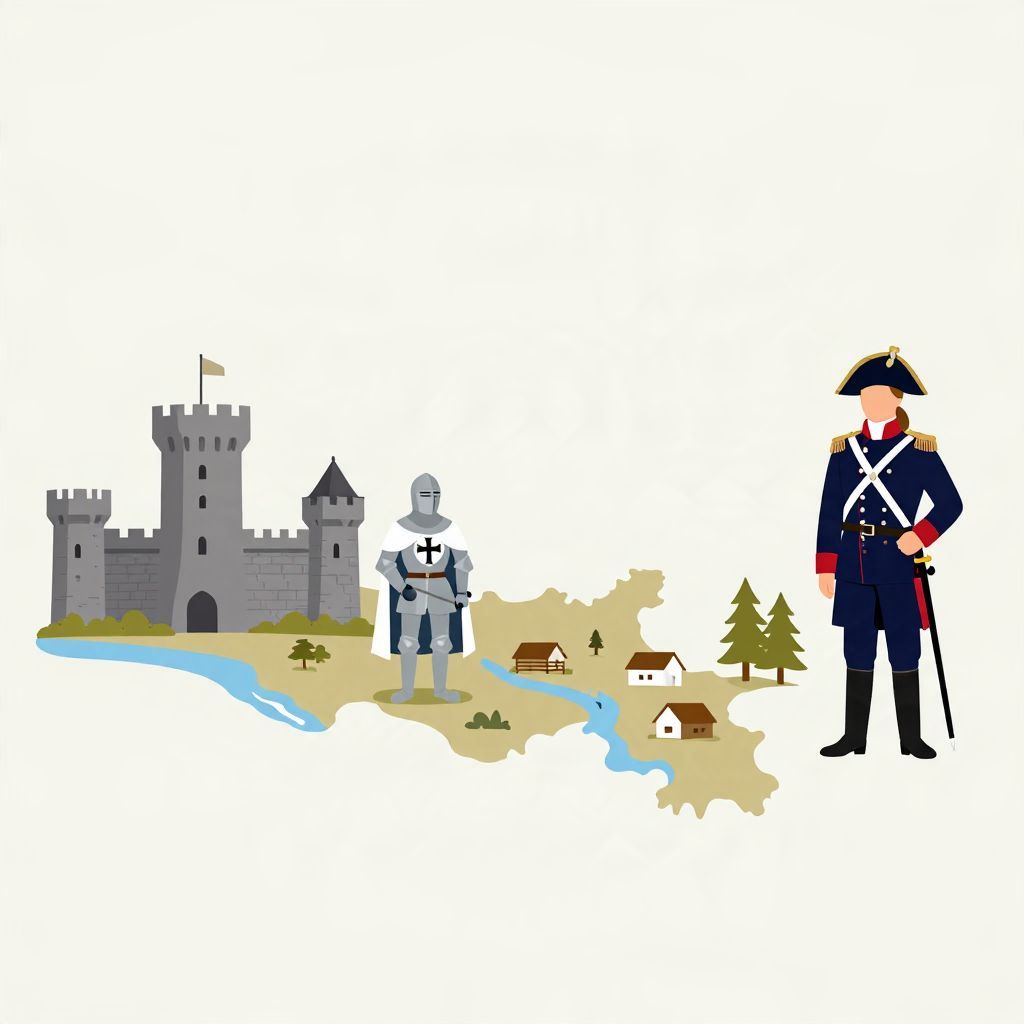
What was Prussia? It was a state that began as a small Baltic territory and grew into one of Europe’s most powerful kingdoms, shaping German history for centuries. Its name survived long after the original region changed, because Prussia came to mean not just a place, but a military, political, and administrative tradition.
Understanding Prussia means tracing a long evolution: from medieval frontier lands, to the rise of the Hohenzollern rulers, to the kingdom that helped create the German Empire in 1871. In the 20th century, Prussia was eventually abolished, but its legacy remained deeply tied to modern Germany.
What Was Prussia?
Prussia was a historical state in northern and central Europe, best known as a kingdom that became a major power in the 18th and 19th centuries. It began in the Baltic region, expanded through war and diplomacy, and later became the leading state in the unification of Germany. Its identity mixed territory, dynasty, army, and bureaucracy.
Where Prussia Began
Prussia’s earliest roots lay not in Germany, but along the southeastern Baltic coast, in lands inhabited by the Old Prussians, a Baltic-speaking people. In the 13th century, the Teutonic Order conquered much of this region during the Northern Crusades. Over time, the area became known as Prussia, though its population and rulers changed dramatically.
The Old Prussians and the Teutonic Order
The Old Prussians were not Germans in the modern sense; they were a distinct Baltic people with their own language and customs. The Teutonic Knights, a military-religious order, established a crusading state there in the 1200s. This was the first major political entity to carry the name Prussia, but it was not yet the Prussia that later dominated European politics.
From the Teutonic State to Ducal Prussia
After military defeats, the Teutonic Order weakened. In 1525, its grand master Albert of Brandenburg secularized the order’s Prussian lands and became Duke of Prussia under Polish suzerainty. This was a turning point: Prussia became a hereditary duchy ruled by the Hohenzollern dynasty, which also governed Brandenburg farther west.
How Prussia Became a Great Power
Prussia rose because the Hohenzollerns combined scattered lands, disciplined administration, and military reform. The key breakthrough came when Brandenburg and Prussia were united under one ruler in the early 17th century. Although the territories were not contiguous at first, this dynastic union created the foundation for a stronger state.
Brandenburg and the Hohenzollerns
The Hohenzollerns were princes of Brandenburg, an important territory within the Holy Roman Empire. In 1618, they inherited the Duchy of Prussia as well. Because Prussia lay outside the empire, the rulers had a special political position: they were both imperial princes in Brandenburg and sovereign dukes in Prussia. That distinction mattered greatly later.
The Kingdom of Prussia
In 1701, Elector Frederick III of Brandenburg crowned himself King in Prussia, becoming Frederick I. The title was carefully chosen. He could not call himself king of Brandenburg, which was part of the Holy Roman Empire, but he could claim royal status in Prussia, where his authority was more independent. This marked Prussia’s entry into the ranks of Europe’s monarchies.
Why Prussia Became So Influential
Prussia mattered because it developed a state unusually focused on administration, taxation, and military readiness. Its rulers turned a relatively modest territory into a highly organized power. Geography helped, but so did policy: Prussia built a strong bureaucracy, a standing army, and a political culture that prized duty and discipline.
The Army and the State
Prussia’s army became central to its identity. Under rulers such as Frederick William I and Frederick II, the state invested heavily in military organization. The army was not simply a tool of war; it shaped society, government, and the monarchy itself. Historians often describe Prussia as a “military state,” though that phrase can oversimplify a more complex reality.
Frederick the Great and Expansion
Frederick II, known as Frederick the Great, ruled from 1740 to 1786 and greatly expanded Prussian power. He seized Silesia from Austria in the War of the Austrian Succession and defended his gains in the Seven Years’ War. His reign made Prussia a major European power, rivaling Austria within the German-speaking world.
Prussia in the Holy Roman Empire and Beyond
Prussia’s rise was closely tied to the structure of the Holy Roman Empire, a loose political order made up of many semi-independent states. Brandenburg was inside the empire, but Prussia was not. That legal difference gave the Hohenzollerns room to assert greater sovereignty than many other German princes could claim.
A Rival to Austria
By the 18th century, Prussia and Austria were the two leading powers among the German states. Their rivalry shaped German politics for generations. Austria remained a vast multiethnic empire, while Prussia built a more compact and efficient state. The competition between them became a central theme in the history of German nationalism.
Partitions of Poland
Prussia also expanded eastward through the partitions of Poland in the late 18th century, gaining territory that connected and strengthened its domains. These partitions were part of a broader European power struggle and had devastating consequences for the Polish-Lithuanian Commonwealth, which was erased from the map for more than a century.
Prussia in the Nineteenth Century
The 19th century transformed Prussia from a regional monarchy into the leading force behind German unification. After the Napoleonic Wars, Prussia modernized further, balancing reform with conservative rule. Its leaders learned that military strength alone was not enough; diplomacy, industrial growth, and political calculation also mattered.
Reform After Napoleon
Prussia suffered major defeats at Napoleon’s hands in 1806, especially at Jena and Auerstedt. The shock prompted reforms in the army, education, and administration. These changes helped modernize the state and prepare it for future success. They also showed that Prussia was capable of adapting, not merely relying on old military habits.
German Unification
In the 1860s, Prussia under Otto von Bismarck led a series of wars that reshaped Europe: against Denmark in 1864, Austria in 1866, and France in 1870–71. The victory over Austria removed the main rival to Prussian leadership among German states. In 1871, the German Empire was proclaimed, with the Prussian king as German emperor.
Was Prussia the Same as Germany?
No. Prussia was the largest and most powerful state within the German Empire, but it was not identical to Germany. The empire included many kingdoms, duchies, and city-states. Still, Prussia dominated the new political order, and its institutions heavily influenced imperial Germany’s army, civil service, and leadership style.
Prussian Influence on the German Empire
Because Prussia was so large, its king also served as emperor, and its ministers often shaped imperial policy. Many outsiders and later historians have linked “Prussian” traditions with German politics more broadly. Yet it is important to distinguish the empire from Prussia itself. The empire was a federation; Prussia was its largest member state.
What Was Prussia Like as a Society?
Prussian society was diverse. It included German speakers, Poles, Lithuanians, Jews, and other communities, especially in the eastern provinces. The state was often associated with strict discipline and hierarchy, but everyday life varied greatly by region, class, and religion. Prussia was not culturally uniform, despite later stereotypes.
Religion and Diversity
Prussia was officially Protestant for much of its history, especially Lutheran and Calvinist in ruling circles. Yet it governed Catholic populations as well, particularly after territorial expansion in the west and east. Jewish communities also played an important role in urban and commercial life, though they faced legal restrictions and discrimination in many periods.
Economy and Administration
Prussia’s rulers encouraged economic development through state planning, land reform, and support for trade and industry. Mercantilist ideas influenced many early modern policies, especially the belief that the state should strengthen itself by regulating commerce and increasing revenue. Over time, industrialization made Prussia one of the most economically dynamic parts of Europe.
The End of Prussia
Prussia survived the fall of the German Empire in 1918 and became a republic within the Weimar Republic. However, its old dominance was weakened. In 1932, the Prussian government was effectively taken over by the central German authorities in the so-called Prussian coup. After World War II, the Allies formally abolished Prussia in 1947.
Why It Was Abolished
Prussia had become associated with militarism, authoritarianism, and German expansionism, especially after the catastrophes of the Nazi era. Although historians debate how fair that image is, the name Prussia was politically discredited after 1945. Its territories were divided among several states, and the old Prussian identity disappeared as a living political entity.
What Prussia Means Today
Today, Prussia exists mainly as a historical term. It refers to a vanished state, but also to a set of institutions and habits that shaped modern Germany: bureaucracy, military organization, state centralization, and political discipline. At the same time, Prussia’s history is a reminder that states are not fixed forever; they rise, change, and sometimes disappear entirely.
So, what was Prussia? It was a Baltic frontier state that evolved into a kingdom, a great power, and finally a central force in German unification before being abolished after World War II. To understand Europe’s modern history, it helps to understand Prussia—and also the wider world of the Holy Roman Empire and the economic ideas that shaped early modern states, including mercantilism.