
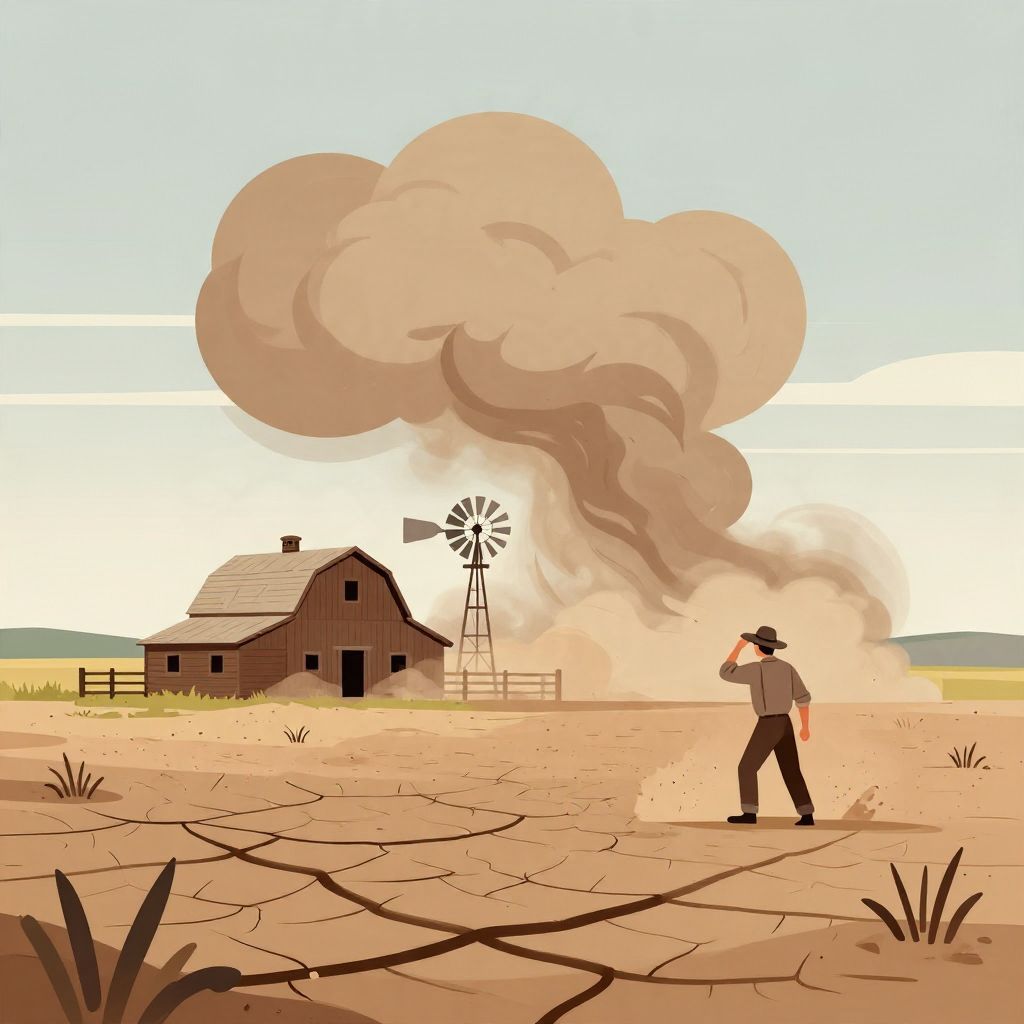
The Dust Bowl was a severe environmental and human disaster that struck the Great Plains of the United States during the 1930s. It combined extreme drought, destructive farming practices, and powerful winds to create massive dust storms that damaged farms, displaced families, and deepened the hardship of the Great Depression.
It is remembered as one of the clearest examples of how climate, land use, and economic pressure can combine to produce a crisis. The Dust Bowl did not affect every part of the Plains equally, but it transformed agriculture, migration, and government policy across the American West and beyond.
What Is The Dust Bowl?
The Dust Bowl was a period in the 1930s when drought and soil erosion turned large parts of the Great Plains into a landscape of dust storms, crop failure, and economic ruin. The worst conditions lasted from about 1934 to 1938, though the broader crisis began earlier and its effects lingered for years afterward.
Where the Dust Bowl Happened
The Dust Bowl centered on the southern Plains, especially parts of Oklahoma, Texas, Kansas, Colorado, and New Mexico. These were dry or semi-arid farming regions where rainfall was already uncertain. When drought returned, land that had been heavily plowed for wheat farming became vulnerable to wind erosion.
The “Dust Bowl” region
The term is often used for the worst-hit counties in the southern Plains, but it is also used more broadly to describe the wider environmental and social crisis. Not every farm in the region was equally affected, and some communities suffered more from economic collapse than from dust itself. Still, the image of dark, rolling dust clouds became the defining symbol of the era.
Why Did the Dust Bowl Happen?
The Dust Bowl was caused by a combination of natural drought and human land use. During the early 20th century, farmers expanded wheat production across the Plains. Deep plowing removed native grasses whose roots had helped hold the soil in place. When drought struck in the 1930s, the exposed topsoil dried out and blew away in strong winds.
Natural drought
The 1930s brought a prolonged drought to much of the central United States. Rainfall dropped sharply in several years, and hot temperatures worsened evaporation. Drought alone would have caused serious hardship, but it became catastrophic because the land had already been weakened by intensive cultivation.
Farming practices and soil erosion
Before large-scale settlement, the Great Plains were covered in native prairie grasses adapted to wind, dry weather, and periodic drought. Farmers later replaced much of that grassland with wheat fields. In the years before the crash of 1929, high grain prices encouraged even more planting. When prices fell and drought followed, many farmers had little financial cushion and little protection for the soil.
Economic pressure
The Great Depression made the crisis worse. Farmers were already struggling with debt, low crop prices, and reduced income. Many could not afford to leave land fallow or invest in conservation measures. As a result, environmental damage and economic distress reinforced one another.
How the Dust Bowl Developed
The Dust Bowl did not begin overnight. It emerged as drought, overplowing, and wind erosion intensified across several years. By 1934, enormous dust storms had become common, and in some places the sky darkened in the middle of the day. Dust drifted into homes, schools, barns, and machinery, making daily life difficult and often dangerous.
- Late 1920s: wheat expansion and heavy plowing increase vulnerability.
- 1930–1931: drought begins to stress crops and pastureland.
- 1934: major dust storms spread across the Plains and into eastern cities.
- 1935–1938: repeated storms and continued drought drive the worst conditions.
- Late 1930s: rainfall improves in many areas, though recovery is slow.
Black blizzards
Some of the most dramatic storms were called “black blizzards” because they could sweep across the landscape like a wall of darkness. These storms carried topsoil for hundreds of miles. People sometimes had to cover windows, seal doors, and breathe through damp cloths to reduce the dust entering their homes.
What Was Daily Life Like During the Dust Bowl?
For many farm families, daily life became a struggle to keep going. Dust damaged crops, sickened livestock, and clogged engines and machinery. Homes had to be cleaned constantly, but dust still seeped through cracks and settled on food, bedding, and furniture. Schools and businesses were often disrupted, and some families lived with constant fear of the next storm.
Health and hardship
Dust inhalation caused coughing, eye irritation, and other respiratory problems. In severe storms, visibility could drop so low that travel became impossible. Children often missed school, and families sometimes wore improvised masks. The crisis was not only environmental but also deeply personal, affecting health, dignity, and family stability.
Farm foreclosures and debt
Many farmers lost their land because they could not pay mortgages or taxes. Banks and creditors foreclosed on properties, and tenant farmers were especially vulnerable. The Dust Bowl accelerated rural poverty and pushed many people to leave the Plains in search of work elsewhere.
Migration and the “Okies”
One of the most famous consequences of the Dust Bowl was mass migration from the Plains, especially from Oklahoma, Texas, and Arkansas toward California. Not everyone who moved was from Oklahoma, but the label “Okie” became a common, often insulting, term for migrants from the region. They traveled hoping to find seasonal farm labor or other work, though jobs were scarce and wages low.
Life on the road
Many families traveled in overloaded cars and trucks, carrying what they could. Their journey was shaped by poverty as much as by dust. Once in California and other western states, migrants often faced discrimination, poor housing, and competition for work. Their experience became a major part of American memory of the 1930s.
How Did the Government Respond?
The Dust Bowl helped push the federal government to take a more active role in conservation and rural relief. Under President Franklin D. Roosevelt’s New Deal, agencies promoted soil conservation, tree planting, erosion control, and better farming methods. These efforts did not instantly end the crisis, but they marked an important shift in American policy.
Soil conservation
The federal government encouraged contour plowing, strip cropping, terracing, and leaving some land unplowed to reduce erosion. The Soil Conservation Service, created in 1935, became a key institution in this effort. Its work reflected a new understanding that farming had to be managed with the land’s limits in mind.
The shelterbelt project
One famous response was the planting of shelterbelts, rows of trees intended to slow wind and protect soil. This project stretched across parts of the Plains and symbolized the attempt to rebuild the landscape after years of damage. While not a complete solution, it showed how conservation could be used as public policy.
What Caused the Dust Bowl to End?
The Dust Bowl eased in the late 1930s as rainfall improved in many areas and conservation measures took hold. However, recovery was uneven. Some farms never fully returned to their earlier productivity, and many families had already left. The end of the worst dust storms did not erase the long-term social and economic consequences.
Climate and recovery
Better weather helped restore vegetation in some places, but the region remained vulnerable to drought. The Dust Bowl showed that environmental recovery depends on both climate and human choices. Even after the storms passed, the memory of the disaster shaped farming practices for decades.
Why the Dust Bowl Matters in History
The Dust Bowl matters because it revealed how environmental damage can become a national crisis. It changed agricultural policy, influenced migration patterns, and became a lasting symbol of hardship during the Great Depression. It also helped Americans see that land use, economics, and weather are deeply connected.
Lasting historical significance
Historians often treat the Dust Bowl as both a warning and a turning point. It exposed the dangers of farming marginal land without adequate conservation, but it also led to reforms that changed how the federal government approached soil, farming, and rural relief. Its legacy continues in discussions of drought, sustainability, and climate resilience.
Key Facts About the Dust Bowl
- Time period: mainly 1934 to 1938, within the broader 1930s crisis.
- Region: especially the southern Great Plains.
- Main causes: drought, overplowing, soil erosion, and economic stress.
- Main effects: dust storms, crop failure, health problems, debt, and migration.
- Government response: New Deal conservation programs and soil protection measures.
The Dust Bowl was not just a weather event; it was a human and environmental disaster shaped by farming choices, drought, and depression-era poverty. Its history shows how fragile land can become when natural stress and economic pressure collide, and why conservation remains essential to agriculture and public policy.