
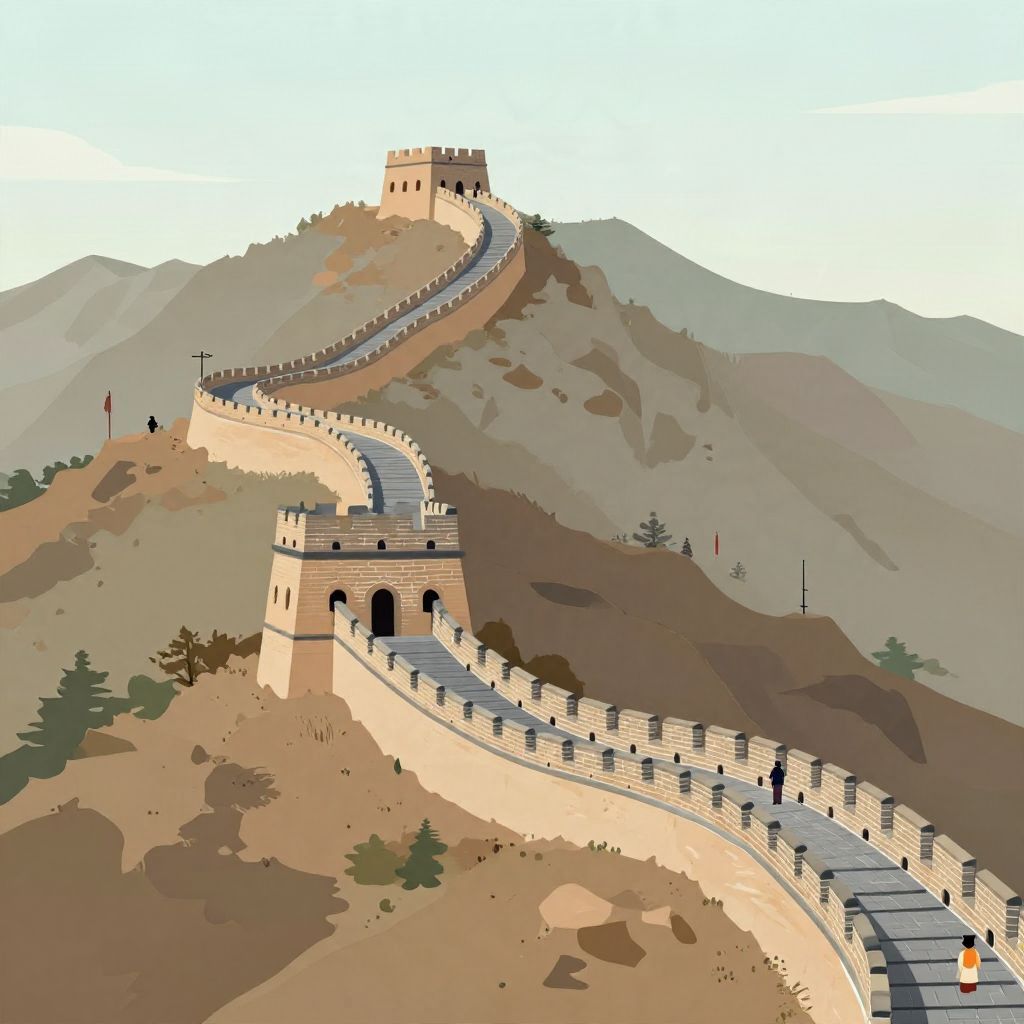
How tall is the Great Wall of China? The short answer is that it varies widely, because the “Great Wall” is not one single wall but a long system of walls, fortifications, watchtowers, and barriers built and rebuilt over many centuries.
In the best-known Ming dynasty sections, the wall is often about 6 to 8 meters tall, or roughly 20 to 26 feet, though some stretches are lower and some towers are much higher. Its height depended on local terrain, available materials, and the military purpose of each section.
How Tall Is The Great Wall Of China?
The Great Wall of China is usually about 6 to 8 meters tall in its most famous Ming-era sections, but its height is not uniform. Some parts are only a few meters high, while watchtowers and strategic points can rise much higher. Because it was built across mountains, plains, and deserts, there is no single official height.
Why There Is No Single Height
People often imagine the Great Wall as one continuous stone barrier, but historically it was a changing defensive network. Different dynasties built different walls, and later rulers repaired, extended, or replaced earlier sections. That means the wall’s dimensions vary by region, period, and construction method.
A wall, not one wall
The phrase “Great Wall of China” refers to multiple walls and fortifications built over time, especially from the Warring States period through the Ming dynasty. Some sections were made of packed earth, others of stone and brick, and some were reinforced with towers, beacon posts, and gates. Their height reflected local needs rather than a single standard plan.
Terrain shaped the structure
In steep mountain passes, builders often needed less height because cliffs and natural barriers already made invasion difficult. On open ground, the wall could be taller and thicker. In some areas, the wall was designed more to slow movement and provide a firing platform than to create an impassable obstacle.
Typical Height of the Ming Dynasty Wall
The most famous surviving sections of the Great Wall were built during the Ming dynasty, especially from the 14th to 17th centuries. These sections are commonly around 6 to 8 meters high and 4 to 5 meters wide at the top, though measurements vary. This height allowed soldiers to patrol the wall and defend it from horseback raiders.
What the height was meant to do
A wall of this size was high enough to make climbing difficult and to give defenders an advantage. The top was broad enough for troops, weapons, and supplies to move along it. Parapets and crenellations added protection, while towers gave defenders a raised position for observation and signaling.
Watchtowers were often taller
Watchtowers were not built to the same height as the wall itself. They often rose several stories above the wall line, making them much more prominent. Their purpose was surveillance, communication, and defense, so their height mattered as much as the wall’s thickness.
How the Great Wall Changed Over Time
The Great Wall’s history stretches across more than two millennia. Its earliest antecedents appeared in the Warring States period, when rival kingdoms built earth walls for defense. Later, the Qin dynasty connected and expanded some of these works after the unification of China in 221 BCE, though much of that early wall no longer survives in recognizable form.
Major phases of construction
- Warring States period (before 221 BCE): regional kingdoms built defensive walls.
- Qin dynasty (221–206 BCE): some walls were linked and extended.
- Han dynasty (206 BCE–220 CE): walls were pushed farther west to protect frontier routes.
- Ming dynasty (1368–1644): the best-preserved and most recognizable wall sections were built and rebuilt.
Because these phases used different materials and engineering methods, height also changed over time. Earthen ramparts could erode and become lower, while later brick-faced walls were sturdier and often taller. What survives today is mostly the Ming version, not the full historical extent of earlier walls.
Materials and Construction Methods Affected Height
The wall’s height was closely tied to what builders could use locally. In some areas, rammed earth was the main material, packed layer by layer into wooden frames. Elsewhere, stone or brick was added to strengthen the structure. These choices influenced how high builders could safely raise the wall.
Earth, stone, and brick
Rammed earth walls could be substantial but were vulnerable to weathering. Stone and brick allowed for more durable and often taller structures, especially in the Ming period. In mountainous regions, builders sometimes used the terrain itself as part of the defense, reducing the need for an extremely tall wall.
Labor and logistics
Building higher walls required more labor, more materials, and more time. Transporting stone and brick across rough frontier landscapes was difficult, so engineers balanced height with practicality. The result was a defensive system shaped by geography, military urgency, and imperial resources.
How Tall Are the Most Famous Sections Today?
Visitors to popular sections near Beijing often see walls that look impressively tall and steep, but even these vary. Restored stretches can appear higher because of repairs, steps, and parapet walls. In some places, the wall rises dramatically above the surrounding landscape; in others, it is much lower or partially ruined.
Why tourist sections can be misleading
Tourist-friendly sites are usually repaired or stabilized, so they may not reflect the original condition of the wall everywhere. Some sections have been rebuilt to make them safer for visitors. That means the height people see today can differ from the wall’s historical height and from one location to another.
Myths and Common Misunderstandings
One common myth is that the Great Wall was built as one continuous structure from a single era. In reality, it was assembled over centuries by different dynasties for changing military needs. Another misunderstanding is that it was uniformly massive everywhere, when in fact its dimensions depended heavily on local conditions.
What the wall was not
The Great Wall was not a perfectly straight, uniform barrier designed to stop every invasion by itself. It worked as part of a broader frontier system that included garrisons, signal towers, forts, and armies. Its height helped, but it was only one element in a much larger defensive strategy.
Why Height Mattered in Chinese Frontier Defense
The wall’s height was important because it gave defenders visibility, protection, and time. Frontier warfare often involved fast-moving cavalry raids, so a raised wall and tower network helped spot threats early and coordinate a response. Height made the wall harder to cross and easier to defend from above.
Military function and symbolism
Beyond defense, the wall also symbolized imperial authority. A tall, imposing structure marked the edge of state power and the effort to control movement across the frontier. Even when it did not fully prevent raids, it communicated that the dynasty was present, organized, and watchful.
The Great Wall’s Historical Legacy
Today, the Great Wall is admired as one of the most famous monuments in the world, but its original purpose was practical and military. Its height, though impressive, was never the same everywhere and was never the wall’s only important feature. Its real significance lies in the long history of Chinese state-building, frontier defense, and engineering.
So, if you are asking how tall the Great Wall of China is, the most accurate answer is that its height usually ranges around 6 to 8 meters in major Ming sections, with wide variation across the whole system. If you want to explore more, you may also like how long the Great Wall is and what the Great Wall of China was for.