
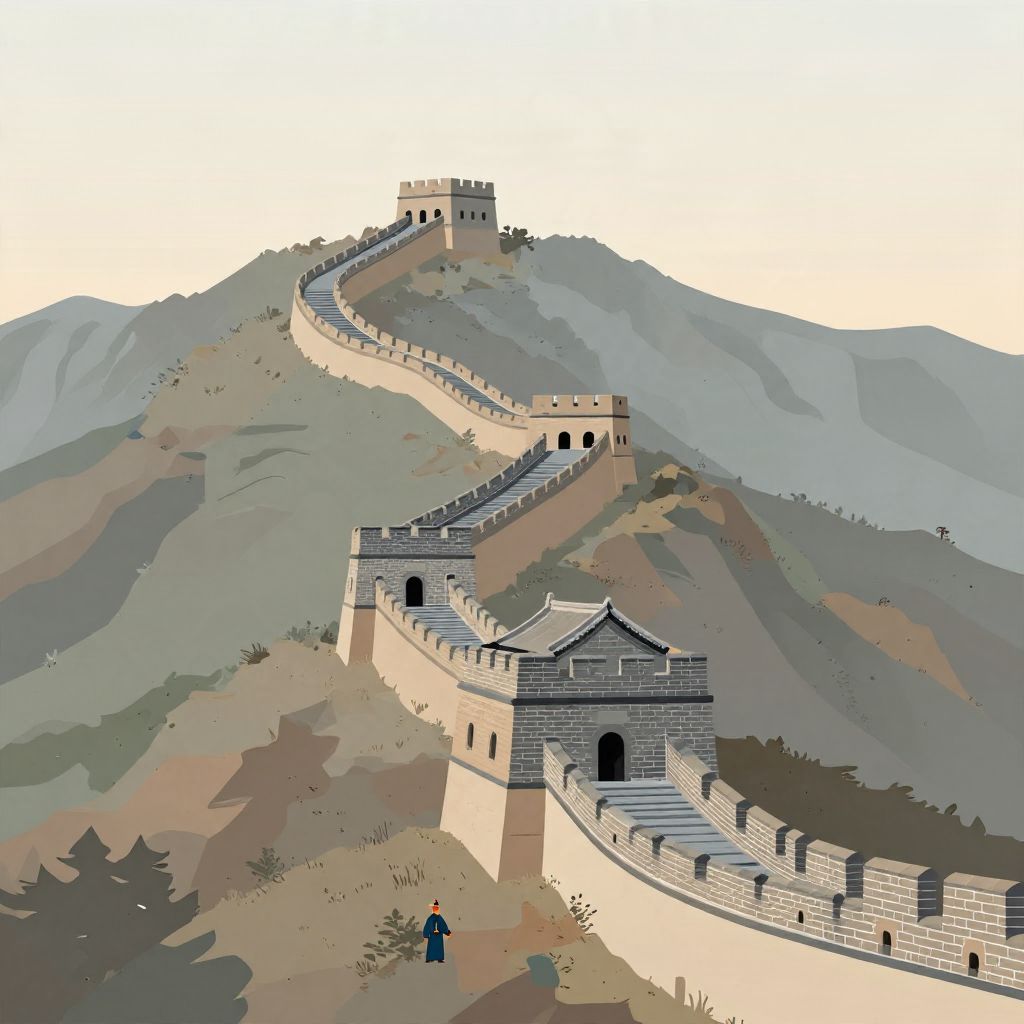
How long is the Great Wall? The short answer is that the Great Wall of China is not one single wall, but a vast network of walls, trenches, watchtowers, and fortifications built over many centuries. Depending on what is counted, its total length is often given as more than 21,000 kilometers, or about 13,000 miles.
That number can be surprising, because the wall you see in photographs is only a small surviving portion. To understand its true length, it helps to look at how the wall developed, who built it, and why historians use different measurements.
How Long Is The Great Wall?
The Great Wall of China is generally measured at about 21,196 kilometers in total, according to a major Chinese survey completed in 2012. That figure includes surviving wall sections, trenches, natural barriers, and related defensive structures from several dynasties. If you mean the most famous stone walls near Beijing, those visible sections are only a tiny fraction of the whole.
Why the Great Wall’s Length Is Hard to Pin Down
The Great Wall does not have one starting point, one ending point, or one continuous line. It was built, rebuilt, extended, and abandoned by different rulers over more than 2,000 years. Some parts were made of rammed earth, some of brick, and some were simple earthen embankments, so historians must decide what counts as “the wall” before giving a length.
Different measurements, different answers
Popular estimates often say the Great Wall is around 8,850 kilometers long, but that figure refers mainly to the wall built during the Ming dynasty and does not include every related defensive feature. The broader 21,196-kilometer figure reflects a more expansive definition used in modern surveying. In other words, the answer depends on whether you mean the Ming Wall alone or the entire historical system of fortifications.
What Counts as the Great Wall?
When people speak of the Great Wall, they usually imagine a single barrier stretching across northern China. Historically, however, it was a military frontier system. That system could include walls, beacon towers, passes, garrisons, horse paths, trenches, and natural defenses such as rivers and mountains. This is why length calculations can vary so much.
Not one wall, but many walls
- Early walls built by rival states before China was unified
- Qin dynasty frontier fortifications after unification in 221 BCE
- Han dynasty extensions protecting trade and frontier routes
- Ming dynasty stone-and-brick walls, the best preserved today
Each phase added to the overall total, but not all sections survived. Some were eroded, buried, dismantled, or absorbed into later construction. That is why the Great Wall’s “length” is partly a historical question and partly a surveying one.
A Brief History of the Great Wall’s Construction
The wall’s history begins long before the famous Ming sections. Chinese states started building defensive walls during the Warring States period (roughly 475–221 BCE), when competing kingdoms fortified their borders against one another. After China was unified, later dynasties connected and expanded these defenses to protect against northern nomadic powers.
The Warring States period
Before imperial China, states such as Qi, Yan, and Zhao built walls to defend territory and control movement. These early barriers were separate projects, not one continuous structure. Yet they established the idea of long frontier walls as a practical military tool.
The Qin dynasty
After Qin Shi Huang unified China in 221 BCE, the Qin state linked some earlier walls and added new fortifications in the north. Later tradition often credits him with “building the Great Wall,” but that is an oversimplification. He did not create the entire wall as seen today; instead, he helped shape an early imperial defense network.
The Han dynasty
The Han dynasty extended frontier defenses westward as China expanded its interests along routes tied to the Silk Road. These walls helped protect trade, military outposts, and communication lines. In some regions, the wall system stretched deep into desert frontiers, showing that its purpose was broader than simple border defense.
The Ming dynasty
The most visible and best-preserved sections were built during the Ming dynasty (1368–1644). Facing threats from northern powers, Ming rulers invested heavily in stone and brick walls, watchtowers, and passes. Much of the wall tourists visit today dates from this period, especially near Beijing and other accessible areas.
How Long Is the Ming Great Wall?
If you are asking about the wall most people picture, the answer is usually the Ming Great Wall. Modern surveys have placed its length at about 8,850 kilometers, including walls, trenches, and natural barriers. If only the main wall sections are counted, the figure is slightly lower. This is the version most often discussed in travel writing and popular history.
Why the Ming wall is the best known
The Ming wall survives better because it was built with durable materials in many places and because later generations preserved or reused some sections. Its towers, battlements, and passes also make it visually dramatic. By contrast, many earlier walls were made from packed earth and have largely disappeared into the landscape.
How the Wall Was Built Across Such a Huge Distance
Building a structure of this scale required enormous labor, local materials, and careful organization. Different dynasties used soldiers, peasants, convicts, and laborers to transport earth, stone, bricks, and timber. Construction methods varied by terrain: stone in mountains, tamped earth on plains, and mixed materials in harsher frontier zones.
Labor and logistics
The wall was not built in one grand project. It was assembled in segments over centuries, often in response to military pressure. Roads, supply lines, and garrisons had to support workers in remote areas. In some places, the wall followed ridgelines and mountain passes, reducing the amount of material needed while maximizing defensive advantage.
Terrain shaped the wall’s length
Because the wall followed natural features, its total length is not a straight line on a map. It bends around hills, crosses valleys, and links strategic passes. That winding route adds to the overall distance and helps explain why the wall’s measured length is so much greater than many people expect.
Why the Great Wall Was Built
The Great Wall was primarily a military and political project. It was meant to slow invasions, control frontier movement, signal imperial power, and support garrisons. It also helped regulate trade and migration along the northern borderlands. In this sense, the wall was as much about state control as it was about defense.
Defense, surveillance, and administration
Watchtowers allowed signals to travel quickly across long distances, often by smoke by day and fire by night. Garrisons stationed along the wall could respond to raids and monitor frontier activity. The wall thus functioned as a communication system as well as a barrier.
Not an impenetrable fortress
Despite its fame, the Great Wall was never a perfect shield. Armies could bypass weak points, bribe gatekeepers, or exploit political instability. The wall worked best as part of a larger frontier strategy, not as a stand-alone solution. Its history shows the limits of walls as military tools, even when built on a massive scale.
Common Myths About the Great Wall’s Length
Because the Great Wall is so famous, it has attracted many myths. Some are harmless exaggerations, while others distort the historical record. Separating legend from evidence gives a clearer picture of what the wall really was.
Myth: The Great Wall is visible from the Moon
This is false. The wall is not visible to the naked eye from the Moon. Even from low Earth orbit, visibility depends on lighting, weather, and the observer’s conditions. The wall is impressive, but it is not a giant line easily seen from space.
Myth: One emperor built the entire wall
No single ruler built the whole Great Wall. The structure evolved over centuries under multiple dynasties. The Qin, Han, and Ming periods were especially important, but each contributed only part of the larger story.
Myth: The wall is one continuous, untouched monument
Most of the wall is not a continuous surviving structure. Some stretches are ruins, some are reconstructed, and some have vanished entirely. The Great Wall is better understood as a historical landscape than as one uninterrupted line of masonry.
What the Great Wall Means Today
Today, the Great Wall is one of the most recognizable symbols of China and one of the most studied monuments in world history. It represents imperial power, frontier defense, human labor, and the long interaction between settled states and mobile borderlands. Its length is part of what makes it astonishing, but its historical meaning goes beyond distance alone.
A monument shaped by time
The wall’s scale reflects centuries of changing priorities. Some rulers saw it as essential security; others saw it as too costly or ineffective. Over time, the wall became both a practical frontier structure and a cultural symbol of endurance. That dual identity helps explain why it remains so powerful in the modern imagination.
So, How Long Is The Great Wall?
In the broadest historical sense, the Great Wall of China is about 21,196 kilometers long. If you mean the best-known Ming dynasty sections, the length is about 8,850 kilometers. The difference exists because the Great Wall is not a single wall, but a centuries-long system of fortifications built by many dynasties for many purposes.
That is the most accurate way to answer the question: the Great Wall is enormous, but its exact length depends on what historians choose to count. To explore its human cost and cultural meaning further, see how many people died building the Great Wall of China and, for broader context on historical identity and exchange, what cultural divergence means in history.