
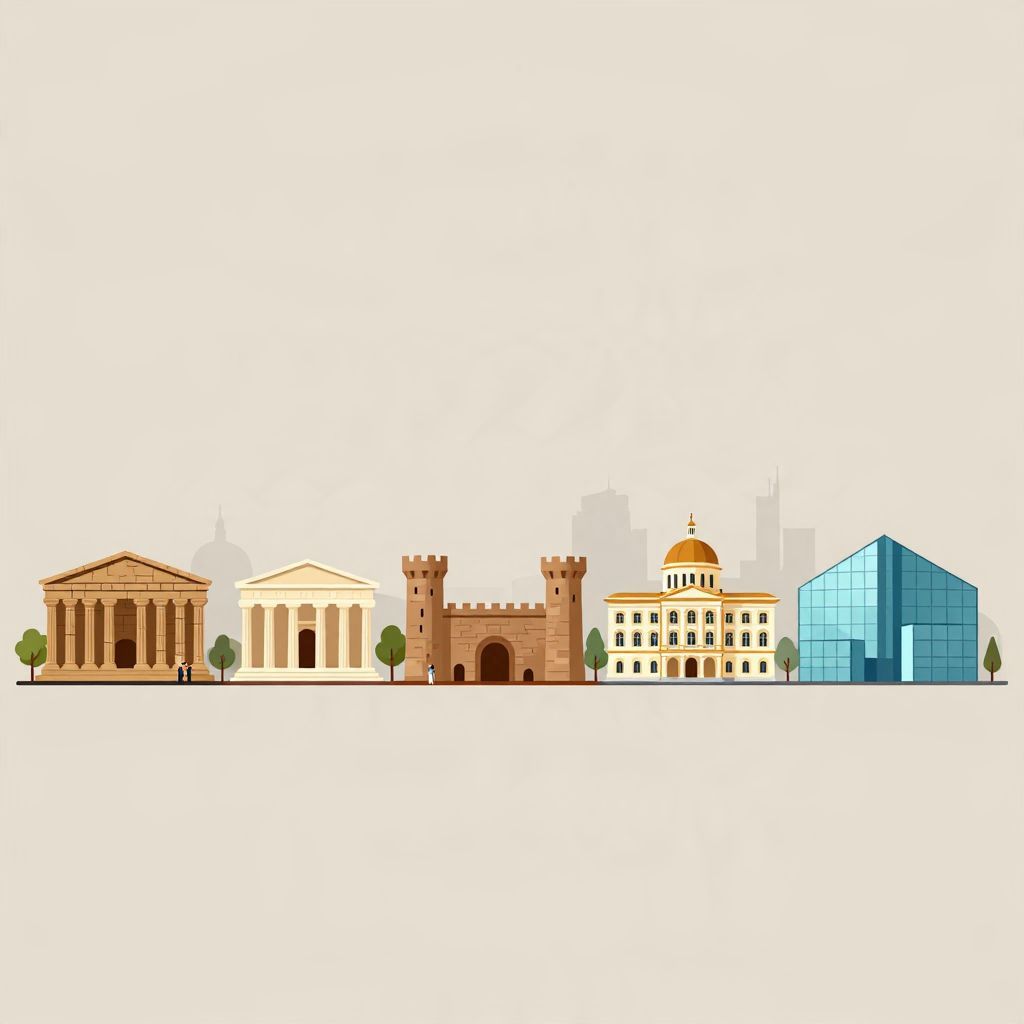
Architecture has changed over time because societies changed: their materials, technologies, beliefs, economies, and political systems all shaped the buildings people made. From stone temples and mud-brick homes to steel skyscrapers and climate-conscious design, architecture has always reflected both practical needs and cultural values.
Looking at architecture across history shows how humans solved problems of shelter, status, worship, and public life. It also reveals a long conversation between tradition and innovation, where new methods often built on older forms rather than replacing them overnight.
How has architecture changed over time?
Architecture changed from local, labor-intensive building traditions into increasingly engineered, global, and specialized design systems. Early structures relied on available materials and handcraft, while later architecture used mathematics, industrial production, and modern technologies to create larger, stronger, and more varied buildings.
Architecture in the ancient world
Early shelters and the first permanent buildings
The earliest architecture was practical and local. People used wood, reeds, mud, stone, and animal skins to create shelters suited to climate and available resources. As agriculture spread after about 10,000 BCE, permanent settlements encouraged more durable buildings, storage spaces, and communal structures.
In places such as Mesopotamia, Egypt, the Indus Valley, and ancient China, architecture became tied to settled life, irrigation, religion, and authority. Temples, tombs, palaces, and city walls were among the first large-scale buildings, and they often required organized labor and central leadership.
Monumental architecture and symbolism
Ancient architecture was not only functional; it was symbolic. The pyramids of Egypt, ziggurats of Mesopotamia, and large ceremonial complexes in Mesoamerica expressed divine power and political control. Their scale demonstrated the ability of rulers to command resources and workers.
The Greeks and Romans added new architectural ideas that would influence later periods. Greek architecture emphasized proportion, columns, and temple design, while Roman builders expanded the use of arches, vaults, domes, concrete, roads, and aqueducts. These innovations allowed for larger interiors and more ambitious public works.
What changed in medieval architecture?
Medieval architecture shifted toward fortified, religious, and community-centered buildings. In Europe, castles, cathedrals, monasteries, and town walls became prominent as political fragmentation, warfare, and religious life shaped the built environment. Builders relied on craft traditions, but they also developed increasingly sophisticated structural techniques.
Romanesque and Gothic styles
Romanesque architecture, common from roughly the 10th to 12th centuries, used thick walls, rounded arches, and relatively small windows. It created heavy, sturdy buildings suited to defense and stability. Churches and monasteries were especially important because the Church was a major landowner and cultural force.
Gothic architecture, which emerged in 12th-century France, introduced pointed arches, ribbed vaults, and flying buttresses. These features redistributed weight and made it possible to build taller structures with larger stained-glass windows. Cathedrals became dramatic expressions of faith, urban pride, and technical skill.
Architecture beyond Europe
Medieval change was not limited to Europe. In the Islamic world, architecture flourished through mosques, madrasas, palaces, and public baths, often featuring courtyards, domes, geometric ornament, and calligraphy. In Asia, traditions such as Chinese timber-frame construction and Japanese temple design developed distinct structural and aesthetic principles.
These regional traditions show an important historical fact: architecture has never followed a single universal path. Different societies solved similar problems in different ways, depending on climate, religion, labor systems, and available materials.
How did the Renaissance and early modern period transform architecture?
The Renaissance, beginning in Italy in the 14th century and spreading across Europe, revived interest in classical Roman forms while introducing new ideas about human proportion, perspective, and urban order. Architects studied ancient ruins and texts, then adapted classical columns, domes, and symmetry for new civic and religious buildings.
Classical revival and urban planning
Renaissance architecture emphasized balance, mathematical harmony, and clear geometry. Figures such as Filippo Brunelleschi and Andrea Palladio helped define this style through domes, villas, and churches that combined ancient inspiration with contemporary needs. Their work influenced later European and American architecture for centuries.
At the same time, cities began to change. Fortifications were redesigned to resist gunpowder artillery, and rulers used grand palaces, boulevards, and squares to display power. Architecture became increasingly linked to statecraft, not just religion.
Baroque, Rococo, and imperial display
In the 17th and 18th centuries, Baroque architecture used curves, dramatic light, ornament, and spatial complexity to create emotional impact. Churches and palaces in Catholic Europe often aimed to impress viewers and reinforce authority. Rococo later softened some of that grandeur with lighter, more decorative interiors.
Outside Europe, empires also used architecture to project power. Mughal monuments in South Asia, Ottoman mosques, and Qing imperial buildings all combined local traditions with imperial symbolism. Architecture increasingly served political identity on a large scale.
What changed during the Industrial Revolution?
The Industrial Revolution, beginning in the late 18th century and accelerating in the 19th, transformed architecture more than almost any previous period. New materials such as cast iron, wrought iron, steel, and mass-produced glass allowed buildings to become taller, broader, and more standardized. Construction also became faster and less dependent on traditional craft alone.
Factories, railways, and new building types
Industrial society created new architectural needs: factories, warehouses, train stations, bridges, department stores, and apartment blocks. These structures were shaped by production, transport, and urban crowding rather than by older patterns of aristocratic or religious patronage.
Engineering became increasingly important. Iron and steel frames made large spans possible, while elevators and later reinforced concrete helped produce skyscrapers. Cities grew rapidly, and architecture had to respond to density, sanitation, fire safety, and mass transit.
The rise of historicism and new materials
Even as technology advanced, many 19th-century architects looked backward for style. Neo-Gothic, Neo-Classical, and other revival movements borrowed forms from earlier periods. This mix of old style and new technology is one of the defining features of modern architecture’s beginnings.
Buildings such as the Crystal Palace in London, built in 1851, symbolized the industrial age with prefabricated iron and glass. It showed that architecture was no longer only about stone permanence; it could also express speed, transparency, and industrial production.
How did modern architecture emerge in the 20th century?
Modern architecture emerged in the early 20th century as architects reacted against historical imitation and sought forms suited to modern life. They favored simplicity, function, new materials, and open plans. The idea that a building should express its structure and purpose became central to modern design.
Function, minimalism, and the International Style
Movements such as Bauhaus, De Stijl, and the International Style promoted clean lines, flat roofs, open interiors, and minimal ornament. Architects including Walter Gropius, Ludwig Mies van der Rohe, and Le Corbusier argued that architecture should reflect industrial society and social change.
This period also saw major experimentation with reinforced concrete, curtain walls, and steel skeletons. Skyscrapers became symbols of corporate power and urban modernity, especially in the United States. At the same time, public housing, schools, and civic buildings were designed to address mass urban populations.
Postwar rebuilding and new debates
After World War II, many cities in Europe and Asia had to be rebuilt. Reconstruction accelerated the use of modernist planning, prefabrication, and large-scale housing estates. Yet modernism also drew criticism for producing cold, repetitive, or socially alienating environments.
By the late 20th century, Postmodern architecture pushed back against strict modernism by reintroducing color, ornament, historical reference, and irony. This was not a return to the past, but a sign that architecture had become more self-aware and pluralistic.
What is changing in architecture today?
Contemporary architecture is shaped by sustainability, digital design, globalization, and changing social expectations. Buildings are now expected to do more than shelter people: they must conserve energy, adapt to climate risks, support accessibility, and often represent a brand, institution, or urban identity.
Digital tools and new construction methods
Computer-aided design, building information modeling, and digital fabrication have changed how architects plan and build. Complex forms that would once have been difficult to draw or construct can now be modeled precisely. Parametric design and advanced engineering have expanded the range of possible shapes and materials.
At the same time, construction methods such as modular building and prefabrication aim to reduce cost and waste. These approaches echo older traditions of standardized building, but with far more advanced logistics and computation.
Sustainability and preservation
One of the biggest contemporary shifts is the emphasis on environmental responsibility. Architects increasingly consider carbon emissions, insulation, natural ventilation, reuse of materials, and resilience to heat, flooding, and storms. In many places, the best environmental choice is not new construction but the adaptive reuse of existing buildings.
This has also renewed interest in heritage conservation. Older buildings are not just relics; they are records of social history, craftsmanship, and local identity. Preserving them while making them usable is one of the central challenges of modern architecture.
What are the biggest long-term patterns in architectural history?
Across history, architecture has changed in several broad ways. First, it moved from local, handmade construction toward global systems involving engineering, industry, and digital design. Second, buildings became more specialized, with distinct forms for worship, government, commerce, transport, and housing. Third, architecture increasingly reflected social values such as prestige, efficiency, identity, and sustainability.
- Materials changed: from mud, wood, and stone to iron, steel, glass, concrete, and engineered composites.
- Structure changed: from load-bearing walls to framed construction and advanced engineering systems.
- Purpose changed: from survival and ritual to commerce, mass housing, and environmental performance.
- Style changed: from regional traditions to revival styles, modernism, postmodernism, and contemporary hybrid forms.
- Design process changed: from master builders and craftsmen to architects, engineers, planners, and digital teams.
Why does the history of architecture matter?
Architecture is one of the clearest ways to see history in physical form. Buildings reveal what people valued, feared, worshipped, and could afford. They also show how societies responded to new technologies, political power, urban growth, and environmental pressures.
In that sense, the history of architecture is not just a story of styles. It is a history of human problem-solving, cultural expression, and changing ways of living together. For related reading, see cultural preservation in architecture and the arcade in Ottonian architecture.