
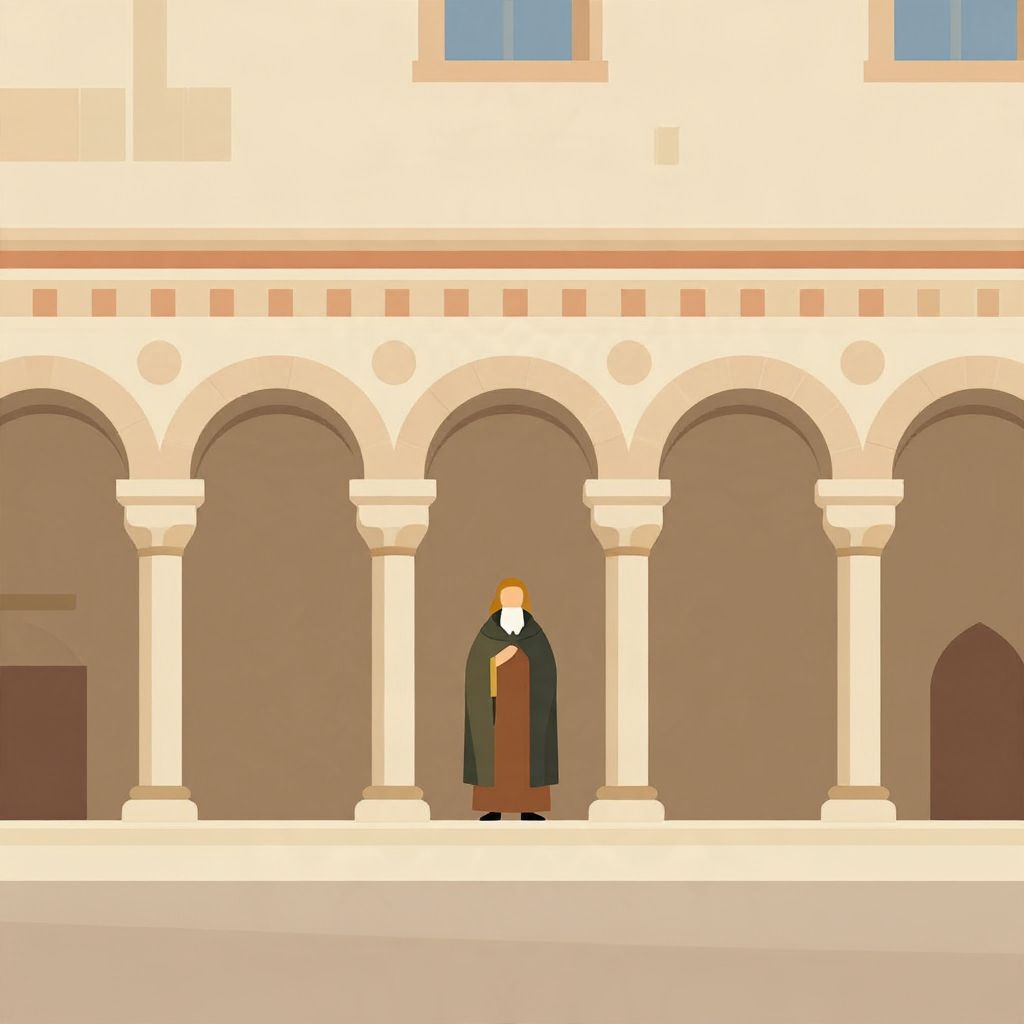
What is the arcade in Ottonian architecture? In simple terms, it is a row of arches carried by columns or piers, used inside churches and other monumental buildings in the Ottonian world of the 10th and early 11th centuries. The arcade helped organize space, support upper walls, and create the solemn, rhythmic interiors associated with early medieval imperial architecture.
In Ottonian churches, the arcade was not just structural decoration. It shaped how worshippers moved through a building, how light and height were perceived, and how architects expressed order, hierarchy, and imperial authority in stone.
What Is the Arcade in Ottonian Architecture?
An arcade in Ottonian architecture is a series of arches supported by columns or piers, usually forming a visual and structural division inside a church. In Ottonian buildings, arcades commonly separated the nave from the aisles and helped define the building’s measured, ceremonial rhythm.
The Ottonian World: Why Arcades Mattered
Ottonian architecture developed in the 10th and early 11th centuries under the rulers of the Ottonian dynasty, especially in the German lands of the Holy Roman Empire. This was a period when rulers, bishops, and abbots invested heavily in monumental churches that reflected both Christian devotion and imperial prestige.
Arcades mattered because Ottonian builders were not simply copying older Roman forms. They adapted inherited architectural ideas to create interiors that felt ordered, dignified, and authoritative. The arcade became one of the most important tools for achieving that effect.
A quick historical setting
- Ottonian period: roughly 919 to 1024, the era of the Ottonian dynasty in East Francia and the early Holy Roman Empire.
- Main patrons: kings, emperors, bishops, and monastic communities.
- Architectural goal: to build churches that expressed Christian universality and imperial continuity.
How Arcades Worked in Ottonian Churches
Ottonian arcades usually formed the lower level of an interior elevation. A nave arcade would run along both sides of the central space, opening onto side aisles. Above it, some churches had galleries or clerestory windows. This layered arrangement made the arcade a key element in both structure and visual composition.
The arches could be round or slightly varied in proportion, resting on columns with capitals that were often reused from earlier buildings or newly carved in a simpler, more monumental style. The result was a calm, repetitive sequence that guided the eye along the length of the church.
Common functions of the arcade
- Structural: it supported the wall system and helped divide the interior into bays.
- Spatial: it separated nave and aisle while keeping the interior open and connected.
- Liturgical: it framed processions and shaped the movement of clergy and worshippers.
- Symbolic: its repeated arches suggested order, stability, and sacred harmony.
Origins: Where Did the Ottonian Arcade Come From?
The arcade was not invented by the Ottonians. It had deep roots in Roman architecture, where arcades were used in aqueducts, basilicas, amphitheaters, and other large structures. Early Christian and Carolingian builders also inherited and transformed this tradition, and Ottonian architects worked within that long lineage.
What makes the Ottonian arcade distinctive is the way it was used in a medieval imperial context. Ottonian builders drew on Roman and Carolingian precedents, but they emphasized more regular interior rhythm, stronger architectural clarity, and a monumentality suited to the empire’s church-centered culture.
Major influences on Ottonian arcades
- Roman architecture: the classical arch and arcade as structural and decorative forms.
- Early Christian basilicas: long church interiors divided by colonnades and arcades.
- Carolingian architecture: the revival of monumental church building before the Ottonians.
- Local medieval practice: regional building traditions in Saxony, Franconia, and other parts of the empire.
Why the Arcade Became So Important in Ottonian Design
The Ottonian period valued visual order. Churches were meant to embody a divinely sanctioned hierarchy, and the arcade helped do that. Its repeated arches created a measured procession of forms, making the interior feel unified without becoming monotonous. In a society that linked religious and political authority, this mattered greatly.
The arcade also helped architects manage the scale of large stone buildings. Ottonian churches were often ambitious in size, and the arcade provided a practical way to divide the interior while maintaining openness. It was both a building solution and an aesthetic statement.
Meaning beyond structure
In Ottonian art and architecture, form often carried meaning. The arcade’s repetition could suggest the ordered community of the Church, the stability of the empire, and the continuity of Christian tradition. That symbolic reading is an interpretation supported by the broader cultural context, even if medieval builders did not leave us a single explicit definition.
Key Features of Ottonian Arcades
Ottonian arcades were usually not lavishly ornate in the later Romanesque sense. Their power came from proportion, rhythm, and mass. They often appear sturdy and restrained, with a strong emphasis on structural clarity rather than excessive surface decoration.
Typical characteristics
- Round arches were common.
- Alternating supports sometimes appeared, with piers and columns used in sequence.
- Reused materials from older Roman buildings were occasionally incorporated.
- Simple capitals or modestly carved capitals were often used.
- Regular bays created a steady visual cadence through the nave.
In some churches, the arcade was part of a more complex system that included galleries, tribunes, or double-aisled plans. The arcade was therefore not isolated; it belonged to a broader architectural language that gave Ottonian churches their distinctive interior order.
Examples of Arcades in Ottonian Architecture
Several surviving or partially surviving Ottonian churches show how arcades were used in practice. Because many buildings were altered over later centuries, scholars often study them through a combination of archaeology, standing remains, and later reconstruction.
Notable examples
- St. Michael’s, Hildesheim (begun c. 1001): famous for its balanced interior articulation, including arcaded nave spaces.
- St. Cyriakus, Gernrode (10th century): an important early Ottonian church with clearly organized arcaded divisions.
- St. Pantaleon, Cologne (10th century): a major imperial church with architectural forms that reflect Ottonian monumental taste.
These buildings show that the arcade was not a marginal detail. It was central to the way Ottonian architects structured sacred space and expressed imperial Christianity in built form.
Arcade, Colonnade, and Arch: What Is the Difference?
The terms can be confusing. An arch is a single curved structural element. A colonnade is a row of columns. An arcade is a row of arches supported by columns or piers. In Ottonian architecture, the arcade often sits between the two ideas: it is both a structural system and a repeated visual sequence.
In a church interior, the arcade usually defined the boundary between the nave and the aisles. In some cases, especially where columns were reused from earlier Roman buildings, the arcade could also carry a strong sense of continuity with antiquity.
How the Arcade Shaped Worship and Experience
Ottonian churches were not designed for passive viewing alone. They were active ritual spaces. The arcade helped shape how people experienced processions, chanting, and the movement of clergy around the altar. Its repeated openings framed sightlines and created a sense of progression toward the sacred east end of the church.
For worshippers, the arcade also controlled what could be seen and how the interior was perceived. It marked boundaries without fully closing them off, which suited a liturgical world that relied on both separation and participation.
Arcades and Ottonian Power
The Ottonian rulers saw themselves as heirs to the Roman imperial tradition and protectors of the Church. Monumental church architecture helped express that vision. The arcade, with its disciplined repetition and classical ancestry, fit perfectly into this program.
It is important, however, not to overstate the symbolism as if every arcade was a direct political manifesto. Medieval buildings served practical, liturgical, and aesthetic purposes too. Still, in the Ottonian context, architecture and authority were closely connected, and the arcade contributed to that relationship.
Legacy: From Ottonian to Romanesque Architecture
Ottonian architecture helped prepare the way for Romanesque building in the 11th and 12th centuries. The arcade remained a fundamental feature of church design, but later Romanesque architects expanded its scale, variety, and decorative richness. Ottonian examples are therefore important as a transitional stage in the history of medieval architecture.
Their arcades show a balance between inherited classical form and emerging medieval monumentality. They are among the clearest signs of how early medieval builders transformed the architectural past into something distinctly their own.
So, What Is the Arcade in Ottonian Architecture?
The arcade in Ottonian architecture is a row of arches supported by columns or piers, most often used inside churches to divide space, support the structure, and create a rhythmic, ordered interior. It came from Roman and early Christian traditions, but in the Ottonian world it gained new importance as a symbol of sacred order, imperial dignity, and architectural discipline.
To understand the arcade is to understand one of the central building blocks of Ottonian church design. If you want to explore the wider setting behind this style, you may also find it useful to read about the Holy Roman Empire and cultural preservation in architecture.