
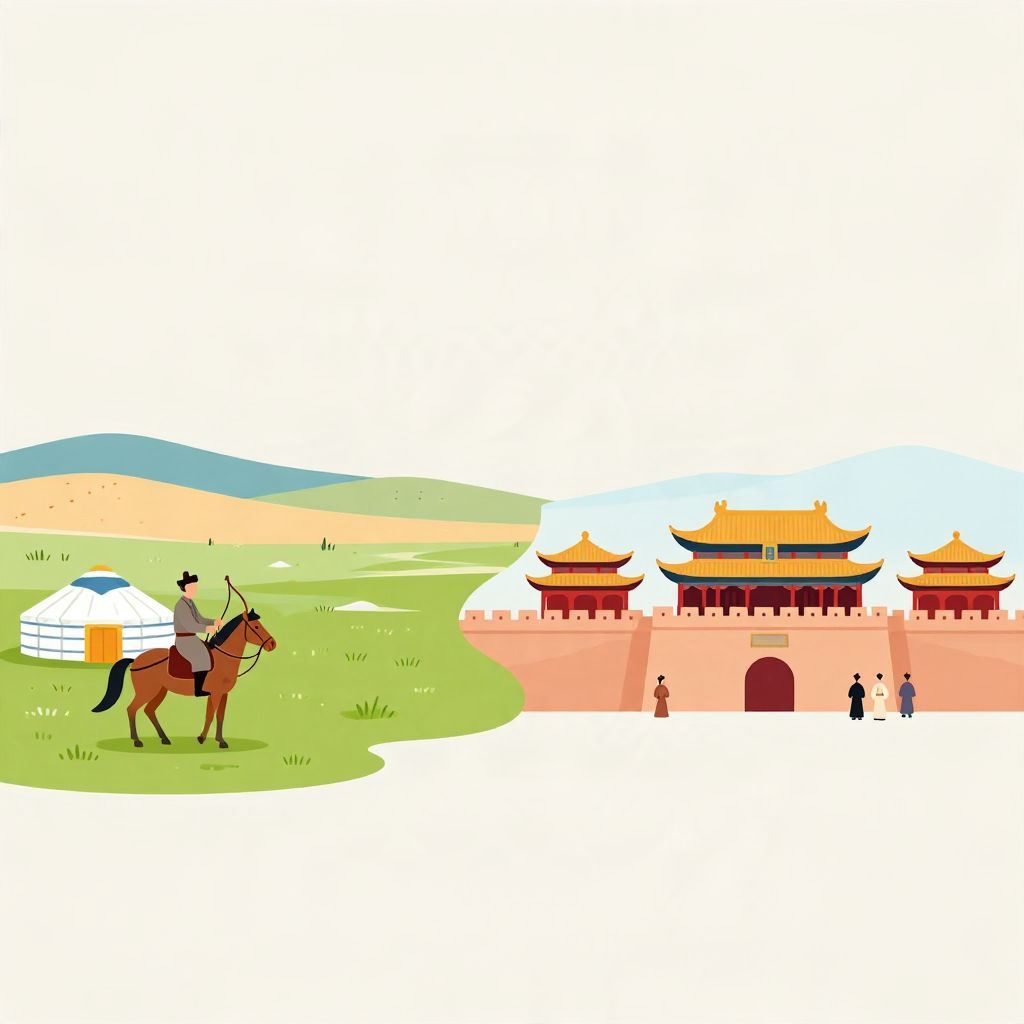
Is Mongolia part of China? The short historical answer is no: Mongolia is an independent country today, while China is a separate sovereign state. The confusion comes from centuries of shifting empires, borderlands, and Chinese claims over parts of historic Inner Mongolia.
To answer the question properly, it helps to separate modern international borders from older imperial rule. Mongolia’s history is deeply tied to the Chinese world, the Mongol Empire, and later Qing administration, but those connections do not mean that the modern state of Mongolia is part of China.
Is Mongolia Part of China?
No. Modern Mongolia is an independent nation-state, recognized internationally since the twentieth century. It is not governed by China and has its own government, borders, and foreign policy. The source of confusion is that a large region called Inner Mongolia is an autonomous region within China, while Outer Mongolia became the independent state of Mongolia.
How the Historical Relationship Developed
Mongolia’s relationship with China changed many times over the centuries. At different moments, Mongol rulers conquered China, Chinese dynasties ruled parts of Mongolia, and the Qing Empire controlled both. Because of this long overlap, the modern border cannot be understood without tracing empire, conquest, and decolonization-like state formation in the twentieth century.
The Mongols and China in the 13th and 14th Centuries
In the 1200s, the Mongols under Genghis Khan built a vast empire across Eurasia. His successors conquered northern China and eventually ruled all of China as the Yuan dynasty. In that period, it would be more accurate to say that the Mongols ruled China, not that Mongolia was part of China in a modern national sense.
The Yuan dynasty, founded by Kublai Khan in the late 13th century, was a Chinese dynasty in the conventional dynastic sense, but it was also a Mongol imperial regime. This distinction matters: the political world of medieval empires was not organized like today’s nation-states. Borders were fluid, and loyalty was often to a dynasty or ruler rather than to a fixed nationality.
After the Yuan: Ming and Qing Rule
After the Yuan collapsed in 1368, the Ming dynasty pushed the Mongols back into the steppe. For centuries afterward, Mongolia remained outside direct Chinese rule, though trade, diplomacy, and warfare linked the two regions. The balance shifted again in the 17th century when the Qing dynasty, ruled by the Manchus, expanded northward and incorporated Mongol territories into its empire.
Under the Qing, Mongolia was not treated simply as an ordinary province. Different Mongol areas were organized through banners, leagues, and other imperial structures. The Qing governed a multiethnic empire that included Han Chinese, Manchus, Mongols, Tibetans, and others. This imperial arrangement later became important because both Chinese and Mongolian nationalists interpreted it in different ways.
Why Inner Mongolia and Outer Mongolia Matter
The key to the modern answer is the distinction between Inner Mongolia and Outer Mongolia. These are historical-geographic terms, not a statement that one is “more Mongolian” than the other. Inner Mongolia remained within China after the fall of the Qing, while Outer Mongolia moved toward independence in the early 20th century.
Outer Mongolia Becomes Independent
When the Qing dynasty collapsed in 1911, Mongol nobles in what is now Mongolia declared independence. With Russian support and later Soviet influence, Outer Mongolia developed as a separate political entity. China did not fully accept this immediately, and the status of the region remained contested for years.
The turning point came in the mid-20th century. After World War II, agreements involving the Soviet Union and China helped confirm Mongolia’s separate status. The People’s Republic of Mongolia was established in 1924, and China eventually recognized Mongolian independence in 1945–1946. Since then, Mongolia has functioned as an independent state.
Inner Mongolia Remains in China
Inner Mongolia, by contrast, stayed within Chinese state borders. Today it is an autonomous region of the People’s Republic of China. That means it has a degree of cultural and administrative autonomy, but it is not a separate country. It is part of China in the same way that Tibet or Xinjiang are part of China, though each has a distinct historical and political background.
Because the name “Mongolia” appears in both places, many people assume the whole region belongs to China. In reality, the modern political division is the result of imperial collapse, nationalist movements, Soviet influence, and postwar diplomacy.
What Counts as “Part of China” Historically?
Whether Mongolia was “part of China” depends on the time period and definition being used. If someone means the modern nation of Mongolia, the answer is no. If someone means whether Mongol lands were ever under Chinese dynastic control, the answer is sometimes yes, especially under the Qing. If someone means whether Mongol rulers ever governed China, the answer is also yes, during the Yuan dynasty.
Different Historical Frameworks
- Modern national framework: Mongolia is not part of China.
- Imperial framework: Mongol territories were at times ruled within larger empires centered in China.
- Dynastic framework: The Mongols ruled China during the Yuan dynasty.
- Regional framework: Inner Mongolia is part of China; the independent state of Mongolia is not.
This is why simple yes-or-no answers can mislead. The question changes meaning depending on whether it is about present-day sovereignty, historical empire, or cultural geography.
Chinese Claims, Mongolian Identity, and the Modern Border
In modern times, Chinese state narratives have often emphasized historical continuity across the Qing Empire and the current Chinese nation-state. From that perspective, territories once governed by the Qing can be described as historically connected to China. Mongolian national history, however, emphasizes distinct identity, independence, and the right of Mongols to self-rule.
Both views draw on real history, but they are not the same. The Qing Empire was not a nation-state in the modern sense, and its borders do not map neatly onto today’s China. Likewise, Mongolian identity did not disappear simply because the region was once part of a larger empire. Modern sovereignty emerged only after the imperial order broke apart.
Why the Border Was Contested
Border disputes arose because empires often absorbed frontier peoples without creating clear national borders. When the Qing fell, new governments had to decide what counted as China and what counted as a separate nation. Mongolia’s case was especially complex because Russian and Soviet interests also shaped events. The result was not a clean separation, but a negotiated and politically charged one.
Mongolia Today: Independent, Not Chinese
Today, Mongolia is a landlocked republic between Russia and China. It has its own constitution, parliament, president, and diplomatic relations. It is a member of the United Nations and is widely recognized as a sovereign state. That is the decisive answer to the question in the present day.
At the same time, Mongolia’s history continues to shape how people understand the region. The legacy of the Mongol Empire, Qing rule, Soviet support for independence, and the existence of Inner Mongolia inside China all make the topic unusually layered. The modern answer is simple, but the historical road to that answer was not.
Why This Question Still Causes Confusion
Several factors keep the confusion alive. First, the term “Mongolia” refers both to an independent country and to a Chinese autonomous region. Second, the Mongol Empire once ruled China, which can blur the direction of historical power. Third, imperial borders and modern national borders are not the same thing. Finally, political language today often compresses a long and complicated past into a single claim.
It is also worth noting that popular discussions sometimes mix up ethnicity, empire, and statehood. Mongols as an ethnic group live in both Mongolia and China, but ethnicity alone does not determine national borders. A people can be spread across several states without those states becoming one country.
Conclusion: The Historical Answer
So, is Mongolia part of China? In the modern political sense, no. Mongolia is an independent country, while Inner Mongolia is a region within China. Historically, the relationship was more complicated: Mongol rulers once governed China, and the Qing Empire later ruled both Mongol and Chinese lands. The present border emerged only after empire gave way to modern states.
If you want to place Mongolia in the broader history of East Asia, it helps to look at the long story of frontier empires and borderlands, including the role of the Great Wall of China in shaping relations between agrarian states and steppe peoples. For a related look at one of the most famous symbols of that frontier, see how tall the Great Wall of China is.