
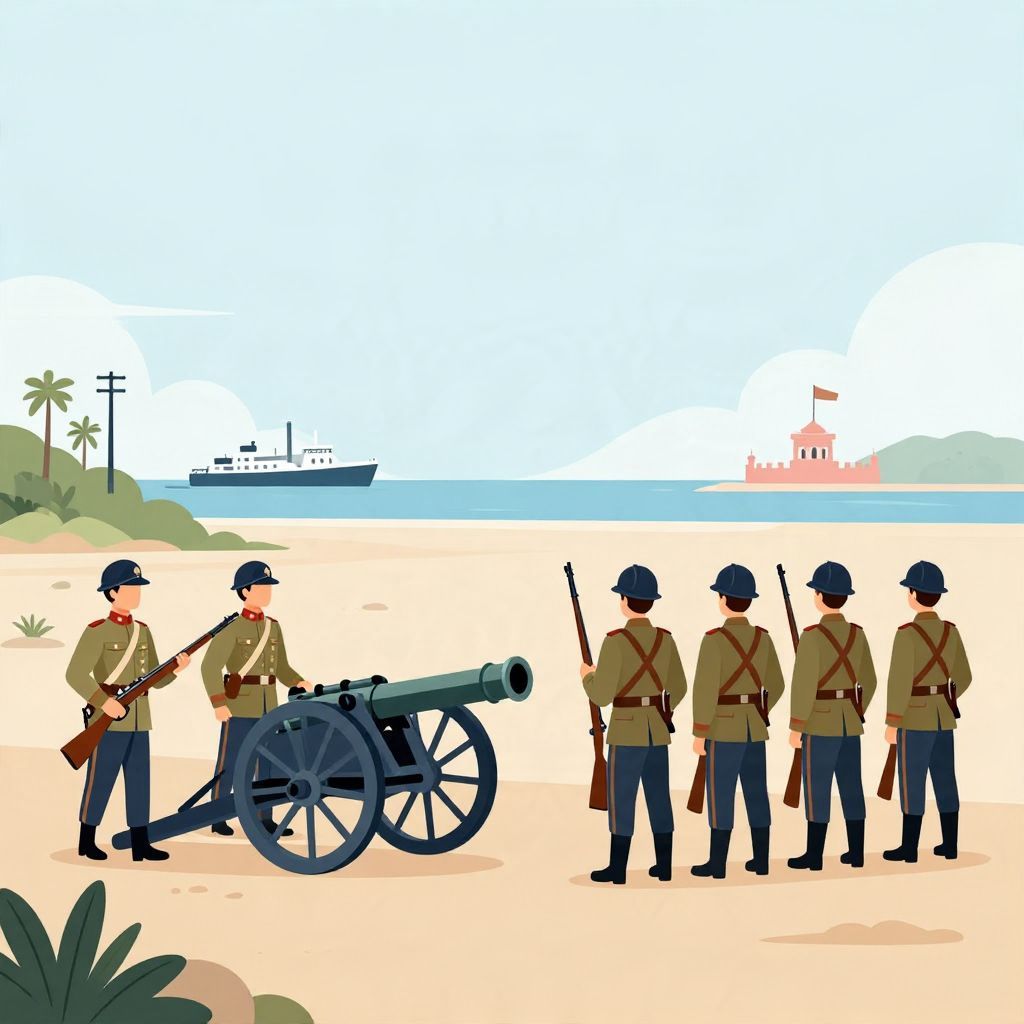
How did advanced weaponry help Europe during New Imperialism? In the late 19th and early 20th centuries, European powers used industrially produced rifles, machine guns, artillery, steam-powered gunboats, and telegraph-supported command systems to conquer and control overseas territories with far fewer soldiers than before.
These weapons did not guarantee victory by themselves, but they gave imperial states a decisive military edge over many African and Asian societies. That advantage helped Europe seize land, crush resistance, protect trade routes, and build empires at a speed that would have been far harder in earlier centuries.
How Did Advanced Weaponry Help Europe During New Imperialism?
Advanced weaponry helped Europe during New Imperialism by making conquest faster, cheaper, and more lethal. Industrial firearms, machine guns, modern artillery, and naval firepower let European armies defeat larger local forces, seize strategic ports and inland regions, and suppress resistance after occupation. Military technology was a major reason European empires expanded so rapidly after about 1870.
The military revolution behind New Imperialism
New Imperialism refers to the period roughly from the 1870s to the outbreak of World War I in 1914, when European states expanded aggressively across Africa and Asia. Industrialization transformed warfare during these decades. Factories could mass-produce rifles, shells, steamships, and ammunition, while railways and telegraphs helped armies move and communicate more efficiently than earlier imperial forces had done.
From older muskets to industrial firepower
By the late 19th century, European armies were equipped with breech-loading rifles, repeating rifles, and later machine guns such as the Maxim gun, introduced in the 1880s. These weapons fired faster, farther, and more accurately than many older arms. In battle, that meant European troops could hold off or destroy much larger forces that relied on spears, swords, bows, or older firearms.
Artillery also changed the balance of power. Modern cannons and explosive shells could break fortifications, bombard towns, and force surrender before armies even closed in for hand-to-hand combat. This made resistance against imperial invasion far more difficult, especially when local states lacked comparable industrial production.
Why machine guns mattered so much
The machine gun became one of the most important symbols of New Imperialism because it multiplied the killing power of a small European force. A few soldiers with rapid-fire weapons could stop a mass attack and inflict devastating casualties. In several colonial campaigns, this technology helped European armies defeat much larger indigenous forces with shocking speed.
Examples from Africa
European expansion in Africa shows the effect clearly. During the Battle of Omdurman in 1898, British and Egyptian forces armed with modern rifles, artillery, and machine guns defeated the forces of the Mahdist state in Sudan. The battle demonstrated how industrial weapons could turn a colonial army into a devastating fighting machine even when it was outnumbered.
In other parts of Africa, European armies used similar advantages to conquer territory in the Scramble for Africa. Resistance was often brave and sustained, but local forces were usually at a severe disadvantage when facing concentrated rifle fire, artillery, and disciplined formations supported by modern logistics. The result was not simply military victory; it was the rapid collapse of independent states and the imposition of colonial rule.
Psychological impact as well as physical force
Advanced weapons also had a psychological effect. The noise, speed, and destructive power of machine guns and artillery could intimidate opponents before a battle even began. European commanders often used this fear to demand submission, negotiate from a position of strength, or discourage rebellion after conquest. In imperial warfare, the threat of overwhelming force was sometimes as important as the fighting itself.
Naval power and control of trade routes
Advanced weaponry helped Europe not only on land but at sea. Steam-powered warships armed with heavy guns allowed imperial powers to project force along coasts, rivers, and harbors. This mattered because many empires depended on controlling ports, shipping lanes, and river systems that linked interior regions to global trade.
Gunboats and coastal domination
Gunboats could bombard shore defenses, support landings, and pressure rulers into signing unequal treaties. European powers used naval superiority to force access to markets and strategic points such as ports, canals, and river mouths. Once a coastline was secured, inland expansion became easier because troops, supplies, and ammunition could be transported more efficiently.
Naval firepower also helped Europe maintain imperial control after conquest. If a colony rebelled, warships could shell coastal cities, cut off supplies, and reinforce garrisons. This made resistance more difficult for societies that lacked modern fleets or the industrial infrastructure needed to match European naval power.
Technology, logistics, and empire-building
Weapons alone did not create empire. Europe’s success depended on the wider industrial system behind those weapons. Factories produced ammunition in huge quantities, railways moved troops inland, and telegraph lines allowed commanders to coordinate across vast distances. Advanced weaponry worked best when combined with these systems of transport and communication.
How logistics multiplied military strength
- Railways moved soldiers and supplies quickly to frontier zones.
- Telegraphs let imperial officials send orders and receive reports faster than messengers could travel.
- Steamships shortened travel times between Europe and overseas colonies.
- Industrial ammunition production kept armies supplied during long campaigns.
This combination meant that Europe could fight in distant regions while still controlling events from imperial capitals. A small number of European administrators and officers could oversee large territories because military technology made rebellion more manageable and conquest more sustainable.
Why European armies often defeated larger local forces
It is important not to oversimplify imperial conquest as a story of technology alone. Many African and Asian societies fought back effectively, adapted quickly, or used diplomacy to delay conquest. Still, advanced weaponry gave Europe a major edge in direct warfare. That edge was especially powerful when combined with training, discipline, and access to industrial supply lines.
Several factors worked together
- Firepower: European troops could fire faster and more accurately.
- Range: Their weapons could strike before many opponents got close enough to fight effectively.
- Organization: European armies often used standardized drills and command structures.
- Supply: Industrial economies could replace weapons and ammunition more reliably.
- Naval support: Ships could reinforce land campaigns and control access to key regions.
In short, advanced weaponry did not act in isolation. It was part of a larger imperial system that linked industry, finance, transport, and military power. Together, these forces made European expansion much more aggressive and durable than earlier forms of overseas contact.
Did advanced weapons make imperialism inevitable?
No. Technology helped Europe, but it did not make empire automatic or unavoidable. Political ambition, economic motives, nationalism, and competition among European states all drove New Imperialism. Weapons gave leaders the means to pursue those goals more aggressively. Without industrial firepower, however, many campaigns would have been slower, costlier, and more uncertain.
Imperialism was also about competition between European states
European powers feared that if they did not seize territory, rivals would. This competition encouraged military investment and colonial expansion. Advanced weapons were therefore both a cause and a consequence of imperial rivalry. States that built stronger armies and navies gained prestige, protected trade interests, and claimed more territory in Africa and Asia.
At the same time, imperial warfare often depended on local allies, rivalries among indigenous states, and existing political divisions. Europeans sometimes won because they exploited these divisions as much as because they possessed better weapons. That is one reason historians view New Imperialism as a combination of military, economic, and political factors rather than a simple story of superior technology.
The human cost of military advantage
Advanced weaponry helped Europe conquer empires, but it also made colonial warfare far more destructive. Battles became deadlier, civilian populations were exposed to bombardment, and resistance movements were often met with overwhelming force. The military edge that helped Europe expand also deepened the violence of imperial rule.
In many colonies, European control was maintained through coercion, punitive expeditions, and the threat of force. This created long-term resentment and instability. The same technologies that enabled conquest also helped enforce labor systems, extract resources, and suppress uprisings. For colonized peoples, “progress” in military technology often meant greater suffering rather than security.
Why this matters today
Understanding how advanced weaponry helped Europe during New Imperialism matters because it explains how a relatively small number of industrial states dominated much of the world by 1914. Military technology was not the only reason, but it was one of the clearest and most visible tools of empire. It helped turn industrial power into political control.
The legacy of that era still shapes modern borders, state systems, and memories of colonial rule. It also shows how technology can magnify power when combined with economic ambition and political competition. If you want to see how imperial rivalry contributed to global conflict, you may also want to read about how imperialism led to World War I. For a broader look at how governments used power and expansion in earlier contexts, see what the Northwest Ordinance was.
Bottom line: advanced weaponry helped Europe during New Imperialism by giving European states a decisive battlefield advantage, enabling rapid conquest, coastal domination, and colonial control. It was one of the main reasons the imperial expansion of the late 19th century succeeded so quickly—and why its consequences were so far-reaching.