
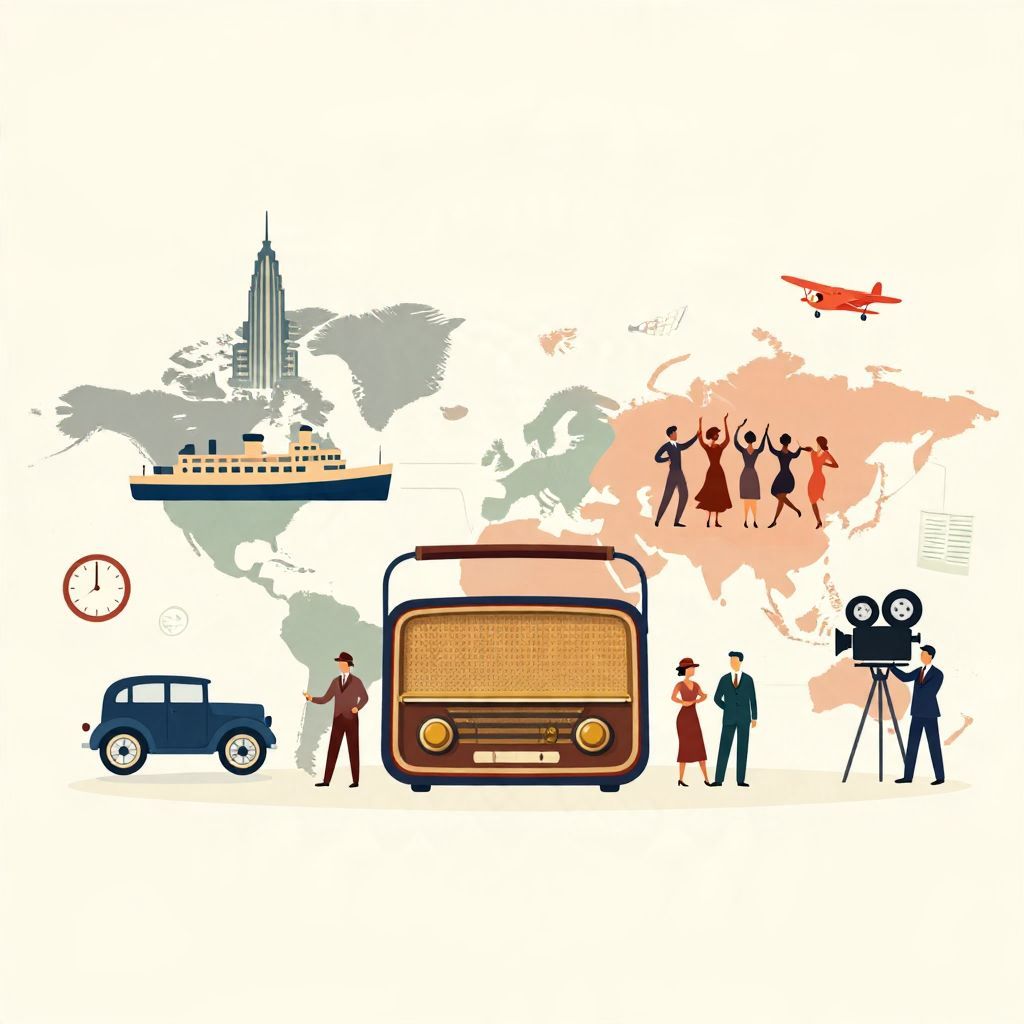
What happened in 1926 was a mix of cultural change, political tension, technological progress, and economic uncertainty. It was a year that helped define the modern 20th century, with major events in Britain, Europe, Asia, and the United States shaping politics, media, labor, and everyday life.
There was no single world-changing event that explains 1926 on its own. Instead, the year stands out because several important developments happened at once: the General Strike in Britain, the rise of new media and mass entertainment, major diplomatic and imperial shifts, and growing signs of the instability that would later deepen into the Great Depression.
What happened in 1926?
In 1926, the world saw a major labor confrontation in Britain, important political changes in Europe and Asia, and continuing social and technological modernization. The year also marked cultural milestones, including the growth of radio, cinema, and consumer culture, while many societies were still recovering from World War I and adjusting to new political realities.
A year of labor unrest and political strain
One of the most significant events of 1926 was the British General Strike, which began in May and lasted nine days. It was called in support of coal miners who faced wage cuts and longer hours after the coal industry struggled with falling profits. The strike showed how sharply industrial societies were divided over wages, labor rights, and government power.
The British General Strike
The General Strike began on 3 May 1926 and ended on 12 May 1926. Around 1.5 million workers joined in sympathy with the miners, including transport workers, printers, and some railway employees. The strike did not bring down the government, but it revealed deep tensions between organized labor, employers, and the state.
Its aftermath was important. The strike failed to win lasting gains for the miners, and the government emerged stronger. At the same time, the event became a landmark in British labor history, influencing later debates about trade unions, collective bargaining, and the role of the state in industrial disputes.
Political change in Europe
Across Europe, 1926 was a period of fragile democratic politics and unresolved postwar problems. In France and Germany, governments remained unstable, while economic reconstruction and international diplomacy continued to shape public life. Many countries were still dealing with inflation, debt, and the political consequences of the First World War and the Treaty of Versailles.
In Poland, Józef Piłsudski carried out the May Coup in 1926, taking power after a period of political instability. His move reflected a wider interwar pattern: many countries were struggling to balance parliamentary democracy with demands for order, nationalism, and stronger executive authority.
What happened in 1926 in the wider world?
Outside Europe, 1926 brought important developments in Asia, the Middle East, and the Americas. Imperial systems were under pressure, nationalist movements were growing, and modern state-building was accelerating. The year did not produce a single global turning point, but it added momentum to long-term changes that would reshape the century.
China and the Northern Expedition
In China, the Northern Expedition continued in 1926 under the Nationalist Party, or Kuomintang. The campaign aimed to unite China by defeating regional warlords and expanding central control. It was part of the larger Chinese National Revolution and helped set the stage for later conflict between Nationalists and Communists.
This mattered because China in the 1920s was still fragmented after the fall of the Qing dynasty. The struggle for national unification was not just military; it was also about who would define China’s future political order.
Turkey and state modernization
In Turkey, the republic created after the collapse of the Ottoman Empire continued its reforms under Mustafa Kemal Atatürk. In 1926, the Turkish Civil Code was adopted, replacing older legal structures and advancing a broader program of secular and legal modernization. This was one of the clearest examples of post-imperial state-building in the interwar period.
The reforms were controversial in their own time, but they became central to the identity of the modern Turkish state.
International diplomacy and the League of Nations
1926 also saw ongoing efforts to build a more peaceful international order after World War I. The League of Nations remained active, though its authority was limited. One of the year’s notable diplomatic moments was Germany’s admission to the League, a sign that former wartime enemies were being gradually reintegrated into international politics.
That development was important, but fragile. The interwar peace system depended on cooperation that was often shallow and politically contested, especially as nationalist resentment and economic instability persisted.
Culture, media, and everyday life in 1926
Beyond politics, 1926 was a year when modern mass culture became more visible. Radio broadcasting expanded, film audiences grew, and newspapers continued to shape public opinion on a large scale. Many people in cities and industrial towns were living with new technologies that changed how they worked, traveled, and entertained themselves.
Radio and mass communication
Radio was becoming a powerful medium in the 1920s, and 1926 was part of that transformation. Broadcasting helped create shared national audiences and made news, music, and entertainment more immediate than ever before. It also gave governments and public figures a new way to reach the public directly.
This shift mattered culturally as well as politically. Radio helped standardize accents, spread popular music, and create a stronger sense of national and international connectedness.
Film, literature, and popular culture
The 1920s were the age of silent cinema, jazz, and changing social norms. In 1926, popular culture reflected both excitement and anxiety about modern life. Cities offered new forms of leisure, while traditional moral debates continued over fashion, gender roles, youth behavior, and consumerism.
Literature and the arts also reflected the postwar mood. Many writers and artists were still responding to the shock of World War I, exploring disillusionment, modern identity, and social change.
Science, technology, and transport in 1926
1926 was also a year of steady technological change. The 1920s saw rapid development in aviation, automobiles, electrical systems, and industrial production. These changes did not transform life overnight, but they steadily altered how people moved, communicated, and imagined the future.
Aviation and exploration
One of the most famous technological milestones associated with 1926 was the first successful liquid-fueled rocket launch by Robert H. Goddard in the United States. This was a small but historically important step in rocketry and space science, even though its significance was not widely recognized at the time.
Such experiments were part of a broader era of scientific curiosity and engineering ambition. The groundwork laid in the 1920s would later matter enormously for aviation, missiles, and space exploration.
Consumer goods and modern living
Households in wealthier parts of the world were increasingly exposed to electric appliances, mass-produced goods, and advertising. Cars were becoming more common in some countries, though ownership was still far from universal. The modern consumer economy was growing, but unevenly, and many people still lived with older patterns of work and domestic life.
Why 1926 mattered historically
What makes 1926 important is not just the number of events that happened, but what they reveal about the era. The year sits in the middle of the interwar period, when the world was trying to rebuild after World War I without yet knowing how unstable the 1930s would become. Labor conflict, political experimentation, imperial decline, and technological change all pointed toward a new modern age.
In that sense, 1926 was both a culmination and a warning. It showed how societies were changing, but also how fragile many of those changes were. The balance between democracy and authoritarianism, labor and capital, empire and nationalism, innovation and insecurity was already under strain.
Timeline of major events in 1926
- 3 May 1926 – The British General Strike begins.
- 12 May 1926 – The General Strike ends after nine days.
- 1926 – The Northern Expedition continues in China.
- 1926 – Germany is admitted to the League of Nations.
- 1926 – Turkey adopts the Civil Code as part of major legal reform.
- 1926 – Robert H. Goddard conducts a pioneering liquid-fueled rocket launch.
- 1926 – Poland experiences the May Coup, bringing Piłsudski to power.
The aftermath of 1926
The consequences of 1926 unfolded over the following years. In Britain, the defeat of the General Strike weakened organized labor in the short term, even as labor politics remained central to national life. In Europe, political instability continued to erode confidence in democratic systems. In Asia, nationalist and revolutionary movements gained strength, setting the stage for larger conflicts later in the decade and beyond.
Technologically and culturally, 1926 helped accelerate the modern world. Radio, film, mass production, and scientific experimentation all advanced further. But the year also belongs to the uneasy interwar era, when progress and instability moved side by side.
So, what happened in 1926? It was a year of labor conflict, political upheaval, modernization, and cultural change—less a single dramatic turning point than a snapshot of a world in transition. For more context on the surrounding era, you may also want to read what happened in 1924 and explore broader historical context through the story of how the Titanic broke in half.