
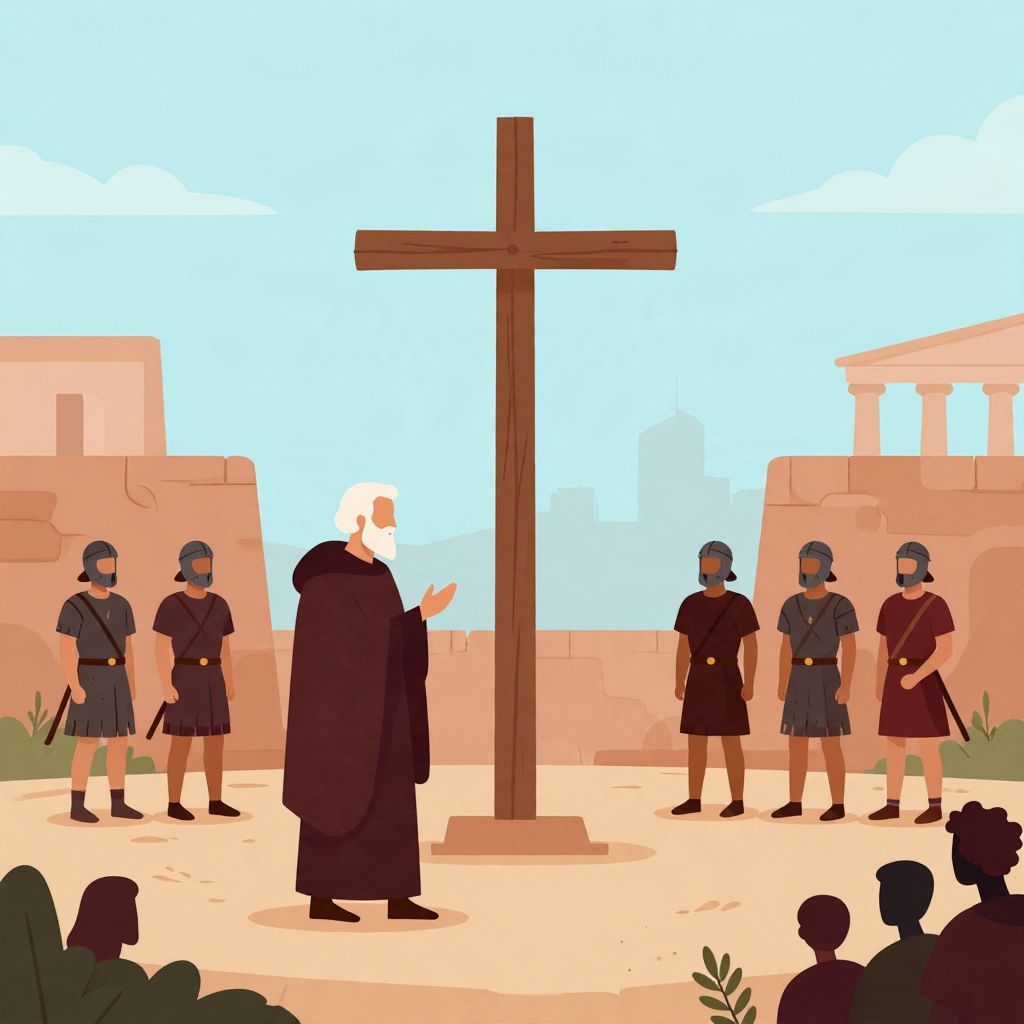
How did Simon Peter die? The short answer is that early Christian tradition says Peter was executed in Rome during the reign of Emperor Nero, probably in the mid-60s CE, and that he was crucified. Later tradition adds that he asked to be crucified upside down, but that detail is not firmly established by the earliest evidence.
Because the surviving sources are limited and written from a religious perspective, historians can say more confidently that Peter was believed to have died as a martyr than exactly how every detail unfolded. His death became one of the most important stories in early Christianity, shaping ideas about authority, sacrifice, and the church in Rome.
How Did Simon Peter Die?
Simon Peter is traditionally said to have died by crucifixion in Rome, likely around 64–68 CE, during or after Nero’s persecution of Christians. The most famous version says he was crucified upside down at his own request, but that specific detail comes from later Christian tradition rather than from the earliest surviving accounts.
What the Historical Evidence Actually Says
There is no contemporary Roman record describing Peter’s death in detail. What historians have are early Christian writings, later church traditions, and indirect references that together make martyrdom in Rome a strong historical conclusion, even if the exact manner of execution remains uncertain.
The earliest clues
One of the most important early witnesses is 1 Peter, which refers to “Babylon,” often understood by scholars as a coded reference to Rome. This does not describe Peter’s death directly, but it supports the idea that Peter was associated with Rome in the late first century. Other early Christian writers, including Clement of Rome and later Ignatius and Irenaeus, treat Peter as a martyr whose witness was tied to the Roman church.
By the early second century, the tradition that Peter died in Rome had become widely accepted among Christians. That does not prove every later detail, but it does show that the memory of Peter’s Roman martyrdom was early and influential, not a medieval invention.
What historians can and cannot confirm
- Well supported: Peter was a leading disciple of Jesus and was later remembered as a martyr.
- Likely: He died in Rome sometime in the mid-1st century CE.
- Probable but not certain: He was executed by crucifixion.
- Uncertain: The upside-down crucifixion story and many dramatic details of the event.
Why Was Peter Executed?
The most likely reason is that Peter, as a prominent leader in the early Christian movement, was caught up in Roman suspicion of Christians, especially in the aftermath of the Great Fire of Rome in 64 CE. Under Nero, Christians were blamed and persecuted as a disruptive and unpopular group. Peter’s leadership would have made him a visible target.
It is important, however, not to imagine a modern-style legal trial with a full written record. Roman treatment of Christians in this period was often harsh, local, and politically driven. Peter may have been executed simply because he represented a movement seen as socially troublesome, religiously deviant, or politically suspect.
Nero and the persecution of Christians
The Roman historian Tacitus later wrote that Nero punished Christians after the fire, describing them as hated for their “abominations.” Tacitus does not mention Peter by name, but his account helps explain the broader environment in which a figure like Peter could have been executed. Rome under Nero was not a safe place for Christian leaders.
Even so, historians remain cautious. We know Nero persecuted Christians, but we cannot prove the exact administrative process by which Peter was condemned. The safest conclusion is that his death fits the pattern of martyrdom in a hostile imperial setting.
Did Simon Peter Really Die Upside Down?
The upside-down crucifixion is one of the most famous stories about Peter, but it is best understood as a later Christian tradition, not a securely documented fact. According to the story, Peter felt unworthy to die in the same manner as Jesus and asked to be crucified head downward.
This account is associated especially with later apocryphal literature, including the Acts of Peter, which is not a historical eyewitness text. The story became powerful because it expressed humility and devotion, but historians generally treat it as symbolic theology rather than verifiable biography.
Why the story spread
Early Christians often used martyr stories to teach faithfulness, courage, and imitation of Christ. Peter’s upside-down crucifixion offered a vivid image of humility: the chief apostle dying in a way that visually reversed honor and status. That made the story memorable and spiritually meaningful, which helped it endure.
But memorable does not always mean factual. The basic martyrdom tradition is ancient; the exact posture on the cross is much harder to establish.
Where Did Peter Die?
Tradition places Peter’s death in Rome, and that location matters enormously in Christian history. Rome was the center of imperial power, and later Christians saw Peter’s death there as a sign that the gospel had reached the heart of the empire. Over time, the Roman church claimed a special connection to Peter because of this tradition.
Archaeological and historical evidence around the Vatican area has long been associated with Peter’s burial, but the evidence is complex and debated. There is no universally accepted proof that a specific tomb can be identified with absolute certainty as Peter’s grave. Still, the long-standing tradition of Peter’s burial near the Vatican became central to Christian memory and later to the building of St. Peter’s Basilica.
Rome as a symbolic setting
Rome was not just another city. It was the capital of the empire that ruled the Mediterranean world. If Peter died there, his death symbolized the clash between a new religious movement and imperial authority. For later Christians, that made his martyrdom especially powerful: the apostle who had followed Jesus in Galilee was said to have borne witness in the empire’s greatest city.
What Happened After Peter’s Death?
Peter’s death did not end his influence. In fact, it strengthened it. Early Christians remembered martyrs as witnesses whose suffering confirmed the truth of their faith. Peter’s death therefore became part of the foundation story of the church, especially in Rome.
His martyrdom also helped shape Christian ideas about leadership. Because Peter was remembered as a chief apostle, later generations used his memory to support claims about apostolic succession, especially in the Roman church. This did not settle all later debates, but it made Peter a central figure in arguments about authority and continuity.
Key consequences of Peter’s death
- It reinforced the idea that Christian faith could require suffering and death.
- It gave the Roman church a powerful apostolic connection.
- It helped define martyrdom as a model of witness in early Christianity.
- It contributed to later traditions about papal authority and succession.
Why Peter’s Death Matters Historically
Peter’s death matters because it sits at the intersection of history, memory, and identity. Historically, it reflects the vulnerability of early Christians in the Roman world. Religiously, it became a defining martyr story. Politically, it helped link Rome to the origins of Christian authority. Few ancient deaths had such a long afterlife in tradition.
It also shows how history is preserved. For ancient figures like Peter, the evidence is often fragmentary, layered, and shaped by later belief. That does not make the story useless. It means historians must separate the strongest historical claims from the later devotional details that grew around them.
History and tradition together
The most responsible answer is not to dismiss Peter’s death because the sources are imperfect, nor to repeat every later legend as fact. Instead, historians recognize a core tradition: Peter probably died in Rome as a martyr, likely by crucifixion, sometime in the 60s CE. The upside-down crucifixion remains possible within tradition but unproven.
Simon Peter in the Broader Story of Early Christianity
Peter’s death also helps explain why he became such a towering figure in Christian memory. He was not remembered simply as one disciple among many. He was seen as a witness to Jesus’ ministry, a leader in the earliest church, and a martyr whose death carried theological meaning. That combination made him uniquely important.
His story also illustrates how early Christianity spread through testimony under pressure. The faith did not grow only through preaching and organization, but through the memory of people who suffered for it. Peter’s death, whether viewed as a historical execution or a sacred witness, became part of that larger narrative.
Conclusion
So, how did Simon Peter die? The best historical answer is that he was probably crucified in Rome in the mid-1st century CE, likely during Nero’s persecution of Christians. The upside-down crucifixion is a later tradition, not a securely proven fact. What is clear is that Peter’s death became one of the most important martyr stories in Christian history, shaping beliefs about suffering, leadership, and the Roman church. For more on ancient and famous deaths, you may also be interested in how Brutus died and how Sonny Liston died.