
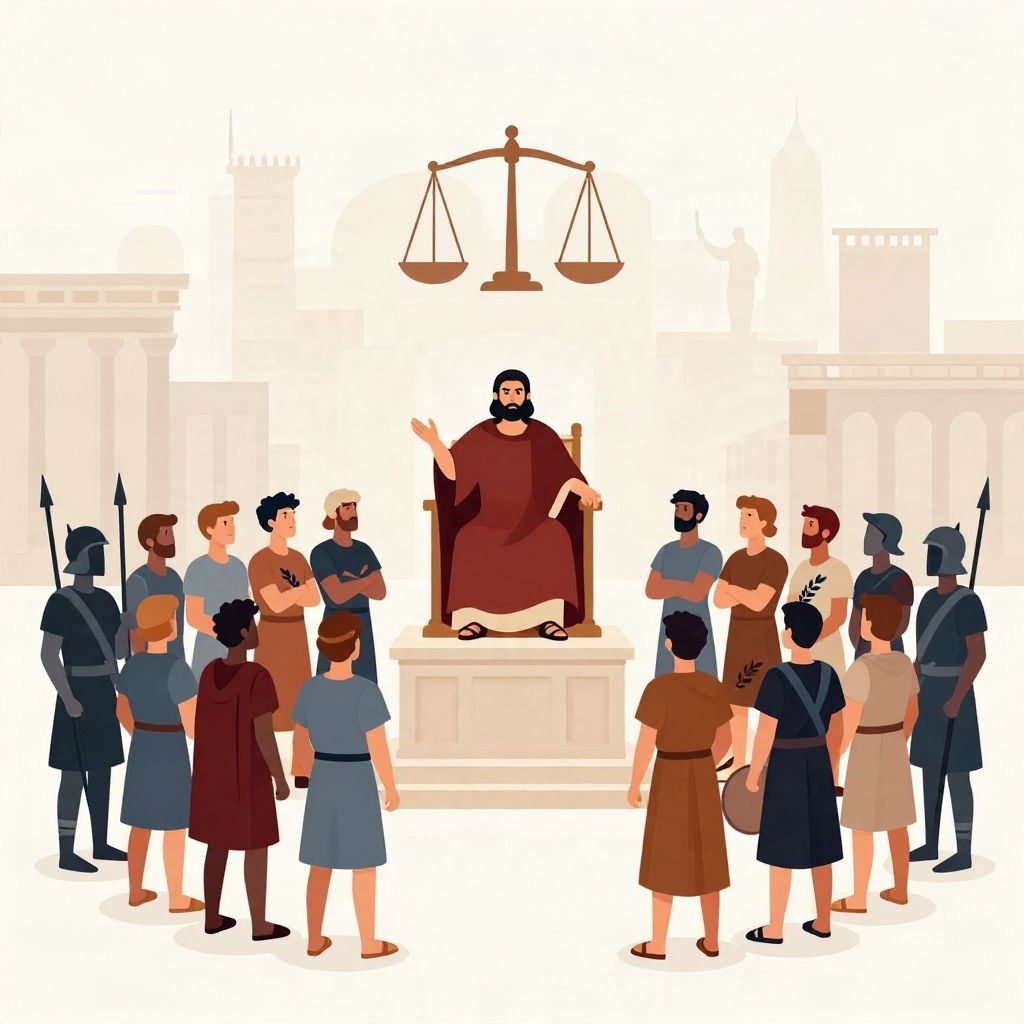
“When tyranny becomes law” is a powerful phrase about the moment authority stops protecting the public and instead uses legal systems to entrench oppression. It is often associated with the warning that law can be turned into a tool of domination when rulers, parties, or states place power above justice.
Historically, the idea helps explain how authoritarian regimes, colonial systems, and even some democracies in crisis have used courts, decrees, emergency powers, and censorship to make abuse look lawful.
When tyranny becomes law, what does it mean?
When tyranny becomes law, it means oppression is no longer carried out only by force or fear; it is written into legal rules, enforced by officials, and presented as legitimate. In history, this has happened when governments weaken checks and balances, silence opposition, and use law to punish enemies while protecting those in power.
The historical meaning of the phrase
The phrase is not a formal legal term from one specific era. It is a political warning used to describe a recurring historical pattern: rulers can make unjust actions seem normal by passing laws, issuing decrees, or controlling courts. The danger is not just cruelty, but cruelty given the appearance of legitimacy.
That distinction matters. A tyrant can rule by violence alone, but tyranny becomes far more durable when it is embedded in institutions. Once courts, police, bureaucracies, and legislatures are made to serve the ruler rather than the public, oppression can continue even when it appears orderly.
Why law matters in tyranny
Law is supposed to limit power, define rights, and provide predictable rules. But in many historical cases, law was used in the opposite way. It became a mechanism for surveillance, confiscation, censorship, forced labor, disenfranchisement, or political imprisonment. The result was not lawlessness, but a legal order designed to serve domination.
How tyranny became law in history
Throughout history, tyranny has become law through a few repeating methods: concentrating executive power, weakening representative institutions, controlling judges, criminalizing dissent, and redefining enemies as threats to the state. These methods appear in different forms across monarchies, empires, dictatorships, and revolutionary governments.
1. Emergency powers and temporary exceptions
One common route is the use of emergency powers. Leaders claim that extraordinary danger requires extraordinary authority. Sometimes real crises exist—war, rebellion, economic collapse, or invasion—but emergency powers can outlive the emergency itself. What begins as a temporary measure may become a permanent expansion of state power.
In modern history, this pattern can be seen in many countries where constitutions were suspended, parliaments sidelined, or rights restricted under the pretext of national security. The legal language of necessity often made repression easier to justify.
2. Legal discrimination
Another route is the creation of laws that target specific groups. These may be based on religion, ethnicity, class, political belief, or social status. Such laws do not always announce themselves as tyranny. They may be presented as public order, purity, reform, or national defense. But their effect is to strip some people of equal protection.
Historical examples include segregation laws, anti-Jewish statutes in various periods, colonial legal systems that ranked subjects unequally, and political codes that denied rights to laborers, women, or dissidents. Tyranny becomes law when inequality is not just tolerated but codified.
3. Controlled courts and sham legality
Courts can either restrain power or legitimize it. In authoritarian systems, judges may be appointed for loyalty, pressured into compliance, or removed if they resist. Trials may still occur, but they are often staged to produce the outcome the regime wants. This creates the appearance of due process while hollowing out justice.
In such systems, legality and justice are no longer the same thing. A person may be convicted under a valid statute, yet the statute itself may be unjust, selectively enforced, or adopted through a corrupted process.
Key historical examples of tyranny made lawful
There is no single event that explains the phrase. Instead, the idea is illuminated by many historical cases in which power was legalized. Some are ancient, some modern, and some remain contested in interpretation. Together, they show how law can be transformed from a safeguard into a weapon.
Ancient Rome and the erosion of republican limits
In the late Roman Republic, extraordinary commands and political violence gradually weakened constitutional norms. Leaders such as Julius Caesar benefited from systems that allowed temporary powers in crises, but repeated exceptions helped undermine republican balance. By the time the Roman Empire emerged, one-man rule had become normalized under the language of order and stability.
Rome is a useful example because it shows that tyranny does not always arrive in a single dramatic moment. It can grow through legal precedents, political intimidation, and the slow collapse of institutional restraint.
Absolute monarchy and the divine right of kings
In early modern Europe, many monarchs claimed that their authority came directly from God and therefore should not be challenged by subjects or assemblies. This did not always mean constant terror, but it did mean that law often protected hierarchy more than liberty. Royal edicts, censorship, and punitive taxation could be justified as legitimate exercises of sovereign power.
Where estates, parliaments, or local privileges survived, they sometimes limited monarchy. Where they were weakened, law increasingly reflected the will of the ruler. The issue was not simply cruelty, but the idea that the ruler stood above ordinary accountability.
Revolutionary terror and the law of suspicion
During the French Revolution, especially in the period known as the Reign of Terror from 1793 to 1794, revolutionary government used legal instruments to identify enemies of the revolution. Revolutionary tribunals, broad definitions of suspicion, and rapid executions turned political fear into policy. The revolution had begun with ideals of liberty and equality, but under crisis, law became a means of coercion.
This period is often misunderstood as pure chaos. In fact, it involved institutions, decrees, and courts. That is precisely why it matters for the history of tyranny: oppression can be highly organized and still be oppressive.
Twentieth-century dictatorships
Modern dictatorships frequently relied on law to consolidate power. Fascist and communist regimes in the twentieth century often preserved constitutions in name while emptying them of meaning. Elections could continue, but only as controlled rituals. Courts could function, but not independently. Police powers expanded, and the state claimed the right to define enemies of the people.
In Nazi Germany, legal measures stripped Jews and other targeted groups of rights step by step, making persecution bureaucratic and systematic. In Stalinist systems, law and party discipline merged in ways that enabled purges, forced confessions, and political terror. In both cases, the state used legality to normalize violence.
Why people accept lawful tyranny
One of the hardest historical questions is why societies tolerate the legalization of oppression. The answer is rarely simple. People may fear chaos more than injustice, especially during war or economic collapse. Others may believe propaganda, trust institutions, or assume that harmful laws will affect only someone else.
Some also support repressive laws because they benefit from them. Tyranny often survives not only through fear, but through incentives: jobs, privileges, land, security, or social status. Law can divide populations, rewarding compliance and isolating dissenters.
Common conditions that help tyranny become law
- Crisis — war, rebellion, or economic breakdown can make people accept extraordinary authority.
- Propaganda — rulers portray opponents as traitors, criminals, or subversives.
- Weak institutions — courts, legislatures, and local governments fail to check executive power.
- Fear — citizens may stay silent to protect themselves and their families.
- Incremental change — oppressive laws are introduced gradually, making resistance harder.
The difference between law and justice
History shows that legality and justice are not always identical. A law can be validly enacted and still be morally wrong. This is one of the central lessons behind the phrase “when tyranny becomes law.” It warns that the existence of a rule does not guarantee fairness, especially if the political system that made the rule is itself corrupted.
That is why many historical reform movements focused not only on changing rulers, but on changing institutions: constitutions, courts, voting rights, press freedoms, and protections for minorities. These were attempts to prevent power from disguising itself as law.
How historians interpret the phrase
Historians generally treat the phrase as a broad political and moral statement rather than a single documented historical quote with one origin. Its enduring value lies in its applicability across eras. It captures a pattern seen in empires, monarchies, revolutions, and modern states: the transformation of coercion into procedure.
Scholars also caution against using the term too loosely. Not every unpopular law is tyranny, and not every strong state is tyrannical. The key historical question is whether law is constrained by accountability, rights, and genuine public participation—or whether it has been captured by rulers to entrench power.
Why the idea still matters today
The history behind “when tyranny becomes law” remains relevant because modern governments still face the temptation to expand authority in the name of security, order, or emergency. Surveillance technologies, executive decrees, emergency legislation, and attacks on independent courts can all raise familiar historical concerns.
The lesson is not that law is inherently dangerous. Rather, law is powerful, and power can be abused. When legal systems stop protecting equal rights and start serving unchecked authority, tyranny no longer needs to hide. It can speak in the language of legality.
The lasting historical warning is simple: a society should not judge its laws only by whether they are written down, but by whether they restrain power, protect rights, and allow dissent. For related reading on power and political violence, see what American imperialism was and why Marie Antoinette was killed.