
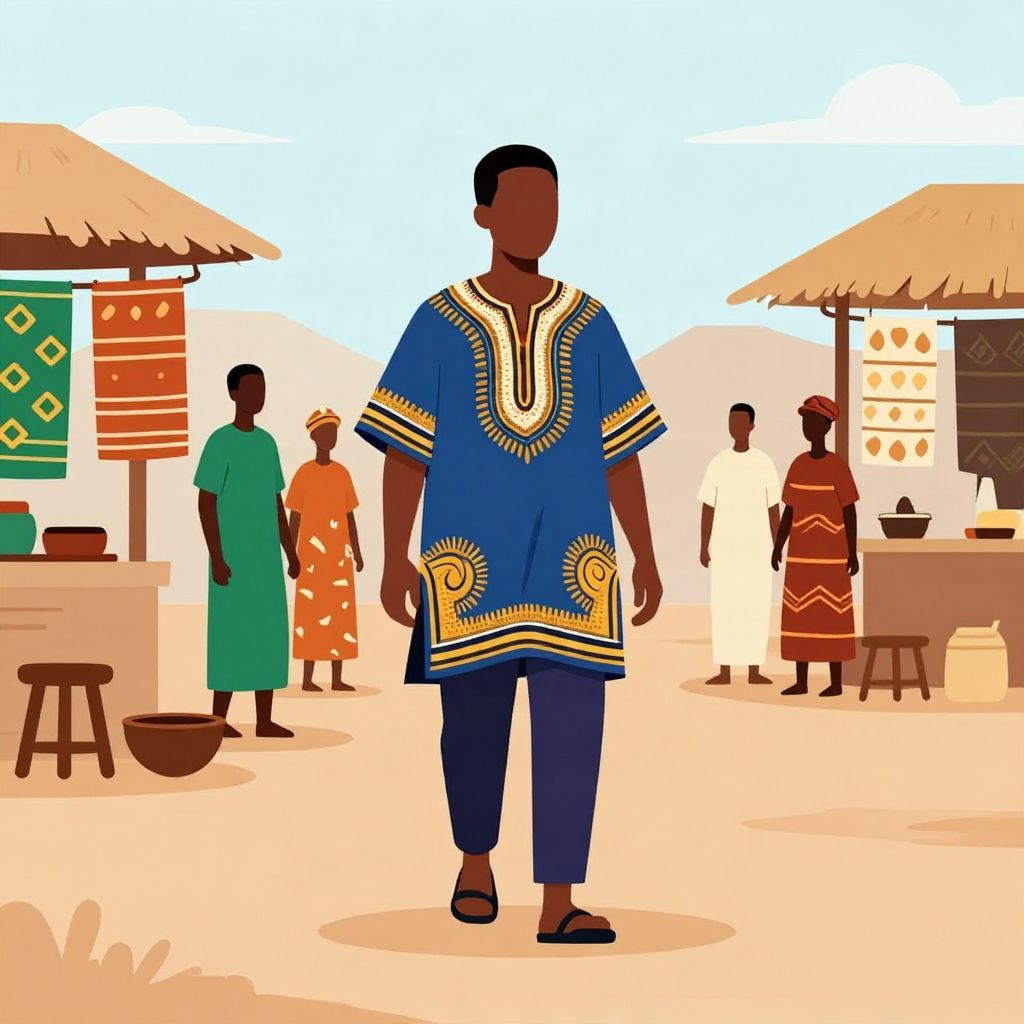
What is a dashiki? It is a loose-fitting, brightly patterned tunic or shirt that became widely associated with West African dress, African identity, and the Black freedom movements of the 20th century. The garment is both practical and symbolic: it can be worn as everyday clothing, ceremonial dress, or a political statement.
Its history stretches across African textile traditions, colonial-era encounters, and modern cultural revival. While many people think of the dashiki as a single “traditional African shirt,” its meaning is more layered than that, shaped by regional fashion, global trade, and changing ideas about heritage.
What Is A Dashiki?
A dashiki is a loose, often brightly colored garment with a V-shaped neckline, sometimes embroidered around the collar and chest. It is commonly worn in West Africa and in the African diaspora. The modern dashiki is best understood as a 20th-century style drawing on older West African clothing traditions rather than as one ancient, unchanging outfit.
Where Did the Dashiki Come From?
The dashiki emerged from West African clothing traditions, especially in regions such as present-day Nigeria, Benin, Togo, Ghana, and neighboring areas. Its form reflects long-standing preferences for loose garments suited to hot climates, along with local textile aesthetics, embroidery, and tailoring. The exact “origin” of the dashiki is not a single moment, because the style developed gradually from older tunics and robes.
Older West African clothing traditions
Before the modern dashiki became recognizable as a named style, many West African societies wore flowing shirts, robes, and wrapper garments made from woven cloth. In some areas, men wore tunics or long shirts over trousers; in others, both men and women used layered cloths that could be adapted for work, ceremony, or status. These garments were often decorated with embroidery, strip-woven fabric, or symbolic patterns.
Trade, textiles, and regional style
West African dress was shaped by trade networks across the Sahara, the Atlantic coast, and inland markets. Imported cottons, locally woven cloth, and later machine-made fabrics all influenced what people wore. The dashiki’s bright colors and bold patterns reflect this history of exchange, where clothing signaled wealth, identity, religious affiliation, or social rank.
How Did the Modern Dashiki Take Shape?
The modern dashiki became widely recognizable in the mid-20th century, especially during the 1960s. Tailors and designers in West Africa and the diaspora adapted older tunic forms into a more standardized garment with a loose body, short or long sleeves, and a decorated neckline. The style spread quickly because it was visually striking, easy to wear, and strongly associated with African pride.
The 1960s and Black cultural politics
In the United States and elsewhere in the African diaspora, the dashiki gained popularity during the civil rights era and the rise of Black Power. Many people wore it as an expression of solidarity with African liberation movements and as a rejection of clothing norms seen as tied to colonial or white-dominated culture. In that context, the dashiki was not just fashion; it was a declaration of identity.
Why the dashiki became symbolic
The dashiki’s symbolism came from several factors at once. Its African associations made it a visible alternative to Western business wear. Its bright fabric challenged the idea that formal clothing had to be dark and restrained. And because it was worn by activists, artists, and students, it became linked to pride, resistance, and cultural reclamation.
What Does the Word “Dashiki” Mean?
The term “dashiki” is commonly associated with West African languages, especially Yoruba usage, though spellings and meanings vary across regions and contexts. In popular usage, the word came to refer to the garment itself. As with many clothing terms that travel across languages, the exact linguistic history is more complex than a single dictionary-style origin story.
Language and naming
Clothing names often change as garments move between communities. A style may exist for generations before receiving a widely used label, or a local term may become generalized through media, trade, and fashion. The dashiki is a good example: the garment’s history is older than the modern name’s global popularity.
What Does a Dashiki Look Like?
Although styles vary, a dashiki usually has a loose cut, a central opening at the neck, and decorative embroidery or printed designs around the collar and chest. It may be sleeveless, short-sleeved, or long-sleeved. Some versions are pullover shirts; others are longer tunic-length garments worn with trousers, skirts, or wrappers.
- Loose fit: allows ease of movement and comfort in warm weather.
- Decorative neckline: often the most distinctive feature.
- Bright fabric: commonly seen in vivid colors and bold prints.
- Versatile use: worn casually, ceremonially, or for cultural expression.
Was the Dashiki Always “Traditional”?
Not in the simple sense people sometimes assume. The dashiki is rooted in African dress traditions, but the version most familiar today is relatively modern. It is better described as a contemporary expression of older traditions than as a fixed ancient costume. That distinction matters because African fashion has always changed through innovation, trade, and contact with other cultures.
Tradition and change in African dress
Calling the dashiki “traditional” can be accurate in a broad cultural sense, but it should not imply that all Africans wore the same garment for centuries. Clothing traditions in Africa are diverse, and styles differ by region, language group, religion, and historical period. The dashiki belongs to that diversity rather than replacing it.
How Did the Dashiki Spread Beyond West Africa?
The dashiki spread through migration, music, political activism, and popular media. African students and professionals abroad wore it, musicians displayed it on stage, and activists adopted it in public life. As a result, the garment became internationally recognizable, especially in the 1960s and 1970s, when global interest in African heritage increased.
Fashion, music, and diaspora identity
Musicians and performers helped make the dashiki visible to wider audiences. In the United States, it appeared in Black cultural spaces as a marker of pride and connection to Africa. In the Caribbean, Europe, and elsewhere, people of African descent used it to express ancestry and belonging. Over time, the dashiki also entered mainstream fashion, sometimes losing some of its political meaning in the process.
Why Is the Dashiki Historically Important?
The dashiki matters because it shows how clothing can carry history. It is not only a garment but also a record of African craftsmanship, diaspora identity, and political change. Its popularity reveals how people use dress to claim dignity, remember ancestry, and communicate values without words.
Key historical meanings
- Cultural continuity: it connects modern wearers to West African textile and tailoring traditions.
- Political expression: it became associated with anti-colonial and Black liberation movements.
- Identity and pride: it offered a visible way to affirm African heritage.
- Global influence: it moved from regional dress to an internationally recognized style.
Common Misunderstandings About the Dashiki
One common mistake is to treat the dashiki as the single “African outfit.” Africa is a vast continent with many clothing traditions, and the dashiki is only one style among many. Another misunderstanding is to assume that it has one fixed meaning. In reality, its significance changes depending on who wears it, where, and why.
Not all African dress is the same
Clothing traditions in North, West, East, Central, and Southern Africa differ widely. Some are shaped by Islamic dress customs, others by local weaving traditions, climate, class, or colonial history. The dashiki is important, but it should be seen within this larger and more varied history of African dress.
The Dashiki Today
Today, the dashiki continues to appear in cultural celebrations, religious events, weddings, festivals, and everyday wear. It also remains a fashion item in the global market, sometimes produced in mass quantities and sometimes made by local artisans. For many people, wearing a dashiki still carries a sense of heritage, even when the garment is styled in modern ways.
Continuing relevance
The dashiki’s endurance shows that clothing can survive because it is adaptable. It can be worn as a statement of ancestry, a celebration of African aesthetics, or simply as a comfortable and attractive garment. Its history is therefore both local and global, rooted in West African traditions yet transformed by modern diaspora life.
So, what is a dashiki? It is a West African-inspired tunic with deep cultural meaning, shaped by centuries of dress traditions and by the politics of the 20th century. Its story is a reminder that clothing is never just fabric: it can preserve memory, express identity, and carry history across generations. For related cultural history topics, you may also want to explore African textile traditions and Black Power and cultural symbolism.