
If you are asking when the first car was made in America, the short answer is that the United States produced some of its earliest gasoline-powered automobiles in the late 1880s and early 1890s. The most commonly cited milestone is 1885–1886, when inventors such as George B. Selden and later Charles and Frank Duryea began building experimental American cars.
The exact “first car” depends on how you define a car: a working prototype, a road-tested vehicle, or the first commercially sold automobile. That distinction matters, because American automotive history began as a series of experiments rather than a single clear-cut invention date.
When Was the First Car Made in America?
The first American-made cars appeared in the 1880s, with the best-known early claim tied to 1885–1886. If you mean the first practical gasoline automobile built in the United States, the Duryea brothers’ car of 1893 is often treated as the first successful American gasoline car. If you mean the first commercially sold American car, that came a little later, in the 1890s.
Why the Answer Is Not a Single Date
Automobile history is messy because early builders were not all making the same thing. Some created steam-powered vehicles, some electric ones, and some gasoline-powered machines. Others built prototypes that never reached the road. So the “first car made in America” can mean different things depending on whether you are asking about invention, operation, production, or sale.
Three different “firsts” people often mean
- First American automobile concept or patent: early experimental designs in the 1880s.
- First successful gasoline car built in America: usually associated with the Duryea brothers in 1893.
- First American car sold commercially: late 1890s, as automobile manufacturing began to emerge as an industry.
The Early American Car Pioneers
American inventors were working on self-propelled vehicles while the automobile was still a new idea in Europe. These early efforts drew on bicycle technology, small engines, and mechanical experimentation. The United States did not invent the car from nothing, but American builders quickly adapted and improved the concept.
George B. Selden and the 1885 patent claim
One of the most famous early American names is George B. Selden, who filed a patent application in 1879 and eventually received a patent in 1895 for a road vehicle powered by an internal combustion engine. Selden is often linked to the “first American car,” but his role is controversial. He did not build a widely used working car in the 1880s, and his importance lies more in patent history than in producing the first practical automobile.
Selden’s case shows why historians are careful with the phrase “first car.” A patent can be historically important without being the same thing as a functioning, roadworthy car.
The Duryea brothers and the first practical gasoline car
Charles and Frank Duryea are usually credited with building the first successful gasoline-powered automobile in America in 1893. Their vehicle was tested in Springfield, Massachusetts, and later became the basis for one of the earliest American automobile companies. This is often the strongest answer if the question is about a real, working American gasoline car rather than an idea on paper.
The Duryeas mattered because they moved beyond experiment and into practical road use. Their work helped prove that gasoline automobiles could function in the United States, where roads, weather, and distances posed different challenges than in Europe.
What Was the First Car in America Like?
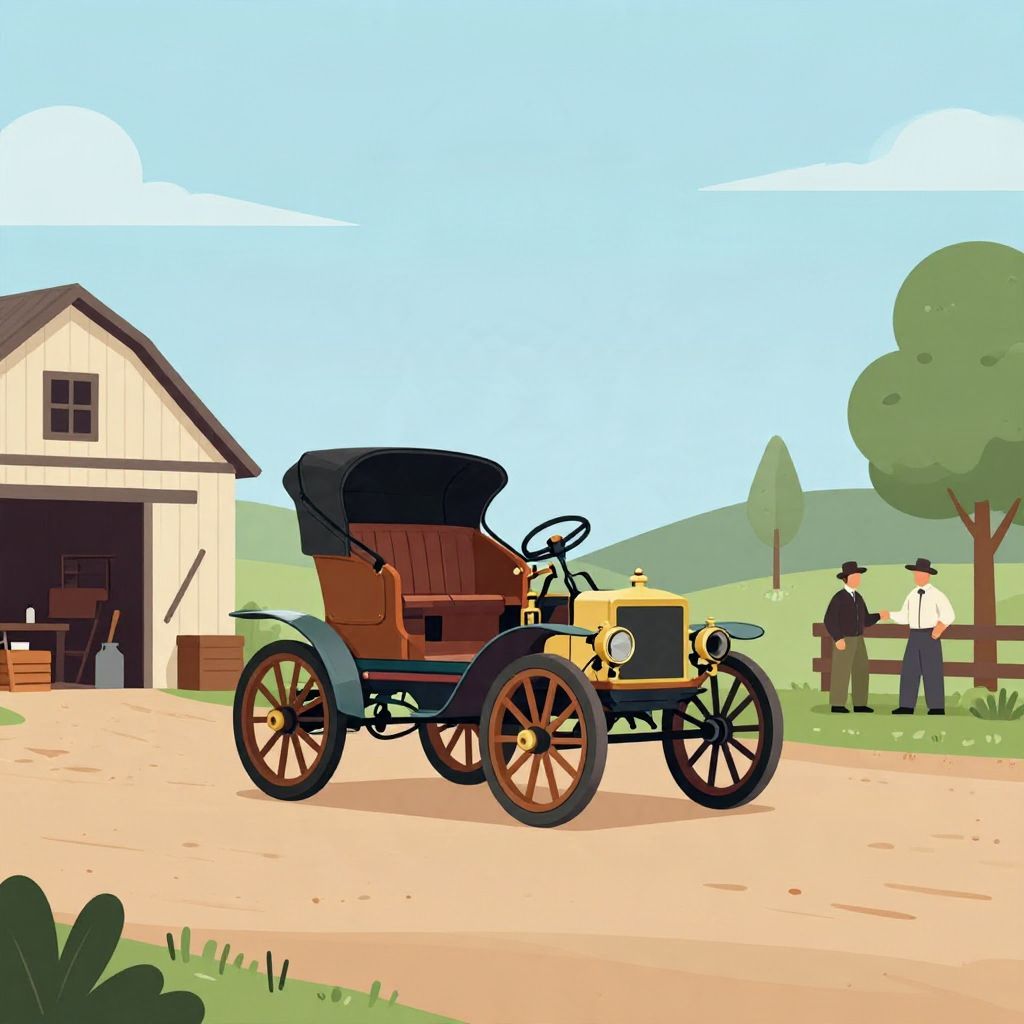
Early American cars were very different from modern automobiles. They were slow, noisy, unreliable by today’s standards, and often looked more like motorized carriages or bicycles than the cars we know now. Many had open frames, thin wheels, and simple controls. They were handmade, not mass-produced.
Common features of early cars
- Lightweight wooden or metal frames
- Small single-cylinder or twin-cylinder engines
- Chain or belt drive systems
- Very low top speeds compared with later automobiles
- Little protection from weather or rough roads
These early vehicles were not yet part of everyday life. They were experimental machines for inventors, mechanics, and wealthy early adopters.
How America Entered the Automobile Age
The first American cars emerged during a period of rapid industrial change. The late 19th century saw improvements in machine tools, metallurgy, engine design, and bicycle manufacturing. Those developments made it possible for inventors to build lighter and more reliable vehicles than earlier steam wagons or heavy experimental machines.
Why gasoline engines became dominant
Steam and electric vehicles also existed in the 1890s, and in some places they were competitive. But gasoline engines gradually won out because they offered longer range, faster refueling, and better suitability for expanding road travel. That did not happen overnight. In the earliest years, American carmakers tested several power sources before gasoline became the standard.
This competition is one reason the phrase “first car made in America” can be misleading. The American automobile industry began as a contest among technologies, not a straight line from one invention to the next.
From Prototype to Industry
The period from the 1880s through the 1890s was the transition from invention to industry. At first, cars were handmade curiosities. Then a small number of builders began selling vehicles, attracting investors, and proving that automobiles could become a business. By the turn of the 20th century, American carmaking was no longer just an experiment.
Important milestones in early American car history
- 1880s: American inventors begin experimenting with self-propelled road vehicles.
- 1893: The Duryea brothers build a practical gasoline car in the United States.
- 1890s: Early American automobile companies begin to form and sell vehicles.
- Early 1900s: The automobile becomes a growing industry rather than a novelty.
Once cars could be built, sold, and repaired more consistently, the automobile moved from invention to social change. It reshaped travel, commerce, and eventually American landscapes themselves.
Why the First American Car Matters
The first American cars were more than odd machines. They marked the beginning of a transportation revolution that would transform daily life. Roads, suburbs, gas stations, repair shops, and eventually mass production all followed from these early experiments. The automobile also changed where people lived, how they worked, and how goods moved across the country.
In that sense, the “first car made in America” is not just a technical milestone. It is the opening chapter in a much larger story about industrial growth, mobility, and the modern United States.
The Best Historical Answer
If you want the most accurate short answer, say this: the first cars made in America appeared in the 1880s, with the most important practical gasoline-car breakthrough coming in 1893. If you are speaking strictly about the first successful American gasoline automobile, the Duryea brothers are the key names. If you are speaking about the earliest patent or concept, George B. Selden enters the story, though his claim is more complicated.
So the date depends on what “first” means, but the historical story is clear: America’s automobile age began in the late 19th century, when inventors turned the idea of a self-propelled vehicle into a working reality. For more broader historical context, you may also enjoy reading about the oldest city in America and what happened in 1924.