
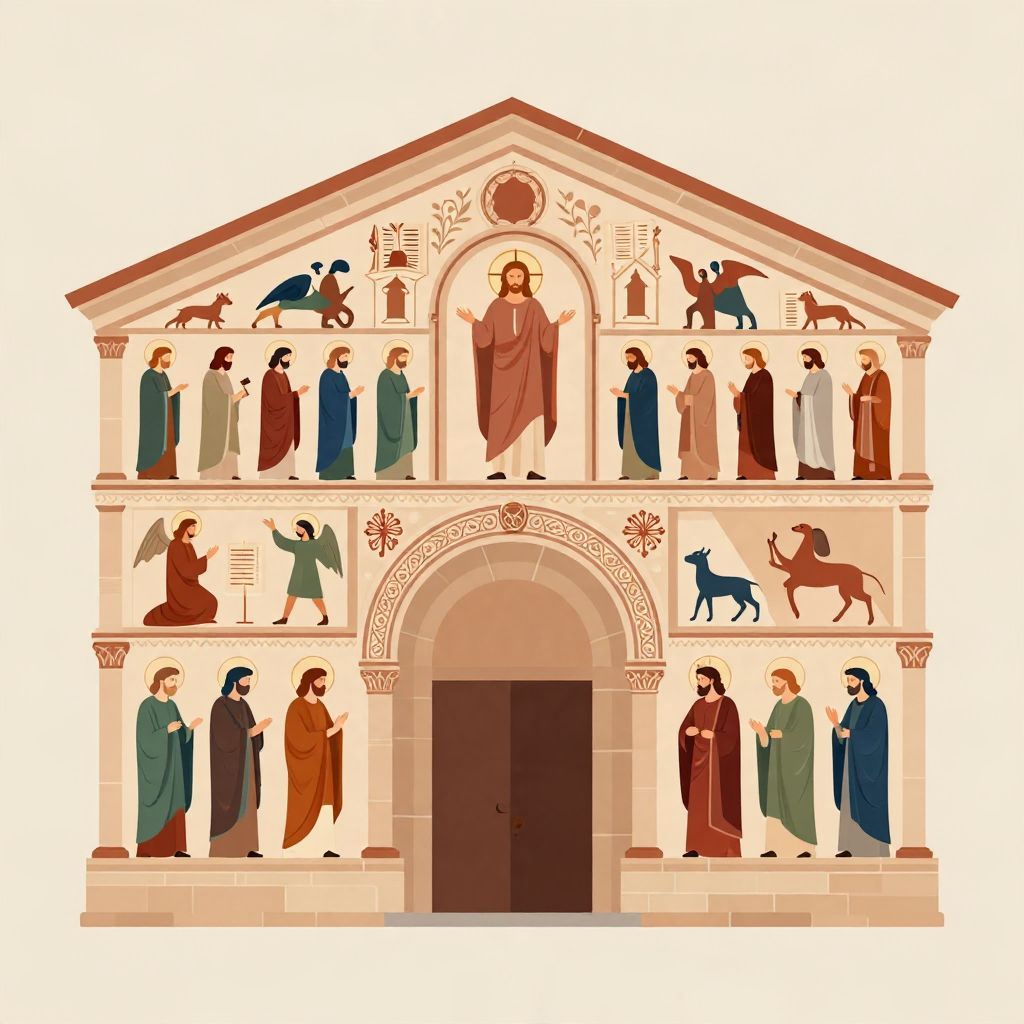
What themes were prevalent in Romanesque art? The short answer is that Romanesque art, which flourished across western Europe roughly from the 10th to the 12th centuries, was dominated by religious subjects. Its images were designed to teach Christian doctrine, inspire devotion, and warn viewers about sin and salvation.
Because most people could not read, churches used sculpture, frescoes, manuscript illumination, and stained glass to communicate biblical stories and moral lessons. Romanesque art therefore centered on Christ, the Virgin Mary, saints, the Last Judgment, heaven and hell, and symbolic animals and monsters that carried moral meaning.
What themes were prevalent in Romanesque art?
The most prevalent themes in Romanesque art were Christian and didactic: scenes from the Bible, Christ in glory or judgment, the Virgin and saints, the struggle between virtue and vice, and visions of salvation or damnation. These themes reflected the Church’s central role in medieval life and the need to teach faith visually.
The religious purpose of Romanesque imagery
Romanesque art developed in a deeply Christian society where monasteries, cathedrals, and pilgrimage churches were major centers of learning and worship. Art was not made primarily for decoration. It was meant to instruct, persuade, and shape religious feeling. That is why its themes are so often moral, symbolic, and scriptural.
In churches, images functioned almost like a visual sermon. A sculpted tympanum over a doorway or a painted apse could present a sacred narrative to worshippers as they entered the building. The message was clear: human life was judged by God, and salvation depended on faith, repentance, and the Church’s sacraments.
Why biblical stories mattered so much
Biblical scenes were among the most common subjects because they provided a shared framework for understanding Christian belief. Artists depicted episodes from the Old and New Testaments, often selecting those that emphasized prophecy, redemption, and divine authority. The life of Christ was especially important, since it connected birth, sacrifice, resurrection, and final judgment into one theological story.
Commonly represented scenes included the Nativity, the Crucifixion, the Resurrection, the Ascension, and Christ enthroned in majesty. These images were not always naturalistic or historically realistic. Instead, they were arranged to communicate spiritual truths more than earthly detail.
Christ as judge, ruler, and redeemer
One of the most powerful Romanesque themes was Christ in Majesty, often shown seated on a throne, surrounded by a mandorla, and accompanied by the symbols of the four Evangelists. This image emphasized Christ’s authority over the universe and his role as judge at the end of time. It was especially common on church portals and in apse decoration.
The Last Judgment was another major theme. Romanesque artists often showed the saved and the damned divided at the end of history, with angels and demons contending for human souls. These scenes were intended to awaken moral reflection and fear of sin, especially in spaces where pilgrims and worshippers gathered.
Heaven and hell as visual warnings
Romanesque art frequently contrasted bliss and punishment. The blessed might be shown in ordered procession, welcomed into paradise, or gathered under Christ’s protection. The damned, by contrast, were often dragged by demons, swallowed by monsters, or cast into flames. Such imagery was not merely dramatic; it reinforced the medieval idea that earthly conduct had eternal consequences.
These scenes could be unsettling, but that was part of their function. Medieval viewers were meant to feel both awe and caution. The art taught that divine justice was real, and that the church building itself was a threshold between the ordinary world and sacred truth.
The Virgin Mary and the saints
Another prevalent theme in Romanesque art was devotion to the Virgin Mary. She appears in scenes such as the Annunciation, Nativity, and Adoration of the Magi, and she is often shown as an intercessor who stands close to Christ. Her growing prominence in medieval devotion helped make Marian imagery especially important in churches and illuminated manuscripts.
Saints were also widely represented. Their lives offered models of holiness, endurance, and miracle-working power. Local saints could be especially significant, since churches and monasteries often promoted the relics and legends of their own patron figures. This gave Romanesque art both universal Christian meaning and local identity.
Martyrdom, miracles, and holy example
Many saintly images focused on martyrdom, healing, or miraculous intervention. These stories demonstrated that holiness could triumph over violence, illness, and death. For medieval audiences, saints were not distant historical figures but active spiritual protectors. Their images encouraged prayer, pilgrimage, and trust in divine aid.
Some saints were shown in calm, frontal poses that stressed sanctity and authority rather than narrative action. Others appeared in dramatic scenes of suffering or miracle. Both approaches served the same purpose: to make holiness visible and memorable.
Old Testament scenes and prophecy
Romanesque artists also drew heavily on the Old Testament. These stories were often understood as prefigurations of Christian truth, meaning that earlier events in Jewish scripture were seen as pointing forward to Christ. This interpretive approach was central to medieval theology and shaped many artistic programs.
Figures such as Adam and Eve, Noah, Abraham, Moses, David, and Daniel appear repeatedly in Romanesque decoration. Their stories could illustrate obedience, disobedience, covenant, sacrifice, deliverance, and divine law. In church settings, Old Testament scenes helped viewers see the continuity between biblical history and Christian salvation.
Typology in Romanesque art
One of the most important intellectual frameworks behind Romanesque imagery was typology, the idea that events in the Old Testament foreshadowed events in the New. For example, Jonah’s emergence from the fish could symbolize Christ’s resurrection, while the sacrifice of Isaac could suggest Christ’s own sacrifice. This method gave Romanesque art a layered, symbolic structure.
Typological thinking meant that a single image could carry several meanings at once. To a medieval viewer, it was not just a story illustration. It was a visual argument about the unity of scripture and the fulfillment of divine history.
Animals, monsters, and symbolic creatures
Romanesque art is famous for its lively and sometimes strange bestiary of lions, griffins, serpents, dragons, birds, and hybrid creatures. These were not random decorations. They often carried moral, spiritual, or allegorical meanings. Animals could stand for virtues, vices, temptation, vigilance, or the battle between good and evil.
Such imagery was especially common in sculpture on churches, where carved capitals, portals, and cloisters offered space for symbolic invention. Some creatures were borrowed from classical tradition or from the wider medieval imagination, while others came from bestiaries, books that explained animal behavior in moral terms.
Why strange creatures appear so often
Monsters and hybrids helped Romanesque artists express ideas that ordinary natural forms could not easily convey. A beast devouring a person might symbolize sin or hell. A lion could represent strength, Christ, or royal authority depending on context. The meaning was often shaped by placement, accompanying figures, and the overall design of the building.
These images also reveal the medieval fascination with the boundary between the known and the unknown. Romanesque art did not separate the sacred from the marvelous as sharply as modern viewers might expect. Instead, the world of signs, wonders, and moral lessons was richly interconnected.
Everyday labor, social order, and medieval life
Although Romanesque art is best known for religious themes, it sometimes included scenes of daily life, labor, and social order. These could appear in manuscript calendars, church sculpture, and decorative programs. Farmers, craftsmen, musicians, and feasting figures remind us that medieval art was not only about heaven and hell; it also reflected the rhythms of earthly life.
The months of the year were sometimes paired with agricultural tasks such as plowing, harvesting, pruning, or threshing. Such imagery linked sacred time to the practical cycle of work. It also reinforced the idea that human life unfolded under divine order, with each season carrying its own meaning.
How secular motifs fit a sacred world
Even when Romanesque art depicted ordinary activities, those scenes usually served a broader symbolic purpose. Work could represent the burden of life after the Fall. Feasting might suggest abundance, but also excess. Musicians and dancers might appear in contexts that hinted at celebration, temptation, or social hierarchy. In other words, the secular was rarely purely secular.
This blending of sacred and everyday imagery is one reason Romanesque art feels so vivid. It reflects a culture in which religion structured daily existence, but daily existence still found a place in artistic expression.
Pilgrimage and the spread of Romanesque themes
Romanesque art spread widely across Europe in part because of pilgrimage routes, monastic networks, and the growth of stone church building. Major shrines such as Santiago de Compostela in Spain drew travelers from across the continent, encouraging the exchange of artistic ideas and iconographic themes.
Pilgrimage churches needed durable and legible images for large crowds. As a result, sculpted portals, painted apses, and decorated cloisters became ideal spaces for large-scale religious storytelling. The repetition of certain themes across regions helped create a shared visual language for medieval Christianity.
Regional variety within a common tradition
Although the themes were broadly similar, Romanesque art varied by region. French, Spanish, Italian, German, and English works all developed local styles and preferences. Some areas emphasized monumental sculpture, while others favored wall painting or manuscript illumination. Yet the underlying themes remained recognizably Christian, moral, and symbolic.
This balance of unity and diversity is one of the defining features of Romanesque culture. The same basic messages could be adapted to different materials, patrons, and audiences.
Romanesque art in manuscripts, sculpture, and architecture
The themes of Romanesque art were not limited to one medium. In illuminated manuscripts, artists illustrated biblical texts, saints’ lives, and liturgical books with bold color and expressive line. In sculpture, they carved portals, capitals, and reliefs with dramatic scenes and symbolic figures. In architecture itself, the building form often reinforced the art’s message through processional routes and sacred focal points.
This integration of image and structure made Romanesque churches immersive environments. A worshipper might move from a carved entrance showing judgment and salvation into a nave filled with painted or sculpted reminders of sacred history. The building became a visual map of Christian belief.
What these themes reveal about Romanesque culture
The prevalence of these themes tells us that Romanesque art was deeply shaped by medieval Christianity, clerical teaching, pilgrimage, and a symbolic understanding of the world. Its artists were not trying to create neutral decoration. They were participating in a culture that saw images as tools for instruction, devotion, memory, and moral discipline.
At the same time, Romanesque art was not monotonous. Within its religious framework, artists found room for creativity, regional style, narrative detail, and imaginative creatures. Its themes were consistent because its purpose was consistent: to make invisible spiritual realities visible to ordinary people.
In the end, the most prevalent themes in Romanesque art were biblical narrative, Christ’s authority, the Virgin and saints, judgment, salvation, and moral symbolism. If you want to explore how these ideas changed in later centuries, you may also enjoy reading about Gothic art and medieval Christianity.