
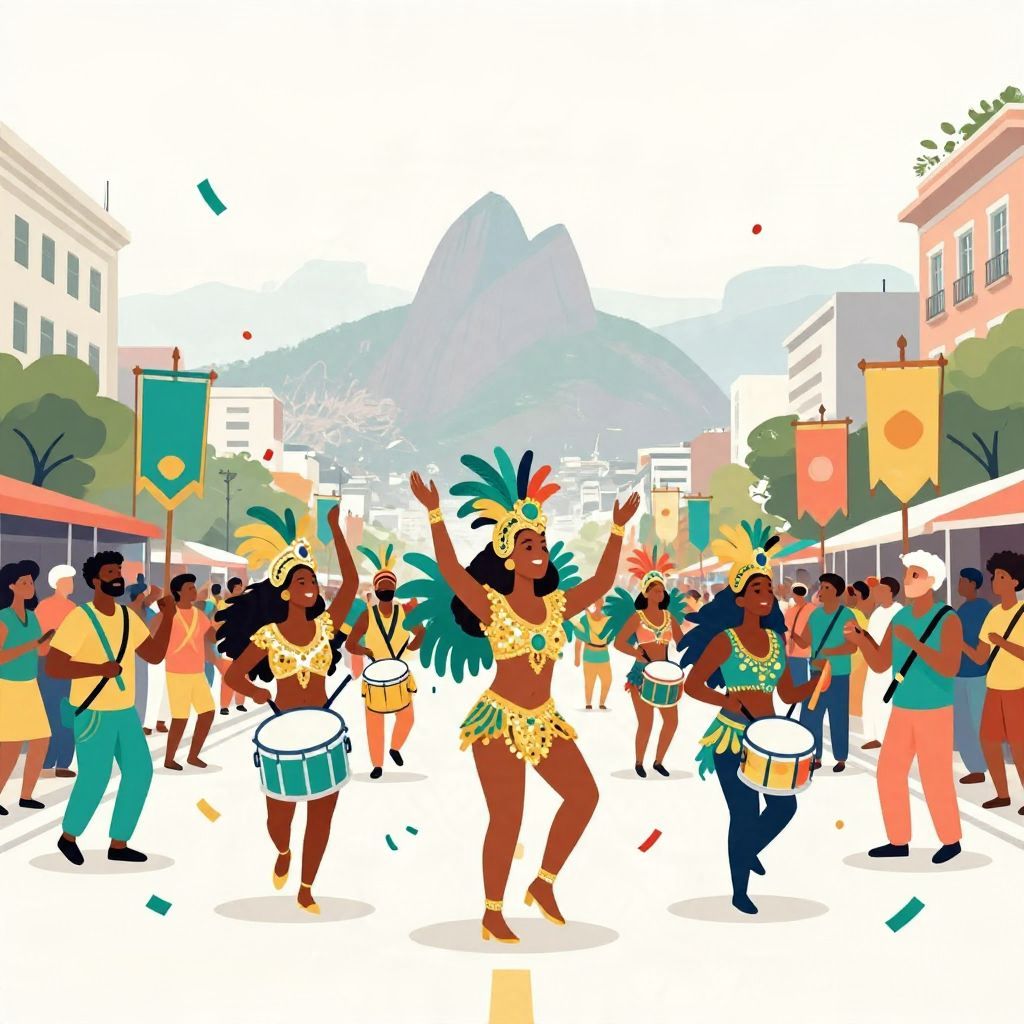
What is a Brazilian Carnival? It is Brazil’s most famous pre-Lenten festival, a season of street parades, music, dancing, costumes, and public celebration that peaks in the days before Ash Wednesday. Rooted in Catholic calendar traditions but shaped by African, Indigenous, and European influences, Carnival became one of Brazil’s most important cultural expressions.
Its modern form is not ancient in a single, simple sense. Brazilian Carnival grew over centuries, especially in the colonial and postcolonial periods, as enslaved Africans, free people of color, immigrants, and urban communities transformed older European customs into a distinctly Brazilian celebration.
What Is a Brazilian Carnival?
Brazilian Carnival is a nationwide festival held before Lent, combining religious timing with popular celebration. In its best-known forms, it includes samba parades, blocos, masked balls, street parties, costumes, and music. The festival varies by region, but it is generally a public, communal event that mixes performance, satire, and social competition.
Where Did Brazilian Carnival Come From?
The origins of Brazilian Carnival lie in European pre-Lenten customs, especially Portuguese traditions brought during colonization beginning in the 1500s. These customs included public revelry before the fasting season of Lent, when Christians traditionally prepared for Easter through restraint and reflection. In Brazil, those customs encountered local and African cultural practices and changed dramatically over time.
One early influence was the Portuguese entrudo, a rough street festival in which people threw water, flour, mud, or scented liquids at one another. In colonial Brazil, entrudo was common in towns and cities, but it was often criticized by elites as disorderly or uncivilized. Even so, it helped establish the idea that the days before Lent were a time for public inversion, play, and release.
How African and Afro-Brazilian traditions shaped Carnival
African cultural influence was central to the making of Brazilian Carnival. Enslaved Africans and their descendants brought musical traditions, rhythms, dances, drumming, and styles of communal performance that became foundational to Brazilian popular culture. Over time, Afro-Brazilian communities helped turn Carnival into a musical and street-based festival rather than only a European-style masquerade.
This influence was especially strong in cities such as Rio de Janeiro, Salvador, and Recife. In these places, Black communities created spaces for celebration, mutual support, and cultural expression even under slavery and racial hierarchy. Carnival became one of the few public moments when social boundaries could be challenged, though never erased.
How Did Carnival Develop in Brazil?
Brazilian Carnival developed gradually from colonial street disorder into organized urban spectacle. By the 19th century, elite masquerade balls, parades, and club celebrations were becoming more common, especially in Rio de Janeiro. At the same time, popular street forms continued to grow among working-class and Afro-Brazilian communities, giving Carnival both top-down and bottom-up traditions.
The 19th century was important because Brazilian cities were changing rapidly. Urban growth, abolitionist debates, immigration, and new forms of mass entertainment all affected Carnival. The festival became a place where class, race, and political identity were performed in public. It was not just a holiday; it was a social stage.
The rise of samba and the modern parade
The modern image of Brazilian Carnival is closely tied to samba, which emerged in Afro-Brazilian communities in the late 19th and early 20th centuries. Samba developed from older musical forms with roots in Bahia and Rio de Janeiro. As it spread, it became associated with Carnival songs, dance, and eventually organized parade competitions.
By the early 20th century, Carnival in Rio increasingly featured escolas de samba, or samba schools. Despite the name, these are not schools in the academic sense. They are neighborhood-based cultural associations that prepare elaborate annual performances. Each school develops a theme, music, costumes, floats, and choreography for the parade.
The samba school parade became a hallmark of Rio’s Carnival in the 20th century, especially after the event was formalized and expanded through organized competition. This gave Carnival a highly visible, theatrical form that could be broadcast, photographed, and nationally celebrated.
Why Is Brazilian Carnival So Important Historically?
Brazilian Carnival matters because it reveals how a colonial festival became a national cultural symbol. It shows the blending of European, African, and Indigenous influences in Brazilian history, and it highlights the role of popular culture in shaping national identity. Carnival also reflects deeper social tensions: celebration and control, inclusion and exclusion, freedom and hierarchy.
Historically, Carnival has been both a release valve and a site of contest. Authorities have often tried to regulate it because large crowds, satire, and bodily freedom can challenge public order. At the same time, communities have used Carnival to assert identity, preserve traditions, and claim space in the city.
Carnival and social hierarchy
For much of Brazilian history, Carnival mirrored the inequalities of society even as it temporarily blurred them. Wealthy participants could attend private balls and sponsor parades, while poorer Brazilians often filled the streets with their own music and costumes. Racialized exclusion was real, yet Afro-Brazilian creativity remained essential to the festival’s character.
In this sense, Carnival is a good example of how popular culture can be both liberating and structured by power. It was never simply a free-for-all. It was shaped by policing, class distinctions, racial prejudice, and changing ideas about respectability.
What Are the Main Forms of Brazilian Carnival?
Brazilian Carnival is not one single event but a family of celebrations that vary by region. The most famous forms are Rio de Janeiro’s samba parade, Salvador’s street music and trio elétrico culture, and northeastern traditions in cities such as Recife and Olinda. Each region has its own history and style.
- Rio de Janeiro: famous for samba school parades, large floats, and competitive performances.
- Salvador: known for massive street parties, electric sound trucks, and strong Afro-Brazilian musical traditions.
- Recife and Olinda: celebrated for frevo, maracatu, giant puppets, and historic street processions.
These regional differences matter because they show that Carnival is not a single invention from one city. It is a national festival with local histories, shaped by migration, slavery, urbanization, and musical innovation.
Street Carnival and blocos
In many cities, blocos are central to Carnival. These are informal or organized street groups that gather musicians, dancers, and revelers around a shared route or theme. Blocos can be small neighborhood events or enormous public gatherings. Their popularity shows how Carnival remains rooted in street participation rather than only staged performance.
How Did the State and Media Change Carnival?
As Brazil modernized in the 20th century, Carnival became more organized, commercialized, and nationally visible. Radio, newspapers, television, and later digital media helped turn local celebrations into national spectacles. The state also played a role, sometimes promoting Carnival as a symbol of Brazilian identity and tourism.
This support brought benefits and tensions. On one hand, official recognition helped preserve and expand Carnival traditions. On the other, commercialization could favor spectacle over community participation, and state regulation could marginalize informal or politically disruptive forms of celebration.
In Rio, for example, the samba school parade became a highly structured event with judging rules, sponsorships, and major audiences. That structure did not eliminate creativity, but it changed the balance between neighborhood culture and mass entertainment.
Is Brazilian Carnival Religious or Secular?
Brazilian Carnival is both. It is tied to the Christian calendar because it occurs before Lent, but many participants experience it primarily as a cultural and social festival rather than a religious observance. Historically, its timing comes from Catholic tradition, while its content has been shaped by music, dance, and public performance from many backgrounds.
This dual character helps explain its endurance. Carnival can be understood as a last burst of festivity before a period of restraint, but it is also a living cultural institution that has outgrown any single religious meaning. For many Brazilians, it is a tradition, an art form, and a public expression of identity at once.
What Are the Key Facts About Brazilian Carnival?
A few core facts help clarify the festival’s historical place. It is celebrated annually before Lent, usually in February or early March, depending on the Christian calendar. Its roots go back to colonial-era Portuguese customs, but its modern identity was formed through Afro-Brazilian cultural creativity and urban development in the 19th and 20th centuries.
- Timing: It takes place in the days before Ash Wednesday.
- Origins: It grew from Portuguese pre-Lenten customs such as entrudo.
- Influences: African, Afro-Brazilian, European, and regional Brazilian traditions all shaped it.
- Forms: It includes samba parades, blocos, street parties, masked events, and regional music traditions.
- Meaning: It is both a festive holiday and a major expression of Brazilian cultural history.
What Does Brazilian Carnival Tell Us About Brazil’s History?
Brazilian Carnival tells a larger story about the country itself. It reflects colonial encounters, slavery, urban life, race relations, popular religion, and the making of national culture. It also shows how marginalized communities have shaped Brazil’s most visible traditions, even when power structures tried to contain them.
That is why Carnival is more than a party. It is a historical institution built over centuries, one that continues to evolve while carrying traces of Brazil’s colonial past, Afro-Brazilian creativity, and modern urban life. To understand Brazilian Carnival is to understand how history can live in music, movement, and public space.
If you want to explore related cultural traditions, you may also find what capoeira is and performative cultural roles in Japan useful comparisons for how history shapes public art and identity.