
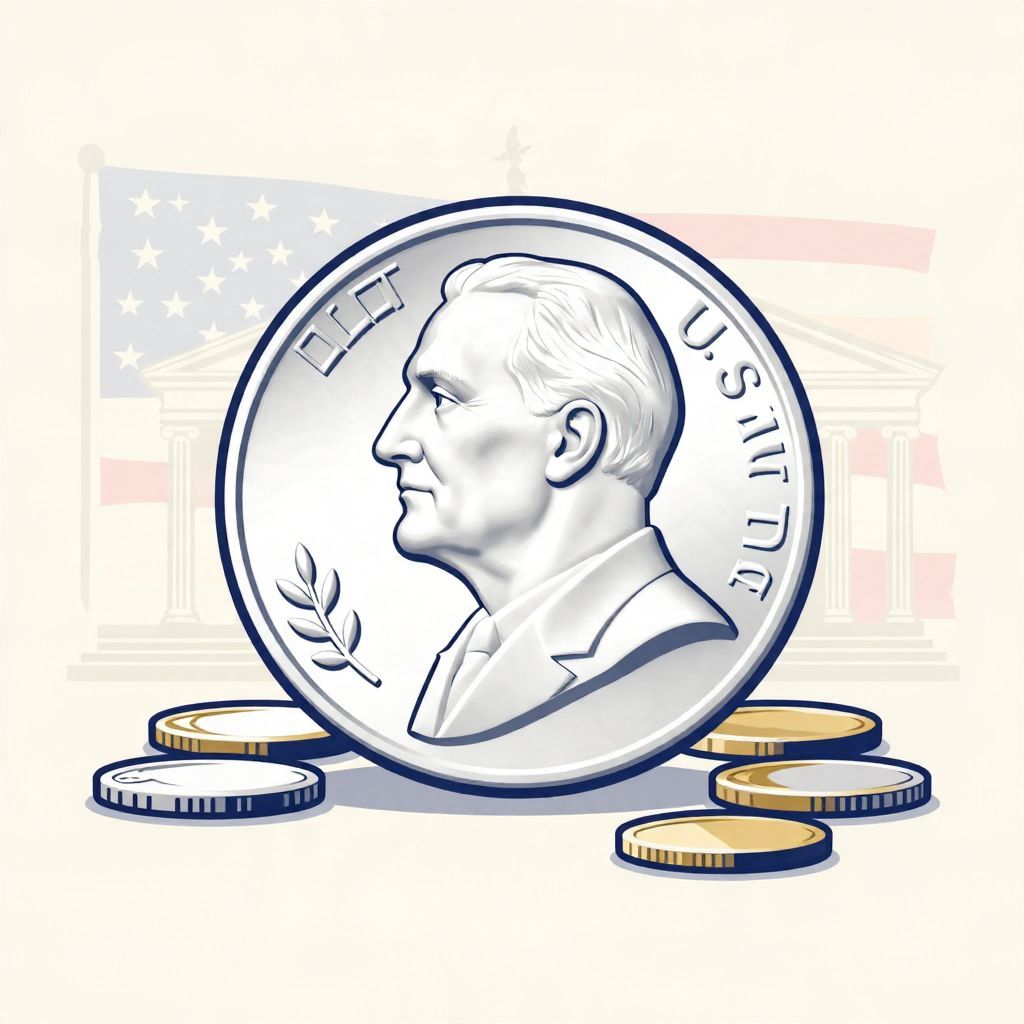
When people ask, “Who is on the dime coin?” they are usually referring to the U.S. dime, the ten-cent coin in everyday circulation. The answer is straightforward: the dime features President Franklin D. Roosevelt on the obverse, or front, of the coin.
But the story behind that portrait is more than a simple naming answer. The dime’s design reflects American history, public memory, and a major shift in how the United States chose to honor one of its most influential presidents.
Who Is On The Dime Coin?
The U.S. dime shows Franklin D. Roosevelt, the 32nd president of the United States. His portrait has appeared on the dime since 1946, shortly after his death in 1945. Roosevelt was chosen to honor his leadership during the Great Depression and World War II, and because of his association with the March of Dimes and the fight against polio.
Why Franklin D. Roosevelt Was Chosen for the Dime
A president remembered for crisis leadership
Roosevelt served as president from 1933 to 1945, the longest term in U.S. history. He guided the country through two of the most difficult periods in modern American life: the Great Depression and World War II. His New Deal programs reshaped the federal government’s role in economic recovery, while his wartime leadership helped define the Allied response to fascism.
The connection to the March of Dimes
The dime’s association with Roosevelt is especially meaningful because of his battle with polio. Roosevelt contracted the disease in 1921 and lived with its effects for the rest of his life. He helped inspire public support for polio research, and the charity known as the March of Dimes became closely linked with his legacy. Although the organization’s name came after the coin, the dime was chosen in part to honor that connection.
Why not another president?
Before Roosevelt, the dime featured Liberty, not a specific person. When the U.S. Mint redesigned the coin after Roosevelt’s death, officials selected him as a national figure whose memory resonated widely. The choice also replaced an older symbolic tradition with a portrait of a modern president, reflecting changing attitudes toward commemoration on U.S. currency.
What the Dime Looked Like Before Roosevelt
The Mercury dime and earlier designs
From 1916 to 1945, the dime carried the famous “Mercury dime” design by sculptor Adolph A. Weinman. Despite the nickname, the coin did not depict the Roman god Mercury. It showed Liberty wearing a winged cap, which led many Americans to mistake it for Mercury. That design replaced earlier versions that also centered on Liberty rather than a named individual.
The shift from symbols to portraits
The move from Liberty to Roosevelt marked a broader trend in U.S. coinage. In the nineteenth and early twentieth centuries, American coins often emphasized allegorical figures, especially Liberty, to avoid over-personalizing the nation’s money. By the mid-twentieth century, however, portraits of presidents and major statesmen had become more common and more widely accepted.
When Roosevelt First Appeared on the Dime
The 1946 debut
Roosevelt first appeared on the dime in 1946, the year after his death. The new design was created by Mint Chief Engraver John R. Sinnock. It entered circulation as a memorial issue and quickly became one of the most recognizable U.S. coin designs.
Why the date matters
The timing is important because it places the dime within the immediate postwar period. Americans were still mourning Roosevelt, and the coin helped transform his image into a permanent public symbol. That made the dime not only currency but also a small, everyday memorial.
Key Facts About the Dime Coin
- Denomination: 10 cents
- President depicted: Franklin D. Roosevelt
- First year of issue with Roosevelt: 1946
- Designer: John R. Sinnock
- Reverse design in modern circulation: Torch, olive branch, and oak branch
- Composition today: Copper-nickel clad, not silver
The modern reverse design
The current reverse of the dime shows a torch, an olive branch, and an oak branch. These symbols represent liberty, peace, and strength. The design replaced the earlier winged Liberty motif and was intended to complement Roosevelt’s portrait with a set of national ideals rather than another person.
How the Dime Changed Over Time
From silver to clad coinage
For much of its history, the dime contained silver. That changed in 1965, when the U.S. moved to copper-nickel clad coinage for most circulating dimes, quarters, and half dollars. The change was driven by rising silver prices and the need to keep everyday coinage practical for circulation. Roosevelt remained on the coin through the material change, showing how the portrait had become a stable national symbol.
A coin with everyday reach
The dime is one of the smallest coins in the U.S. system, but it has had enormous visibility because of how often it is used. That makes Roosevelt’s image especially familiar. Unlike monuments or textbooks, coins circulate through millions of hands, turning a president’s face into a repeated part of daily life.
Franklin D. Roosevelt’s Life and Legacy
Early life and political rise
Franklin Delano Roosevelt was born in 1882 into a wealthy New York family. He entered politics after studying at Harvard and Columbia Law School and served in the New York state legislature before becoming assistant secretary of the Navy during World War I. In 1921, polio changed the course of his life, but it did not end his political career.
Presidency during the Great Depression
Roosevelt won the presidency in 1932, at the height of the Great Depression. His first 100 days in office became famous for the rapid pace of legislation and reform. New Deal agencies aimed to provide jobs, restore confidence in banks, and offer relief to struggling Americans. Historians continue to debate the full economic effects of the New Deal, but there is broad agreement that Roosevelt reshaped the federal government’s role in American society.
Leadership in World War II
As war spread across Europe and Asia, Roosevelt moved the United States toward support for the Allies before the country formally entered the war after Pearl Harbor in 1941. He worked closely with Winston Churchill and other Allied leaders, helping define the strategy that led to victory. Roosevelt died in April 1945, just months before the war ended in Europe.
Why the Dime Matters in U.S. History
A memorial in pocket change
The dime is more than a coin with a face on it. It reflects how Americans remember leaders and how public memory becomes part of ordinary life. Roosevelt’s portrait was not chosen simply because he was famous; it was chosen because his presidency touched major national crises and because his personal struggle with polio gave the coin an added layer of meaning.
The dime as a historical artifact
Coins are small objects, but they carry state power, design choices, and cultural values. The Roosevelt dime shows how the U.S. government uses currency to communicate identity. It also reveals how commemoration can shift from abstract ideals like Liberty to specific individuals whose lives are seen as nation-defining.
Common Questions About the Dime
Is the dime made of silver?
Modern dimes are not made of silver for everyday circulation. Since 1965, they have been copper-nickel clad. Earlier dimes, including Roosevelt dimes minted before that change, did contain silver.
Why is Roosevelt on the dime and not the dollar?
There is no single rule that says a president must appear on a particular denomination. Roosevelt’s placement on the dime was a memorial decision tied to his legacy and to the March of Dimes connection. Other presidents appear on other coins and paper money for different historical reasons.
Has the dime design ever changed?
Yes. The portrait of Roosevelt has remained, but the reverse design has changed over time. The most familiar modern version dates to 1965, when the torch, olive branch, and oak branch design replaced the earlier reverse.
Conclusion
The answer to “Who is on the dime coin?” is Franklin D. Roosevelt, whose portrait has appeared on the U.S. dime since 1946. His presence on the coin reflects not only his presidency but also the nation’s desire to honor leadership, resilience, and public service in the aftermath of war and depression. For readers interested in U.S. money and symbols, related topics such as the history of American coin designs and presidential portraits on currency offer a useful next step.