
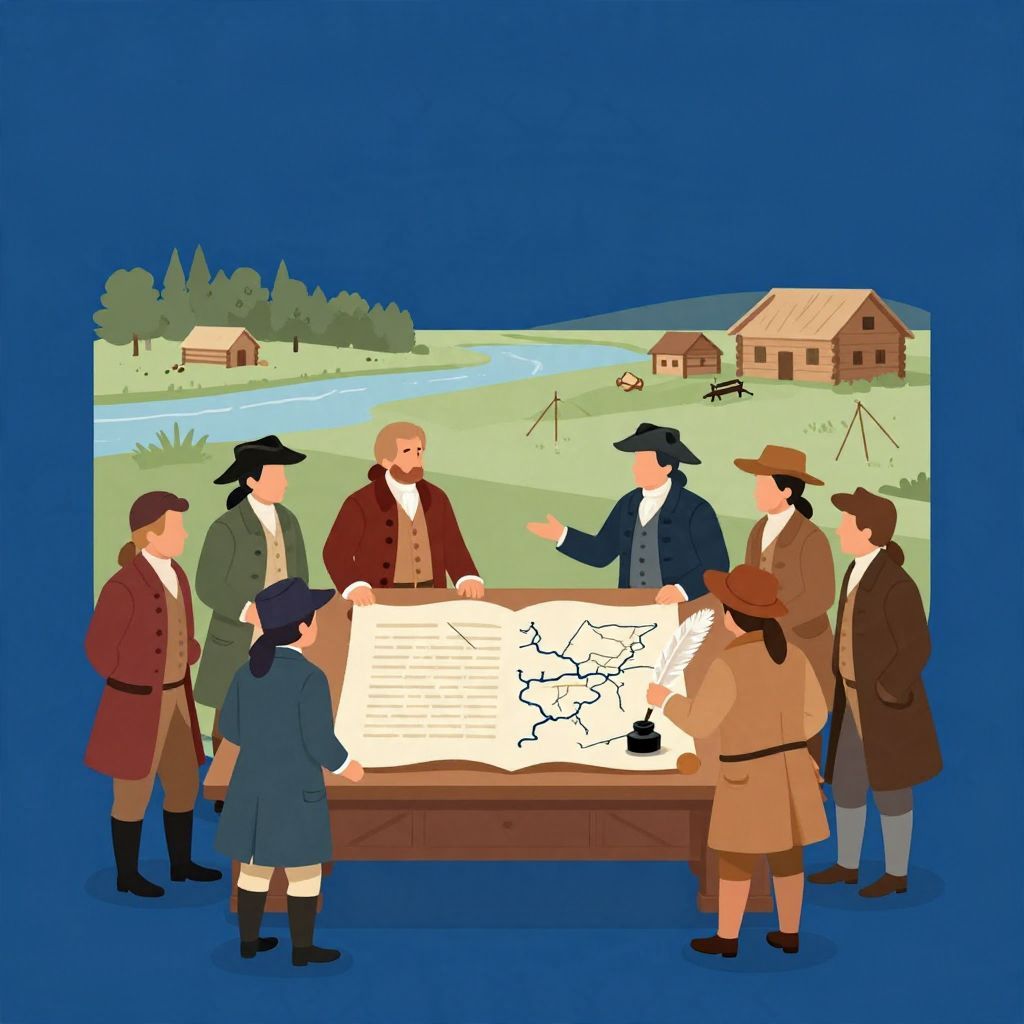
What was the Northwest Ordinance, and why does it matter in American history? Passed by the Confederation Congress in 1787, it created a framework for governing the Northwest Territory, the land north of the Ohio River and east of the Mississippi. It shaped how the United States would expand, admit new states, and manage western settlement after independence.
It was also one of the most important early federal laws in the United States. The ordinance helped define the balance between territorial government, statehood, slavery, education, and Native American land claims in the early republic.
What Was the Northwest Ordinance?
The Northwest Ordinance was a landmark law passed on July 13, 1787, by the Congress of the Confederation. It established a system for governing the Northwest Territory and set rules for creating new states from that region. It also banned slavery there, protected certain civil liberties, and promoted public education.
Background: Why Was It Needed?
After the American Revolution, the United States faced a major problem: it had won a large western territory but lacked a strong federal system to govern it. Several states claimed overlapping western lands, and Congress needed a way to organize settlement without letting expansion become chaotic or politically destabilizing.
The land covered by the ordinance came from the old British claims and was ceded by states such as Virginia, New York, Massachusetts, and Connecticut. This area eventually became the modern Midwest, including Ohio, Indiana, Illinois, Michigan, Wisconsin, and part of Minnesota.
Postwar expansion and land pressure
War veterans, land speculators, and migrants all looked westward. Congress wanted to encourage orderly settlement, raise revenue, and avoid conflicts among settlers, land companies, and Native nations. At the same time, leaders worried that new western communities might become too independent or politically unstable if they were not tied closely to the federal government.
The Articles of Confederation and weak central authority
Under the Articles of Confederation, the national government had limited power. The Northwest Ordinance was one of the clearest examples of Congress trying to govern effectively despite those limits. It became a model for federal territorial administration even before the Constitution took effect.
How Did the Northwest Ordinance Work?
The ordinance created a step-by-step process for turning federal territory into full states. It began with a governor, secretary, and judges appointed by Congress. As population increased, settlers could elect a territorial legislature, and once a territory reached a sufficient population, it could draft a state constitution and apply for admission to the Union.
This system was important because it treated western lands not as colonies, but as future equal states. That principle became a defining feature of American expansion.
The three-stage territorial system
- Initial territorial rule: Congress appointed officials to administer the territory.
- Representative government: When the population grew, settlers gained an elected legislature.
- Statehood: A territory could write a constitution and enter the Union as a state.
The ordinance also stated that new states would enter on an equal footing with the original states. That idea mattered enormously in later American history, because it helped define the Union as a growing republic rather than a fixed group of older states ruling over dependent lands.
Key Facts About the Northwest Ordinance
Several provisions made the ordinance especially influential. Some were practical, while others expressed the political ideals of the early republic.
- Date passed: July 13, 1787
- Governing body: Congress of the Confederation
- Region: Northwest Territory, north of the Ohio River and east of the Mississippi River
- Main purpose: Organize settlement and create a path to statehood
- Slavery clause: Slavery was prohibited in the territory
- Education: The ordinance encouraged schools and public education
- Religious liberty: It protected freedom of religion
- Native relations: It promised that Native peoples’ land and property would not be taken without consent, though this promise was often violated in practice
The ban on slavery
One of the ordinance’s most famous features was its prohibition of slavery in the Northwest Territory. This did not end slavery in the United States, and it did not apply to existing slave states. Still, it was a major early federal restriction on the spread of slavery and later helped shape the sectional divide between North and South.
Historians often note that this clause reflected a mix of moral, political, and economic motives. Some leaders opposed slavery on principle; others feared that slave labor would undercut free white labor or create a plantation society in the West.
Education and civic development
The ordinance encouraged the development of schools and public institutions. It declared that religion, morality, and knowledge were necessary to good government. This reflected the belief that republican self-rule required an educated citizenry.
Religion and civil liberties
The ordinance included protections for religious liberty and other civil rights. These provisions were part of a broader effort to make the new territory attractive to settlers while also reflecting revolutionary-era ideals about freedom and government by law.
Who Created It?
The ordinance emerged from debate among members of Congress and territorial planners in the summer of 1787. Key figures included Nathan Dane of Massachusetts, who is often credited with drafting much of the final text, and Manasseh Cutler, a New England clergyman and land speculator who helped lobby for the bill.
It is important to be careful here: the ordinance was not the work of a single person alone. It was the product of political bargaining, regional interests, and practical concerns about western settlement. Some popular accounts simplify the story too much by treating it as the achievement of one “founder,” but the law was a collective creation.
What Territory Did It Cover?
The Northwest Territory included the land north of the Ohio River, east of the Mississippi River, and south of the Great Lakes. In modern terms, it became the foundation for several Midwestern states. The ordinance did not create those states immediately; it established the legal framework that made their eventual creation possible.
Over time, the territory was divided and reorganized as population increased. From this region came Ohio, Indiana, Illinois, Michigan, Wisconsin, and part of Minnesota. The ordinance therefore had a lasting impact on the political geography of the United States.
Why Was It So Important?
The Northwest Ordinance mattered because it solved several problems at once. It gave Congress a way to manage western lands, promised settlers a path to self-government, and set a precedent for admitting new states on equal terms. It also established a federal precedent for limiting slavery in territories.
In the long run, the ordinance helped shape the American idea of expansion. Rather than building an empire of dependent provinces, the United States would claim new lands, organize them as territories, and eventually transform them into states.
Long-term consequences
- It became a model for later territorial laws.
- It strengthened the principle of equal statehood.
- It influenced the sectional debate over slavery’s expansion.
- It encouraged settlement and political organization in the Old Northwest.
- It helped define the federal government’s role in western growth.
How Did It Affect Native Americans?
The ordinance promised that Native land, property, and liberty would not be taken without consent. In practice, however, U.S. expansion repeatedly violated Native sovereignty. Treaties were often unequal, pressure for land intensified, and military conflict followed as settlers moved deeper into the region.
This is one of the ordinance’s most important contradictions. It expressed legal ideals about fairness and consent, but the expansion it authorized contributed to dispossession. Any full understanding of the ordinance must include that tension.
How Was It Connected to the U.S. Constitution?
The Northwest Ordinance was adopted just weeks before the Constitutional Convention finished its work in Philadelphia. Although it was passed under the Articles of Confederation, it remained influential after the Constitution was ratified. The new federal government continued to use territorial governance and statehood principles similar to those established in 1787.
Because of this, the ordinance is often seen as a bridge between the weak national government of the Confederation period and the stronger federal system created by the Constitution.
What Happened Afterward?
The ordinance guided the development of the Northwest Territory for decades. As settlers arrived, towns grew, governments formed, and new states entered the Union. Its framework proved durable enough to shape not only the Old Northwest but also later American territorial expansion.
Its legacy also deepened in the nineteenth century, when debates over slavery’s expansion made the ordinance a touchstone in arguments about whether federal territories should be free or slave. In that sense, a law from 1787 helped shape the political conflicts that eventually led toward the Civil War.
Summary: The Historical Meaning of the Northwest Ordinance
The Northwest Ordinance was a foundational early American law that organized the Northwest Territory, set a path to statehood, protected certain civil liberties, encouraged education, and banned slavery in the region. It was a practical governing document and a statement of republican ideals, but it also sat within the larger and often unjust process of U.S. expansion.
For readers interested in how America expanded and governed new lands, it connects naturally with later land policy and settlement history, including a closer look at the Northwest Ordinance and the Homestead Act.