
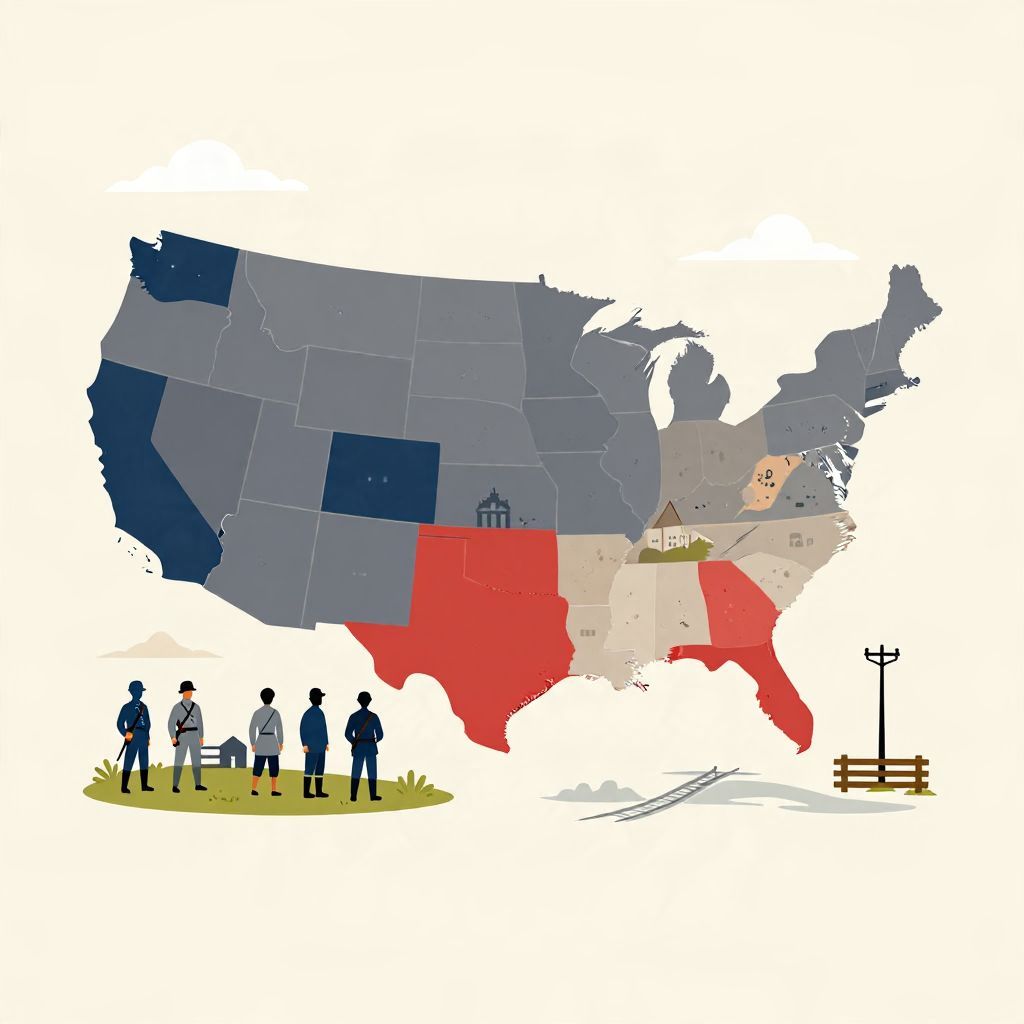
The question of where a second American civil war could start is not a prediction of inevitability, but a way to examine the places where political polarization, demographic change, gun culture, and distrust of institutions have become especially intense. Historically, civil wars do not begin evenly across a country; they usually emerge where local grievances, state power, and national crises collide.
In the United States, the most plausible flashpoints are not random. They are states where partisan identity is strong, armed political movements have gained visibility, and disputes over elections, immigration, race, or federal authority have repeatedly produced confrontation. Three states often discussed in that context are Texas, Arizona, and Florida.
3 States Where a Second Civil War Could Start
The three states most often identified as potential flashpoints are Texas, Arizona, and Florida. Each combines a large population, intense partisan division, and recurring conflict over national politics. None is “destined” for civil war, but each has conditions that could magnify a broader national breakdown into localized violence or secessionist rhetoric.
Why These States Stand Out
To understand why these states are mentioned, it helps to separate dramatic language from historical pattern. Civil wars usually begin when political disagreement stops being managed through law and becomes framed as an existential struggle. States with strong regional identity, high political mobilization, and symbolic importance are more likely to become early centers of unrest.
What historians look for in a civil-war flashpoint
- Deep political polarization between communities and institutions
- Armed or militant activism that normalizes confrontation
- Repeated disputes over elections or authority
- Regional identity that can be turned into separatist language
- A triggering crisis such as a contested election, economic collapse, or federal-state standoff
In the American case, these factors would not produce a nineteenth-century-style battlefield war overnight. More likely, they would first appear as political violence, attempted nullification of federal authority, or organized resistance to state and national governments. That is why the “second civil war” question is really about escalation, not a single dramatic declaration.
Texas: The Most Frequently Cited Flashpoint
Texas is the state most often named in speculation about a second civil war because it combines size, historical memory, gun ownership, and a strong tradition of political independence. It also has a long history of tension between state identity and federal power, which gives secessionist language a ready-made audience even when it remains a minority position.
Historical roots of Texas exceptionalism
Texas entered the United States with a distinct political mythology. It was once an independent republic from 1836 to 1845, and that past still matters culturally. The memory of independence, combined with the state’s role in the Civil War of the 1860s, has helped sustain the idea that Texas is not just another state but a special political community.
That does not mean most Texans support secession. In fact, secessionist sentiment has historically been limited and uneven. But in moments of national stress, Texas’s size and symbolic weight make it a natural stage for conflict. A state government openly defying federal policy would immediately attract national attention, and any breakdown in trust could spread quickly through the state’s large and diverse population.
Major events that could trigger unrest in Texas
- A highly disputed presidential election
- A major federal-state clash over immigration enforcement
- Attempts to challenge federal authority over voting rules or military deployment
- Large-scale political violence involving militias or counter-militias
Texas also matters because it is economically and strategically significant. It has major energy infrastructure, a long border with Mexico, and several large metropolitan areas with very different political cultures. A crisis there would not remain local for long. It would affect supply chains, national politics, and the military balance of any wider conflict.
Lasting effects if Texas became a flashpoint
If Texas were the center of a serious internal conflict, the consequences would likely include a constitutional crisis over the limits of state sovereignty, emergency federal intervention, and a long-term hardening of regional identities. Even short of open war, a prolonged standoff could deepen distrust between urban and rural voters, and between state and federal institutions.
Arizona: Border Politics and Institutional Strain
Arizona is a second plausible flashpoint because it sits at the intersection of immigration politics, election disputes, and ideological conflict over the role of the state. Its population is smaller than Texas’s, but its political symbolism is outsized. Arizona has repeatedly been a battleground state, which means national attention is already concentrated there during elections.
Why Arizona is vulnerable to escalation
Arizona’s modern political tensions are shaped by its border geography and by the intensity of debate over immigration, policing, and election administration. These issues can become emotionally charged very quickly, especially when political leaders portray them as matters of survival rather than policy disagreement.
Historically, border regions often become zones where national anxieties are projected. In Arizona, that has meant debates over federal authority, local enforcement, and the meaning of citizenship. When those debates are combined with armed activism or attempts to intimidate election workers, the risk of escalation rises.
Historical and political pressures in Arizona
- Long-running conflict over immigration and border enforcement
- Repeated election controversies and claims of fraud
- Strong ideological polarization in urban and rural areas
- Visibility of armed political groups and protest movements
Arizona is not historically known for secessionist tradition in the same way Texas is, but that can make its instability harder to predict. A state does not need a deep secession myth to become dangerous; it only needs a crisis that convinces enough people that normal politics no longer work. In that sense, Arizona’s vulnerability lies less in old regional identity and more in the fragility of trust.
What a crisis in Arizona might look like
A second civil war would not likely begin in Arizona with armies marching across borders. More plausible would be a sequence of confrontations: contested election results, armed demonstrations, clashes with law enforcement, and competing claims about legitimate authority. If state and federal officials issued contradictory orders, the state could become a symbolic battleground for the rest of the country.
Florida: Mass Politics, Extremes, and Rapid Escalation
Florida is often overlooked in civil-war speculation, but it belongs on the list because of its size, political volatility, and national visibility. The state has a long record of razor-thin elections, ideological conflict, and highly publicized culture wars. Those conditions make it a place where national division can become immediate and theatrical.
Why Florida matters historically
Florida’s political importance comes from its role as a swing state and from its demographic diversity. It contains large urban centers, retirement communities, immigrant populations, and regions with very different political cultures. That mix can produce not just disagreement, but mutual suspicion. In a broader national crisis, Florida’s divisions could sharpen rapidly.
Florida also has a strong tradition of politically charged media coverage, which can amplify fear and misinformation. In a modern crisis, communication networks matter as much as geography. A state where narratives spread quickly can become a place where panic and mobilization feed one another.
Conditions that could make Florida a flashpoint
- Highly disputed statewide or national election outcomes
- Violent clashes around protests or counterprotests
- Polarized responses to immigration, education, or public safety policy
- Rapid spread of conspiracy theories and armed intimidation
Florida’s geography also complicates any crisis. Its long coastline, major transport routes, and dense population centers would make law enforcement and emergency response difficult if unrest spread across multiple regions. Unlike a smaller state, Florida could absorb a great deal of tension before breaking, which makes the eventual rupture potentially more dramatic.
Could a Second Civil War Really Start in One State?
Historically, civil wars rarely begin as clean, state-by-state events. They usually emerge from national collapse, then localize in specific regions. The American Civil War itself grew out of a sectional crisis that involved multiple states, federal institutions, and slavery as a central cause. A future conflict would probably follow a similarly uneven path.
What would have to happen first
- A major national legitimacy crisis, such as a deeply contested presidential election
- Widespread refusal to accept legal outcomes
- Organized armed groups willing to confront government forces
- Breakdowns in state and federal cooperation
- Escalation from protest to sustained violence
That means no single state can “start” a civil war by itself in the full historical sense. But a state can become the place where a broader breakdown becomes visible first. Texas, Arizona, and Florida are often named because they contain the ingredients that could turn national polarization into a concrete crisis.
Lessons from Earlier Civil Conflicts
History suggests that civil wars are rarely caused by one issue alone. They emerge from a chain of failures: political compromise breaks down, institutions lose credibility, and ordinary disagreement is recast as betrayal. Once that happens, even local incidents can take on national meaning.
In the United States, the memory of the Civil War still shapes how people imagine future conflict. But the next major internal crisis, if one were ever to occur, would probably look different from the 1860s. It would likely involve fragmented violence, legal confrontation, media-driven mobilization, and competing claims of constitutional legitimacy rather than formal battlefield lines.
Conclusion: The Real Warning Sign Is Not Geography Alone
Texas, Arizona, and Florida are the three states most often discussed as possible flashpoints for a second civil war because each combines political intensity, symbolic importance, and a history of conflict over authority. Yet the deeper lesson of history is that civil wars begin when institutions fail, not when a map points to one state. For a broader look at the ideas that drive polarization, see what political ideology means and how political engagement shapes public life.