
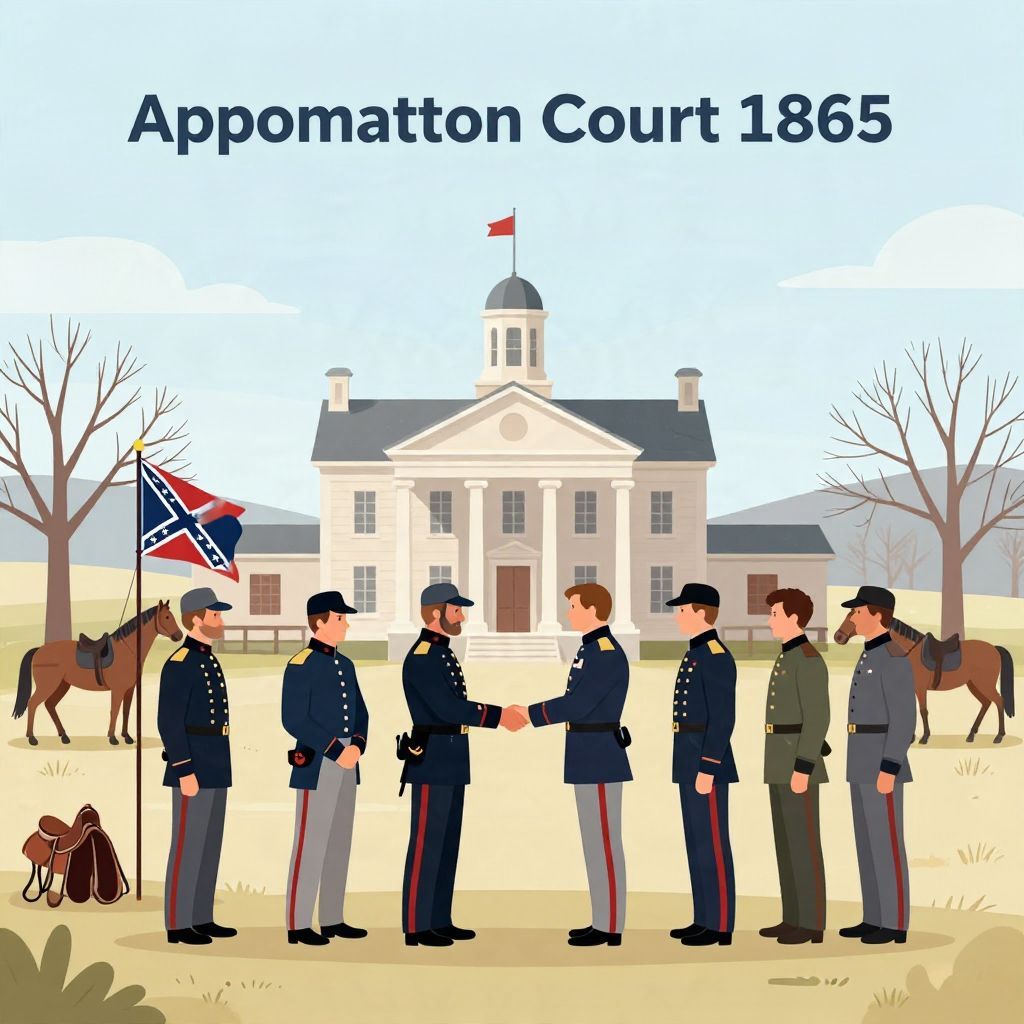
The American Civil War ended in 1865. That is the year most historians and general readers use because the main Confederate armies surrendered in the spring of 1865, bringing large-scale fighting to a close.
The exact date can depend on what you mean by “ended,” since some Confederate forces surrendered later and a few remote units did not formally lay down arms until weeks or months afterward. Still, 1865 is the clear historical answer to the question.
What year did the Civil War end?
The Civil War ended in 1865. The decisive surrender came on April 9, 1865, when Confederate General Robert E. Lee surrendered the Army of Northern Virginia to Union General Ulysses S. Grant at Appomattox Court House, Virginia. Other Confederate forces surrendered soon after, and the war’s organized resistance collapsed during the spring and summer of 1865.
The final months of the war
By early 1865, the Confederacy was exhausted. Union armies had tightened control over key railroads, rivers, and supply lines, while the Union blockade had weakened Southern trade. Confederate manpower, food, and ammunition were running low, and the South’s ability to continue the war was fading fast.
In the East, Grant’s army pressed Robert E. Lee’s forces around Petersburg and Richmond. In the West, Union victories had already broken Confederate strength in much of the region. By April, Richmond had fallen, and Lee’s army was retreating westward in a desperate attempt to find supplies and link up with other Confederate forces.
Appomattox Court House
The surrender at Appomattox was not the end of the war in a legal or technical sense, but it was the moment that mattered most militarily and symbolically. Lee met Grant in a private home in Virginia and agreed to terms that allowed Confederate soldiers to go home after laying down their arms. The terms were deliberately generous, helping to reduce the chance of further resistance and revenge killings.
Why Appomattox matters
Appomattox became the best-known ending because Lee’s Army of Northern Virginia had been the Confederacy’s most important field army. Its surrender signaled that the rebellion was effectively broken. News of the surrender spread quickly and was widely understood as the beginning of the end, even though scattered fighting continued for a short time afterward.
Did the Civil War end on one single day?
Not exactly. The most important surrender happened on April 9, 1865, but the war did not end everywhere at the same moment. Other Confederate armies and smaller commands still existed, and some did not surrender until later in 1865. For that reason, historians often say the Civil War ended in 1865, while noting that the process of ending took several months.
Other major surrenders in 1865
- April 26, 1865: Confederate General Joseph E. Johnston surrendered to Union General William T. Sherman in North Carolina.
- May 1865: Additional Confederate forces in the Trans-Mississippi region began surrendering.
- June 1865: Some Confederate units in the far Southwest surrendered after news of the main defeats reached them.
- November 1865: The last Confederate commerce raider, the CSS Shenandoah, surrendered after months at sea.
These later events matter because they show that the Civil War ended as a process, not as a single switch being turned off. Still, the spring of 1865 marks the practical conclusion of the conflict.
Why 1865 is the accepted answer
When people ask what year the Civil War ended, they usually want the year in which the fighting stopped in any meaningful national sense. That year is 1865 because the Confederacy’s principal armies surrendered then, the Confederate government collapsed, and the Union victory became irreversible. The war’s political and military outcome was decided in that year, even though the aftermath lasted much longer.
It is also important to distinguish between the end of the war and the start of Reconstruction. The surrender of Confederate armies ended the armed conflict, but rebuilding the nation, redefining citizenship, and determining the status of formerly enslaved people were separate struggles that continued for years.
What caused the war to end in 1865?
Several factors came together to bring the Civil War to its close. No single battle ended it by itself. Instead, Union advantages in manpower, industry, transportation, and naval power steadily wore down the Confederacy. By 1865, the South could no longer replace losses or sustain its armies at the same scale as before.
Union strategy and pressure
The Union pursued a strategy of coordinated military pressure. Federal armies attacked Confederate forces from multiple directions, while the navy blocked Southern ports and the Union controlled major rivers and rail junctions. This made it harder for the Confederacy to move troops, trade, or feed its armies.
Confederate exhaustion
The Confederacy suffered from shortages of food, weapons, horses, and trained soldiers. Inflation and supply breakdowns weakened civilian morale as well as military effectiveness. By the end of the war, many Confederate soldiers were hungry, poorly equipped, and aware that victory was becoming impossible.
The fall of Richmond
Richmond, the Confederate capital, fell on April 2, 1865, just one week before Lee’s surrender. Its capture was a major psychological blow. Once the capital was lost, the Confederacy’s political center was shattered, and its remaining armies had little reason to continue coordinated resistance.
The human cost of the war’s end
The end of the Civil War in 1865 did not bring immediate peace in the emotional or social sense. Soldiers returned home to damaged farms, destroyed railroads, and communities transformed by four years of war. Families mourned enormous losses, and the nation had to confront the meaning of emancipation, reunion, and defeat.
The war had also changed the constitutional order of the United States. The defeat of the Confederacy preserved the Union, but it did not settle the deeper conflicts over race, labor, and political power. Those struggles continued through Reconstruction and beyond.
How historians frame the end of the Civil War
Most historians use 1865 because it is the clearest and most practical answer. But they also pay attention to different kinds of endings:
- Military end: the surrender of major Confederate armies in spring 1865.
- Political end: the collapse of the Confederate government and the restoration of federal authority.
- Legal and social aftermath: the long process of emancipation, Reconstruction, and reintegration of the former Confederate states.
This distinction helps explain why the Civil War can be said to have ended in 1865 while its consequences lasted for generations.
Quick answer: the year and the key date
If you need the shortest possible answer, it is this: the American Civil War ended in 1865, with the most famous surrender taking place on April 9, 1865 at Appomattox Court House. That date marks the war’s decisive military conclusion, even though a few Confederate holdouts surrendered later in the year.
The story behind the date matters because it shows that wars do not always end all at once. The Civil War ended through a series of surrenders, the collapse of Confederate power, and the Union’s final victory. For more on the broader era, you may also want to explore related history topics such as Reconstruction after the Civil War and the causes of the American Civil War.