
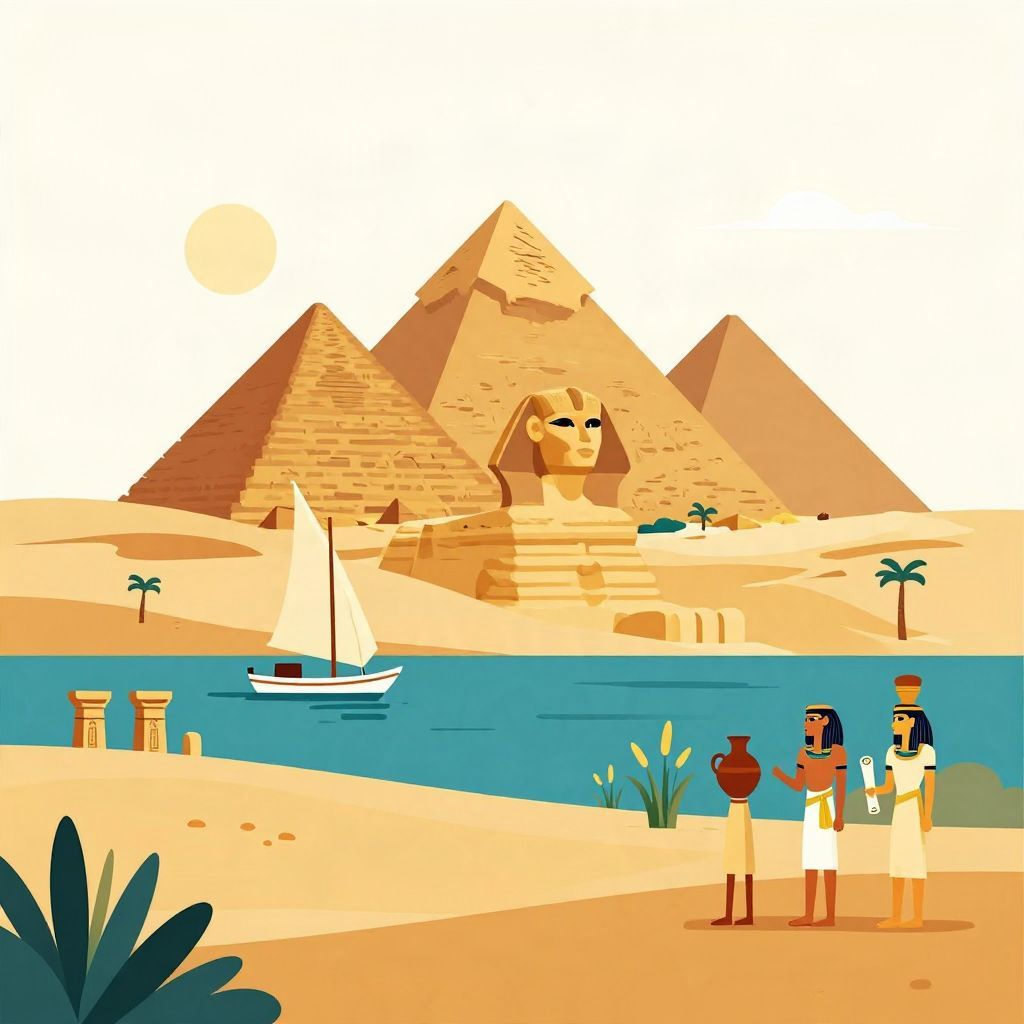
What is Egypt known for? The short answer is that Egypt is known for its ancient civilization, the Nile River, the pyramids and temples, and a long cultural history that links Africa, the Mediterranean, and the Middle East. It is also known for modern political importance, Islamic heritage, and a distinctive national identity shaped over thousands of years.
That reputation did not appear all at once. It grew from geography, early state formation, imperial rule, religion, trade, and archaeology, especially the extraordinary survival of monuments from ancient Egypt.
What Is Egypt Known For?
Egypt is best known for the ancient civilization that flourished along the Nile, including the pyramids, pharaohs, hieroglyphs, mummies, and monumental temples. It is also known for the Nile’s role in sustaining life, for Alexandria’s classical learning, and for its later Islamic, Ottoman, and modern Arab history.
The Nile River: Egypt’s Historical Lifeline
Any answer to what Egypt is known for has to begin with the Nile. For millennia, the river made agriculture possible in an otherwise arid landscape. Seasonal flooding deposited fertile silt, allowing crops, settlements, taxation, and centralized rule to develop along a narrow band of habitable land.
Why the Nile mattered so much
The river shaped Egyptian society in practical and symbolic ways. It supported transport, irrigation, and trade, while also influencing religious ideas about renewal and order. Ancient Egyptians saw the regular cycle of the Nile as part of a stable cosmic pattern, which helped reinforce the importance of kingship and administration.
Ancient Egypt: The Civilization Most People Think Of
Egypt is most widely known for its ancient civilization, one of the world’s earliest and longest-lasting state societies. Unification of Upper and Lower Egypt is traditionally dated to around 3100 BCE, though the process was gradual. From then on, Egypt developed a powerful monarchy, bureaucracy, religious institutions, and distinctive art and writing.
Pharaohs and state power
The pharaoh was more than a king. In ancient Egyptian ideology, the ruler helped maintain ma’at, a concept often translated as order, balance, and justice. This belief gave political rule a sacred dimension. Over time, different dynasties rose and fell, but the idea of kingship remained central to Egyptian civilization.
Hieroglyphs and written culture
Egypt is also known for hieroglyphic writing, one of the world’s most famous ancient scripts. Hieroglyphs were used for religious inscriptions, royal monuments, and formal texts. Alongside them, scribes used simpler scripts for daily administration. Writing helped Egypt govern land, labor, taxation, and religious endowments over long periods.
Mummies and burial beliefs
Mummification is another feature strongly associated with Egypt. The practice reflected beliefs about the afterlife and the preservation of the body. Not everyone received the same kind of burial, and elaborate mummification was expensive, but the survival of royal tombs and funerary goods has made this one of Egypt’s most recognizable historical traditions.
The Pyramids, Temples, and Monumental Architecture
Egypt is famous worldwide for its monumental architecture, especially the pyramids at Giza. Built during the Old Kingdom, roughly the third millennium BCE, these structures were royal tombs and symbols of state power. They remain some of the most studied and visited monuments in world history.
Why the pyramids still matter
The pyramids are known not only for their size but for what they reveal about organization. Building them required skilled labor, planning, quarrying, transport, food supply, and administrative coordination. They are evidence of a complex society, not a mysterious exception to history.
Temples and sacred landscapes
Egypt is also known for temple complexes such as Karnak and Luxor, which were expanded over centuries. These sites were not simply places of worship; they were centers of ritual, economic activity, and royal display. Their columns, reliefs, and inscriptions remain key sources for historians and archaeologists.
Religion, Mythology, and the Afterlife
Ancient Egypt is known for a rich religious world with many gods and local cults. Deities such as Ra, Osiris, Isis, and Amun played major roles in myth, ritual, and political legitimacy. Religion was woven into everyday life, from household amulets to state festivals and temple ceremonies.
Myths and what they meant
Egyptian myths were not fixed in one single book. They varied by place and period, and they should not be read as literal history. Still, they express important ideas about kingship, death, rebirth, and cosmic order. The story of Osiris, for example, became closely tied to resurrection and funerary belief.
Alexandria, Learning, and the Hellenistic World
Egypt is not known only for pharaohs. After Alexander the Great conquered Egypt in 332 BCE, the country entered the Hellenistic world and became ruled by the Ptolemaic dynasty. Alexandria emerged as a major center of scholarship, trade, and cosmopolitan culture.
The Library and intellectual life
The ancient Library of Alexandria has become legendary, though many details about it are uncertain. What is clear is that Alexandria was associated with learning, astronomy, mathematics, geography, and literary scholarship. Egypt’s role in Mediterranean intellectual history is one reason it remains so prominent in world history surveys.
Roman, Byzantine, Islamic, and Ottoman Egypt
Egypt’s history continued long after the age of the pharaohs. It became a Roman province in 30 BCE after the defeat of Cleopatra VII and Mark Antony. Later it was part of the Byzantine Empire, then transformed by the Arab-Muslim conquest in the 7th century CE.
Arabic language and Islamic civilization
Over time, Arabic became the dominant language, and Islam became the majority religion. Egypt developed into a major center of Islamic scholarship, law, architecture, and trade. Cairo, founded in 969 CE under the Fatimid dynasty, grew into one of the great cities of the medieval Islamic world.
Ottoman rule and local power
From 1517, Egypt was part of the Ottoman Empire, though local elites retained significant influence. This period added another layer to Egypt’s identity: it was neither isolated nor simply absorbed, but part of wider imperial systems linking the Mediterranean, the Red Sea, and the Indian Ocean.
Modern Egypt and National Identity
In modern times, Egypt is known for its political and cultural influence in the Arab world. The country gained formal independence from British control in 1922, though British influence remained significant for years. The 1952 revolution ended the monarchy and opened a new era of republican rule.
Why modern Egypt matters historically
Modern Egypt has often been central to regional politics because of its population, strategic location, and cultural reach. Cairo became a major hub for Arabic-language media, literature, and film in the 20th century. Egypt also played important roles in Arab nationalism, the Arab-Israeli conflict, and postcolonial state-building.
What Egypt Is Known For in Culture Today
Today, Egypt is known for a mix of ancient heritage and living culture. Visitors and readers often associate it with archaeological tourism, the Sphinx, the Valley of the Kings, Islamic Cairo, Coptic Christian heritage, and the everyday life of a large, diverse nation that continues to shape regional history.
Food, music, and public culture
Egyptian culture is also recognized through cuisine, music, and literature. Dishes such as ful medames and koshari, the influence of Egyptian cinema, and the work of writers like Naguib Mahfouz have all contributed to Egypt’s modern cultural reputation. These are not ancient traditions in a frozen form; they reflect a society that has kept evolving.
Common Misconceptions About Egypt
Because Egypt is so famous, it is easy to oversimplify it. One common mistake is to treat ancient Egypt and modern Egypt as the same thing. They are historically connected, but they are separated by thousands of years of change in language, religion, rulers, and social life.
Ancient Egypt was not static
Another misconception is that ancient Egypt stayed the same for millennia. In reality, it changed repeatedly through dynastic shifts, foreign rule, religious developments, and economic change. Its continuity is real, but so is its diversity.
Egypt is more than monuments
Finally, Egypt is not known only for ruins. Its historical importance also comes from administration, trade, literature, religion, and its enduring role as a crossroads between continents. The monuments are famous because they survive, but the civilization behind them was broader and more complex.
Key Facts: Why Egypt Stands Out in World History
- Geography: The Nile made large-scale settlement possible in a desert environment.
- Ancient statehood: Egypt formed one of the earliest durable centralized kingdoms, around 3100 BCE.
- Monuments: The pyramids, temples, and tombs are among the most iconic structures in the world.
- Writing: Hieroglyphs and later scripts preserved religion, administration, and literature.
- Religion: Ancient polytheism, later Christianity, and then Islam all shaped Egyptian history.
- Continuity: Egypt remained important under Greek, Roman, Arab, Ottoman, and modern rule.
- Modern influence: Cairo and Egyptian culture have long mattered in the Arab world.
Conclusion
Egypt is known for much more than pyramids, though those alone would make it famous. It is known for the Nile, the rise of one of the world’s earliest states, monumental architecture, religious traditions, and a long history of cultural influence that continues into the present. For related reading, see what Egyptians look like and what happened in 1965.