
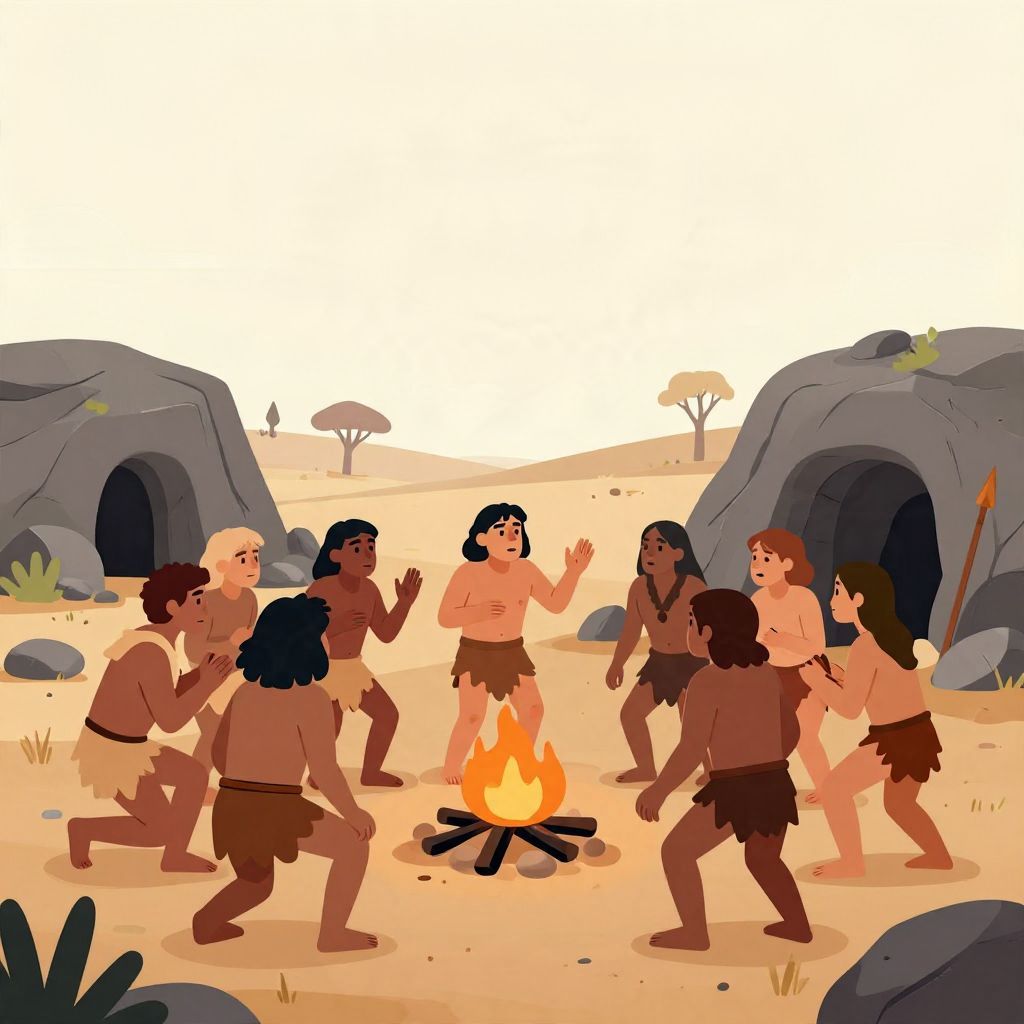
What was the first word ever said? It is one of history’s most intriguing questions, but there is no way to identify a single, provable “first word.” Human speech almost certainly emerged gradually, not in one sudden moment, and the earliest spoken language left no recordings. What we can do is explain what scholars know about the origins of language and why the question remains unknowable.
The best historical answer is that the first word was not one word at all, but part of a slow evolution from sounds, gestures, and shared meanings into full language. Different communities likely developed words independently over tens of thousands of years, long before writing existed.
What was the first word ever said?
There is no confirmed first word ever spoken. Language probably developed gradually among early humans, with sounds gaining shared meaning over time. Because speech began long before writing and recording, historians and linguists can only reconstruct likely stages of language development, not identify a single original word.
Why historians cannot name the first word
Speech predates writing by an enormous span of time. The earliest writing systems appeared only around 3200 BCE in Mesopotamia and Egypt, while human language is far older. Since spoken language leaves no direct fossil record, no document, inscription, or artifact can tell us the exact first word.
Language before writing
For most of human history, people communicated orally. Even after writing appeared, it recorded only a tiny fraction of speech, mostly for administration, religion, law, and trade. That means the first words, if such a moment can even be defined, were spoken in a world that left no written trace.
Why “first word” is a difficult idea
A “word” depends on shared agreement within a community. One person making a sound is not enough; others must understand and use it consistently. For that reason, language likely emerged as a social system rather than as a single invention by one individual.
How language may have begun
Scholars do not agree on one origin story for language, but most think it developed through a combination of biological change, social cooperation, and repeated use. Early humans probably used gestures, facial expressions, and vocal sounds together before speech became more complex and symbolic.
From sounds to meaning
At first, certain sounds may have been tied to immediate needs: warning of danger, calling attention, asking for help, or naming familiar objects. Over time, groups would have learned to associate specific sounds with specific meanings, creating the building blocks of vocabulary.
From gestures to spoken language
Many researchers believe gesture and speech worked together in early communication. A pointing hand, a facial expression, and a vocal sound could reinforce one another. This kind of multimodal communication may have made it easier for early humans to develop stable spoken words.
What might the earliest words have been like?
We cannot know the exact first word, but the earliest words were probably simple and practical. They may have referred to people, objects, actions, or immediate needs rather than abstract ideas. In many languages, early vocabulary tends to center on family, food, danger, movement, and the natural world.
Likely categories of early vocabulary
- People: words for mother, father, child, or group members
- Needs: words for food, water, shelter, or pain
- Actions: words for come, go, give, take, and see
- Objects: words for tools, animals, fire, and places
Simple sounds and repeated patterns
Many early words may have been short and easy to pronounce. Repeated syllables, such as sounds similar to “ma,” “pa,” or “ba,” are common in many languages because they are easy for infants and adults alike to produce. But it would be a mistake to assume these were the literal first words everywhere.
Did the first word come from a single language?
No. Human language almost certainly did not begin in one place and then spread as a finished system. Different populations of early humans likely developed language independently or in overlapping ways. That means there was probably no single global “first word” shared by all humanity.
Multiple origins, not one moment
As human groups migrated and separated, their languages changed and diversified. The world’s languages today belong to many families, and some may descend from very ancient ancestors that are now impossible to reconstruct fully. But even those reconstructions cannot reveal the very first spoken word.
What language scholars can and cannot reconstruct
Linguists can compare related languages to infer older forms of words and grammar. This method helps reconstruct ancient language families, but it has limits. It can suggest what a word may have sounded like thousands of years ago, not what the first human utterance was.
Comparative linguistics
By comparing similar words across related languages, scholars can identify patterns and propose ancestral forms. This is how researchers reconstruct parts of proto-languages. Still, proto-languages are already very developed systems, far removed from the earliest beginnings of speech.
The boundary of evidence
Anything earlier than the oldest reconstructable language lies beyond direct evidence. That includes the first sentence, the first grammar rule, and the first word. At that point, scholars move from evidence to informed hypothesis.
Popular guesses about the first word
People often suggest that the first word was something like “mama,” “hello,” or a sound for “water.” These ideas are understandable, but they are guesses, not historical facts. They reflect how humans imagine language beginning, not what can actually be proven.
Why “mama” is often mentioned
“Mama” appears in many languages because babies naturally produce similar sounds when learning to speak. That does not mean it was humanity’s first word, only that certain sounds are easy for young children and may recur across languages for biological reasons.
Why a greeting is unlikely to be known
Words like “hello” are culturally specific and usually arise within established language systems. A greeting could have existed very early, but there is no evidence to identify one as the first spoken word in human history.
When did humans likely start speaking?
The timing of language’s emergence is still debated. Some scholars argue that fully modern language may have appeared at least tens of thousands of years ago, while others think earlier hominins had more limited forms of communication. The evidence supports a long, gradual development rather than a single date.
What the archaeological record suggests
Archaeology can show symbolic behavior, such as ornaments, art, and complex tools, which may indicate advanced communication. But symbolic objects are not the same as spoken language. They can support the idea that language was present, yet they cannot reveal the first word.
Human evolution and speech
The anatomy for speech involved changes in the brain, vocal tract, and hearing. These changes happened over a long evolutionary period. Language likely became possible only when humans had both the biological capacity and the social need to use it effectively.
Why the question still matters
Even though the first word cannot be identified, the question is historically valuable. It points to one of the biggest transformations in human history: the shift from prelinguistic communication to symbolic speech. That shift made storytelling, law, religion, trade, and complex cooperation possible.
Language changed human society
Once humans could share precise information, they could coordinate hunts, form larger communities, transmit knowledge across generations, and develop culture more rapidly. Language was not just a tool for speaking; it reshaped human life itself.
The short answer
The first word ever said is unknown and probably unknowable. Human language emerged gradually, not in one recorded instant, and likely developed in many groups over a long period. The most accurate historical answer is that there was no single identifiable first word, only the slow birth of speech.
For readers interested in the wider world of ancient communication and historical context, it can also help to explore what language the Romans spoke and related questions about major figures and eras such as who was emperor when Jesus died.