
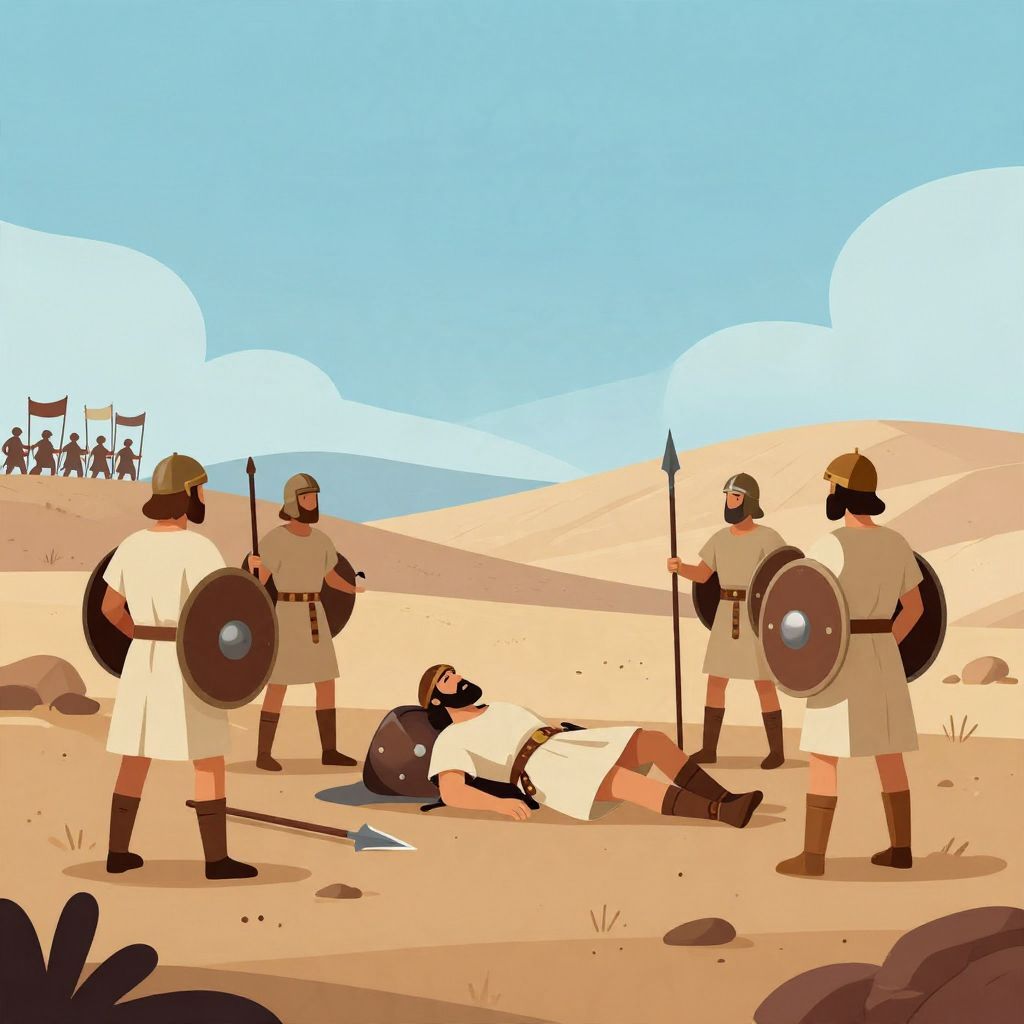
How did Saul die? In the biblical account, Saul, the first king of Israel, died in battle against the Philistines on Mount Gilboa. Wounded and facing capture, he fell on his own sword rather than be taken alive. The story appears in the books of 1 Samuel and 1 Chronicles, and it has long shaped how readers understand the end of Israel’s first monarchy.
Because the Bible preserves more than one version of the event, Saul’s death is best read as both a historical and literary tradition. The core details are consistent, but the exact sequence has been interpreted differently for centuries.
How Did Saul Die?
Saul died during the battle of Mount Gilboa, after the Philistines defeated the Israelites. According to the main biblical narrative, he was critically wounded by archers, feared capture and humiliation, and then took his own life by falling on his sword. A later account says an Amalekite claimed to have delivered the final blow, but that report conflicts with the earlier version.
What the Biblical Text Says
The account in 1 Samuel
The most familiar version appears in 1 Samuel 31. The battle goes badly for Israel, Saul’s sons are killed, and Saul is struck by archers. When he asks his armor-bearer to kill him, the man refuses. Saul then falls on his sword, and his armor-bearer follows his example. The Philistines later display Saul’s body and weapons as trophies.
The account in 1 Chronicles
1 Chronicles 10 retells the same event in a shorter form. It confirms that Saul died because he was wounded in battle and then took his own life. The Chronicler adds a moral interpretation: Saul died because he was unfaithful and did not seek help from God. This is not simply a military report; it is also a theological explanation.
The Amalekite report in 2 Samuel
In 2 Samuel 1, a messenger tells David that he found Saul mortally wounded and killed him at Saul’s request. Most scholars and readers treat this as either a false claim or a story shaped to win favor with David. David’s reaction suggests he does not accept the man’s version. He has the Amalekite executed for claiming responsibility for the death of “the LORD’s anointed.”
What Actually Happened on Mount Gilboa?
The likely historical core is straightforward: Saul’s army was defeated by the Philistines in a major battle in northern Israel, and Saul died amid the collapse of his forces. The biblical texts agree that the battle ended in disaster for Israel and that Saul’s death came at the same time as the deaths of his sons, including Jonathan.
What remains uncertain is the exact manner of death. The tradition of Saul falling on his sword is the best-known version, but the conflicting report in 2 Samuel shows that ancient writers preserved more than one memory of the event. In historical terms, the safest conclusion is that Saul died in battle, probably after being gravely wounded and facing imminent capture.
Why the different versions matter
The differences are important because they reveal how ancient Israelite history was remembered and interpreted. One tradition emphasizes Saul’s final act of self-destruction; another highlights the dishonor of a foreign enemy claiming to have killed him; a third turns the event into a lesson about obedience and divine judgment. These are not just competing facts, but competing meanings.
Who Was Saul and Why Was His Death Important?
Saul was the first king of Israel, anointed during the transition from tribal leadership to monarchy, probably in the late 11th century BCE. His reign marks a major turning point in biblical history: Israel moves from a loose confederation of tribes to a centralized kingship. His death therefore was not only the end of one man’s life, but the end of an era.
Saul’s death also clears the way for David’s rise. After Saul dies, David eventually becomes king, first over Judah and later over all Israel. In biblical storytelling, Saul’s end is part of the larger transition from Saul’s troubled reign to David’s more enduring dynasty.
Saul’s troubled relationship with David
Saul’s final years were marked by tension with David, whom he first served and later pursued as a rival. The Bible presents Saul as increasingly unstable, though historians are cautious about treating the narrative as a clinical portrait. What matters historically is that the text portrays a monarchy under strain, with loyalty, succession, and legitimacy all in dispute.
The Battle of Mount Gilboa
Mount Gilboa was located in the northern part of ancient Israel, near the Jezreel Valley. This region was strategically important because it controlled movement between the coastal plain and the interior highlands. A Philistine victory there would have had serious consequences for Israelite power in the north.
The battle likely reflected the military strength of the Philistines, who were among Israel’s most formidable neighbors in the early Iron Age. The biblical account describes a crushing defeat: Saul’s sons die, the army flees, and the Philistines occupy the battlefield afterward. In that context, Saul’s death appears as the final collapse of a failed defense.
Why Saul feared capture
Ancient rulers who were captured in battle could be humiliated, tortured, or paraded as spoils of war. Saul’s request that his armor-bearer kill him makes sense in that world. If the story is read historically, his choice reflects both personal desperation and the brutal realities of ancient warfare.
Was Saul’s Death Suicide?
Yes, in the main biblical account Saul dies by falling on his own sword, which is a form of suicide. However, the ancient text does not treat the act in a modern psychological framework. Instead, it presents Saul’s death as the tragic end of a king who has been abandoned by fortune, by his army, and, in the Chronicler’s interpretation, by divine favor.
That said, the alternate report in 2 Samuel complicates the picture. Because the messenger’s story conflicts with the earlier account, historians usually do not treat it as a separate factual version with equal weight. It is better understood as part of the biblical narrative tradition surrounding Saul’s death.
What Happened After Saul Died?
- The Philistines recovered Saul’s body and weapons.
- They displayed the bodies of Saul and his sons on the wall of Beth-shan, a public act of humiliation.
- Men from Jabesh-gilead later retrieved the bodies and gave them burial.
- David mourned Saul and Jonathan in a famous lament, emphasizing grief rather than triumph.
These aftermath scenes matter because they show that Saul’s death did not simply remove a king; it created a crisis of memory and legitimacy. The Philistines sought to demonstrate victory, while David’s response helped redefine Saul as both a fallen enemy and a tragic predecessor.
How Historians Read Saul’s Death
Historians approach Saul’s death with caution because the main sources are biblical texts shaped by theology, politics, and later editing. There is no independent contemporary record that confirms every detail. Still, the broad outline is plausible: a regional king was defeated in battle, wounded, and died as his forces collapsed.
Scholars generally distinguish between the likely historical event and the literary shaping of the story. The battle itself is likely historical in broad terms, while the exact words, motives, and final moments are preserved through later narrative traditions. That does not make the story worthless; it means it must be read carefully.
Historical significance of the account
Saul’s death matters because it sits at the intersection of history, memory, and theology. It marks the end of Israel’s first king, the rise of David, and the beginning of a new political order. It also shows how ancient writers explained national disaster through moral and religious language.
Why Saul’s Death Still Matters
Saul’s death remains important because it is one of the defining turning points in the biblical history of Israel. It is the moment when a fragile monarchy gives way to a new dynasty, and when a tragic king becomes part of a larger story about leadership, failure, and succession. The narrative has endured because it is both dramatic and deeply symbolic.
For readers today, the key point is simple: Saul died in battle at Mount Gilboa, probably after being wounded and facing capture, though the Bible preserves more than one version of the final moments. His death mattered then because it ended Israel’s first monarchy; it still matters now because it shows how history and memory can preserve the same event in different ways. For more on biblical royal deaths, see how Solomon died and how Moses died.