
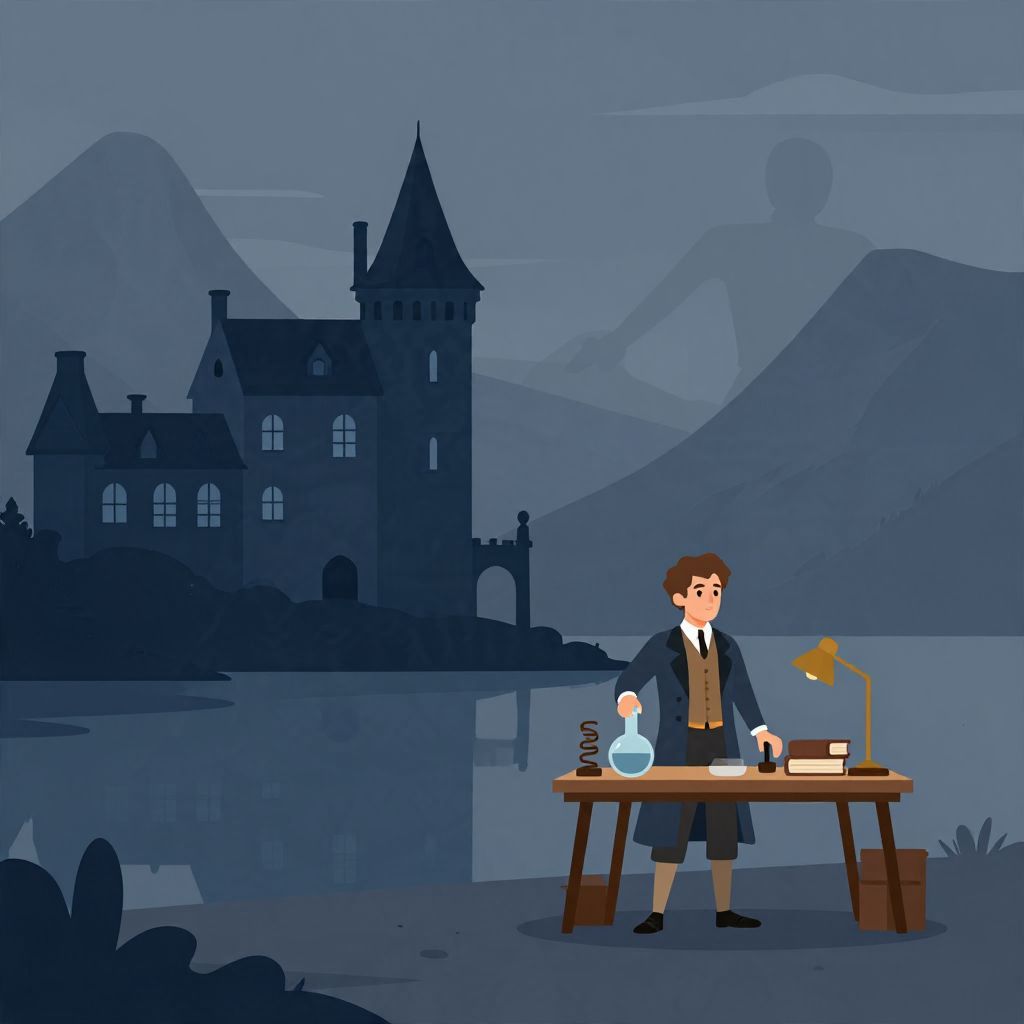
When does Frankenstein take place? Mary Shelley’s novel is set mainly in the late 18th century, with its frame narrative beginning in the 1790s and the central action unfolding across several years in the 1790s and early 1800s. The story moves through Europe, the Alps, and the Arctic, and Shelley leaves some dates intentionally flexible.
Because the novel is told through letters and nested narratives, its timeline is not always exact. Still, historians and literary scholars generally place Frankenstein in the age of the French Revolution, the Enlightenment, and early Romanticism, not in Shelley’s own immediate present of 1818, when the book was first published.
When does Frankenstein take place?
Frankenstein is usually understood to take place from the late 1780s or 1790s into the early 1800s, with the Walton frame narrative set in the Arctic and the main story centered in Geneva, Ingolstadt, Scotland, and the Alps. Mary Shelley never gives a single fixed calendar year for every event, but the novel’s world fits the revolutionary era that shaped her imagination.
The novel’s timeline at a glance
Although Shelley does not provide a strict year-by-year chronology, the sequence of events can be reconstructed from the letters and Victor Frankenstein’s retrospective account. The novel begins with Robert Walton’s Arctic expedition, then shifts back to Victor’s youth, his university studies, and the creation of the Creature, before moving toward the tragic pursuit across Europe and into the polar north.
- Walton’s letters: set in the Arctic, in an undefined but early-19th-century expedition context.
- Victor’s childhood: begins in Geneva, likely in the 1770s or 1780s.
- University years in Ingolstadt: usually placed in the 1790s.
- The Creature’s early experiences: follow soon after Victor’s experiment, over the next few years.
- The final pursuit: ends in the Arctic, where Walton meets Victor near death.
Why the setting matters historically
The novel belongs to a period of major intellectual and political change. The late 18th century saw the rise of scientific experimentation, debates over electricity and anatomy, and a growing fascination with the limits of human knowledge. At the same time, Europe was being transformed by revolution and war, especially the French Revolution and the Napoleonic era. Those pressures help explain the novel’s atmosphere of ambition, isolation, and moral uncertainty.
The Enlightenment and scientific ambition
Victor Frankenstein is shaped by the Enlightenment belief that human reason could uncover nature’s secrets. In the decades before and after 1800, scientists and philosophers were intensely interested in chemistry, medicine, and the possibility of animating life. Shelley draws on that world of experiment, but she also questions its confidence. Victor’s tragedy is not that he seeks knowledge, but that he pursues it without responsibility.
Romanticism and emotional intensity
At the same time, Frankenstein reflects Romantic-era concerns: the power of nature, the loneliness of the individual, and the danger of unchecked ambition. The Alps, storms, glaciers, and Arctic ice are not just scenery. They mirror the novel’s emotional landscape and emphasize how small human beings are in the face of nature’s scale.
How scholars date the events in Frankenstein
Scholars usually date the novel by reading clues in the text rather than by relying on a single explicit year. Mary Shelley wrote Frankenstein; or, The Modern Prometheus in 1816–1817 and published it in 1818, but the action is set earlier. The most common interpretation places the key events in the 1790s, partly because Victor’s education, travel, and the broader social atmosphere resemble that period.
One reason for the uncertainty is that the novel is structured as a retrospective narrative. Walton writes letters in the present; Victor then tells his life story; and the Creature recounts his own experiences. This layered form makes the timeline feel historical rather than immediate, and Shelley does not anchor it to a precise modern date.
Why the 1790s are the best fit
The 1790s are often favored because they align with the novel’s intellectual and political background. Geneva, Ingolstadt, and the wider European setting all reflect a world before the full industrial transformation of the 19th century, yet after the great scientific advances of the Enlightenment. The tone of the novel also matches a Europe unsettled by revolution, war, and rapid change.
Where does the action happen?
Frankenstein moves across several locations, and each one contributes to the story’s meaning. The novel begins in the Arctic, where Walton’s ship is trapped in ice. Victor’s family life starts in Geneva, Switzerland. His scientific education takes place at the University of Ingolstadt, in Bavaria. Later, the plot travels through the Swiss Alps, the British Isles, and remote northern landscapes.
Geneva
Geneva represents Victor’s childhood, family stability, and social privilege. It is also the place he repeatedly returns to in memory, especially when describing his family and his doomed attachment to Elizabeth. The city stands for the domestic world that Victor destroys through obsession.
Ingolstadt
Ingolstadt is where Victor’s transformation begins. At the university, he studies natural philosophy and becomes consumed by the question of life itself. Historically, Ingolstadt was a real center of learning, and Shelley uses it to evoke the period’s scientific culture.
The Alps and the Arctic
The mountains and ice fields are more than dramatic settings. They represent isolation, danger, and the limits of human control. The novel’s movement from the Alps to the Arctic gives the story a vast geographic scale while reinforcing its moral one: the farther Victor and Walton push outward, the more they confront the consequences of ambition.
The historical world behind the story
Mary Shelley wrote Frankenstein in the aftermath of the 18th century’s political revolutions and scientific debates. She was influenced by conversations about galvanism, anatomy, and the possibility of reanimating dead tissue, though the novel is not a scientific treatise. Instead, it uses contemporary ideas to explore a timeless question: what happens when a creator abandons what he has made?
Science in the age of experiment
In Shelley’s time, electricity and the life sciences were exciting and unsettling fields. Public demonstrations and medical research made the body seem newly open to investigation. The novel captures that fascination while warning that knowledge without ethics can become destructive. Victor’s failure is not simply technical; it is moral and emotional.
Revolutionary unease
The late 18th and early 19th centuries were marked by upheaval. The French Revolution challenged old political orders, and the Napoleonic Wars reshaped Europe. Even though Frankenstein is not a political novel in a direct sense, its atmosphere of instability, exile, and fractured family life reflects a world in which old certainties were breaking down.
Does the novel take place in the same era it was written?
No. Frankenstein was published in 1818, but it is set earlier. That distinction matters because Shelley was writing from the early 19th century while imagining a slightly earlier historical world. The novel’s setting is therefore not a simple mirror of her own present. Instead, it looks back to the previous generation, using the recent past to ask questions about science, responsibility, and human limits.
This backward-looking setting also helps explain why the novel feels both modern and historical. Its concerns are rooted in Shelley’s era, but its story is framed as if it belongs to a remembered past. That distance gives the book its eerie, reflective quality.
Why readers sometimes think it is set in the 1800s
Some readers assume Frankenstein takes place in the same period it was published because the novel’s language and concerns feel early modern rather than medieval or ancient. Others notice that the Arctic expedition resembles the age of exploration and assume a broad 19th-century setting. In reality, the book sits on the boundary between the 18th and 19th centuries, with the strongest evidence pointing to the 1790s and early 1800s.
The ambiguity is part of the novel’s design. Shelley does not want readers to focus on a precise date alone. She wants them to see the story as one that could emerge from a particular historical moment and still speak beyond it.
What the timeline tells us about the novel’s themes
The historical setting of Frankenstein is not just background. It shapes the novel’s central ideas. The late 18th century was a time of confidence in reason, but also of fear about its limits. Victor Frankenstein embodies both impulses. He seeks mastery over life, yet he cannot master the consequences of his act. The Creature, meanwhile, exposes the human cost of exclusion and neglect.
The novel’s chronology reinforces this theme. Victor’s youthful ambition leads to years of suffering, and the consequences spread across families, landscapes, and generations. The story’s movement from home to university, from city to wilderness, and from the Alps to the Arctic shows how private error can become a vast historical tragedy.
So, when does Frankenstein take place?
Frankenstein takes place mainly in the late 18th century and early 19th century, most likely during the 1790s and the years just after 1800. Its action unfolds in Geneva, Ingolstadt, the Alps, Britain, and the Arctic, against the backdrop of Enlightenment science and Romantic unease. Shelley keeps the exact dates flexible, but the historical setting is clear enough to place the novel in the era of revolution, experiment, and profound uncertainty.
If you’re interested in how literary timelines shape meaning, you may also enjoy reading about when Moby-Dick was written and when Fahrenheit 451 was written.