
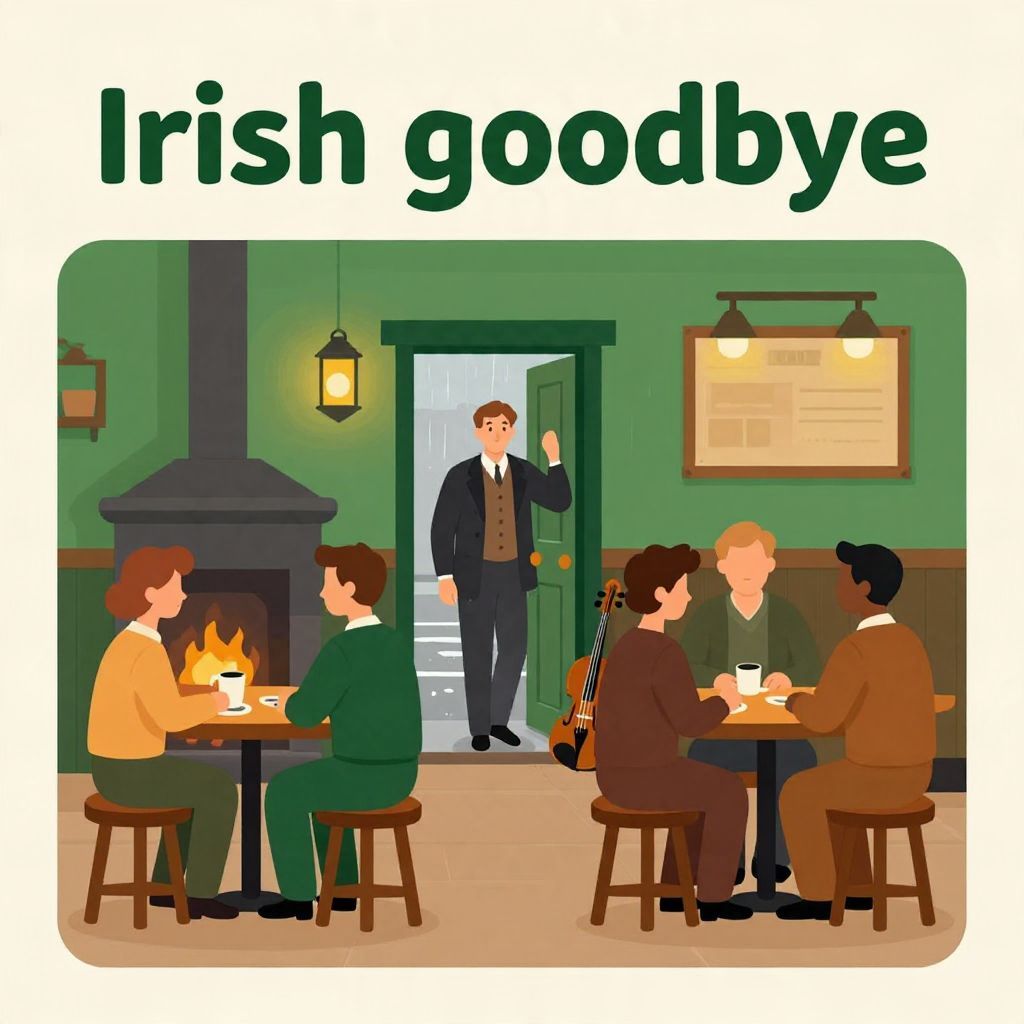
Why is it called an Irish goodbye? The short answer is that the phrase reflects a long history of ethnic stereotyping, not a uniquely Irish custom. It describes leaving a social gathering without saying goodbye, and the label likely grew out of older English-language habits of attaching national names to behaviors that were seen as rude, odd, or different.
Its exact origin is hard to pin down, but the phrase became familiar in modern English as part of a wider pattern of joking or dismissive expressions about national identities. Today, many people use it casually, though the term can still sound insensitive because it ties a common social habit to an ethnic group.
Why Is It Called an Irish Goodbye?
An “Irish goodbye” means leaving a party, bar, or event without announcing your departure or saying farewell. The phrase is called “Irish” because English speakers historically used national labels in idioms to mark behavior as supposedly typical of a group. In this case, the wording is not evidence of an Irish tradition; it is a product of stereotype and informal speech.
The basic meaning of the phrase
In everyday use, the expression refers to slipping out quietly, often to avoid awkwardness, long farewells, or unnecessary attention. The action itself is universal. People in many cultures leave gatherings this way, especially when the event is crowded, informal, or emotionally difficult. The “Irish” part is the label attached to the behavior, not the behavior’s origin.
Why the name is misleading
There is no strong historical evidence that Irish people uniquely practiced this habit more than anyone else. The phrase belongs to a larger family of ethnicized expressions that assign a nationality to a mannerism, food, drink, or social custom. Some of these phrases were playful; others carried prejudice. “Irish goodbye” sits somewhere in between, but it still reflects a tendency to define people through stereotypes.
Where Did the Phrase Come From?
The exact first use of “Irish goodbye” is uncertain. Like many colloquial expressions, it likely developed gradually in spoken English before appearing in print. Scholars and language historians generally treat it as a modern idiom shaped by Anglo-American speech, rather than a term with a single documented inventor or a direct link to one historical event.
The role of ethnic humor in English
English has a long history of using national labels in jokes and idioms. Phrases such as “French leave,” “Dutch courage,” and “Irish goodbye” reflect a pattern in which one group’s name is used to describe behavior considered improper, embarrassing, or excessive. These expressions often reveal more about the speaker’s culture and prejudices than about the people named in the phrase.
From “French leave” to “Irish goodbye”
The older and better-documented expression is “French leave,” which means leaving without permission or without saying goodbye. It appears in English usage by the 18th century and may have been used during periods of Anglo-French rivalry. Over time, “Irish goodbye” became a more specifically social version of the same idea, especially in North American English. The shift shows how idioms evolve and how older stereotypes can be repackaged in new forms.
The Historical Context Behind the Phrase
The phrase makes more sense when placed in the history of Irish migration, British-Irish relations, and the way immigrant communities were portrayed in English-speaking countries. For centuries, Irish people were often stereotyped in Britain and the United States as outsiders, and language played a major role in reinforcing those views.
Irish migration and outsider status
Large-scale Irish migration, especially during and after the Great Famine of the 1840s, changed the social landscape of the United States, Britain, Canada, and Australia. Irish immigrants often faced discrimination in employment, housing, and politics. In that environment, jokes and idioms about “the Irish” could spread easily, even when they had little to do with actual Irish customs.
Stereotypes in everyday language
Ethnic labels in idioms were common in the 19th and early 20th centuries. They helped normalize ideas that certain groups had fixed traits: the French were supposedly flirtatious or formal, the Dutch were supposedly blunt or drunk, and the Irish were often portrayed through comic or derogatory shorthand. Such language was part of everyday prejudice, even when speakers did not intend overt hostility.
Is an Irish Goodbye Actually an Irish Tradition?
Not in any reliable historical sense. Leaving without saying goodbye is a human behavior found everywhere, and there is no evidence that it originated as a distinct Irish social custom. The phrase is best understood as a label imposed from outside, not a description of a uniquely Irish practice.
Why people may have associated it with Ireland
There are a few possible reasons the phrase attached itself to “Irish.” One is that Irish immigrants were highly visible in English-speaking cities, making “Irish” a convenient shorthand in popular speech. Another is that the label may have been used sarcastically, as a way to describe someone who slipped away discreetly. In either case, the phrase grew out of social attitudes rather than careful observation.
What Irish etiquette actually emphasizes
Irish social customs, like those of many cultures, place value on hospitality, conversation, and the obligations of hosting and visiting. In many settings, leaving without acknowledgment would be considered impolite. That does not mean everyone follows the same rules in every situation, but it does show why the phrase is not a trustworthy guide to Irish behavior.
How the Phrase Changed Over Time
In modern English, “Irish goodbye” has become widely recognized in the United States and other English-speaking countries. For many speakers, it is now a lighthearted phrase rather than a deliberate insult. Even so, its history matters because idioms can carry older meanings long after users stop noticing them.
From insult to casual slang
As ethnic jokes became less acceptable in public life, some phrases lost their sharper edge and survived as slang. “Irish goodbye” is often used that way today, especially among younger speakers. But casual use does not erase the phrase’s origins. Language can become normalized while still preserving traces of older bias.
Why some people dislike the term
Some Irish people and others find the phrase irritating because it turns a common social habit into a national stereotype. Even if the expression is not usually meant as a serious insult, it can flatten a complex culture into a joke. That is why some style guides and speakers prefer more neutral alternatives such as “slip out quietly” or “leave without saying goodbye.”
Similar Phrases and What They Reveal
The history of “Irish goodbye” is easier to understand when compared with other expressions that use nationality to describe behavior. These phrases are linguistic fossils: they preserve older social attitudes, even when the original context has faded.
- French leave — leaving without permission or without saying goodbye; older and more established in English.
- Dutch courage — confidence supposedly gained from alcohol; a stereotype rooted in historical rivalry.
- Indian giver — now widely recognized as offensive; it reflects colonial misunderstanding and prejudice.
- Irish goodbye — leaving quietly without farewells; often casual, but still tied to ethnic labeling.
These phrases show how language can preserve social tensions long after the original disputes have disappeared. They also remind us that idioms are historical artifacts, not neutral descriptions.
What Historians and Language Scholars Can Say with Confidence
There are a few points that can be stated carefully and confidently. First, the phrase does not come from a documented Irish custom. Second, it belongs to a broader pattern of ethnicized English idioms. Third, its popularity reflects the history of Irish migration and stereotype in English-speaking societies. Beyond that, the precise moment it entered common speech remains uncertain.
What remains uncertain
Language history often lacks a neat beginning. A phrase may circulate orally for decades before appearing in print, and printed examples do not always show where it first arose. Because of that, historians avoid claiming a single inventor or exact date unless the evidence is strong. For “Irish goodbye,” the safest conclusion is that it emerged gradually from everyday speech shaped by older ethnic humor.
Why the Phrase Still Matters Today
The expression survives because it is useful, memorable, and easy to understand. But it also matters because it shows how ordinary speech can carry history inside it. A small phrase about leaving a party opens a window onto migration, prejudice, humor, and the way national identities were turned into shorthand in modern English.
So, why is it called an Irish goodbye? Because English speakers attached an Irish label to a familiar act of leaving without farewell, most likely as part of a broader tradition of ethnicized idioms. The phrase is less about Ireland than about the history of stereotype in language. If you want to explore related cultural questions, you may also enjoy reading about what are Irish eyes and where Irish people are from.