
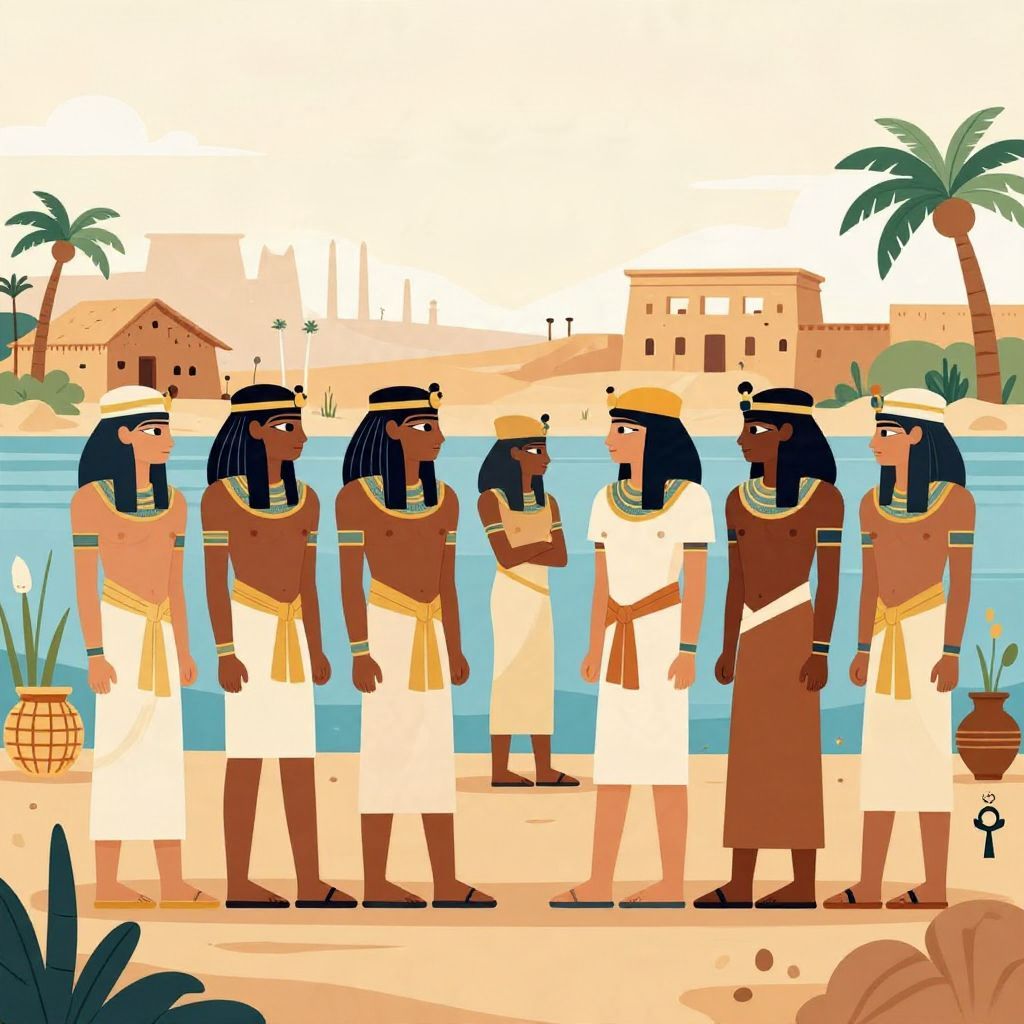
When people ask, “What did Egyptians look like?” they usually mean the ancient Egyptians of the Nile Valley, not modern Egyptians today. The answer is more complex than a single face, skin tone, or body type, because ancient Egypt was a long-lived civilization with regional diversity, changing populations, and a visual culture that idealized people in art.
What we can say with confidence is that ancient Egyptians were Northeast Africans whose appearance varied across time and place, and who shared many traits with neighboring peoples of the eastern Sahara, Nubia, the Levant, and the wider Mediterranean world.
What Did Egyptians Look Like?
Ancient Egyptians were not one uniform “type.” They generally had a range of brown skin tones, dark hair, and features common to Northeast African populations, but there was real diversity from the Nile Delta to Upper Egypt. Their appearance also changed over millennia through migration, intermarriage, trade, and empire.
What We Know from Art, Mummies, and Archaeology
Because ancient Egyptians left behind tomb paintings, statues, mummies, and written descriptions, historians can reconstruct appearance with some confidence. But each source has limits: Egyptian art was symbolic, mummies preserve only some physical traits, and ancient texts often described identity more than “race” in the modern sense.
Egyptian art was stylized, not photographic
Wall paintings and reliefs often show men with reddish-brown skin and women with lighter yellowish or tan tones. This was partly artistic convention, not a literal skin-color chart. Artists used color to distinguish roles, gender, and social ideals, so these images should not be read too literally.
Mummies reveal some physical features
Mummified remains show that many ancient Egyptians had dark hair, brown eyes, and a range of facial structures typical of populations in North Africa and the eastern Mediterranean. Hair could be worn short, braided, or shaved, and wigs were common among elites. However, mummies do not give a complete picture of the living population, because preservation is uneven and burial practices favored certain groups.
Archaeology shows a mixed and changing population
Egypt sat at a crossroads between Africa and Southwest Asia. Over thousands of years, people moved into and out of the Nile Valley through trade, war, diplomacy, and settlement. That means ancient Egyptians were not a static population. Their appearance likely varied by region, class, and historical period, especially in border areas such as the Delta and southern Egypt.
Skin Tone, Hair, and Facial Features
The most careful answer is that ancient Egyptians likely had a broad range of medium to dark brown skin tones, with some lighter individuals as well. They typically had dark hair, though not always. Facial features varied widely, and no single “Egyptian look” fits every period or person.
Skin tone in ancient Egypt
Skin color in the ancient world was shaped by ancestry and environment, but it was not used in the same rigid racial categories common today. Egyptians lived under intense sun, so darker pigmentation was common and adaptive. Artistic depictions frequently show a warm brown palette, which aligns broadly with what we know of Northeast African populations.
Hair was usually dark, but styling mattered
Most evidence suggests dark brown or black hair was common. Many Egyptians shaved their heads or kept hair short for cleanliness in the hot climate, then wore wigs for ceremony and fashion. Wigs could signal status, age, and gender, and they were made from human hair, plant fibers, or both.
Clothing changed how people appeared
Ancient Egyptian clothing was often light and practical: linen garments, kilts, dresses, shawls, and jewelry. Linen was especially important because it was cool in the heat and symbolized cleanliness. Wealthier people could display status through fine pleating, cosmetics, and ornaments, while laborers wore simpler dress or little clothing at work.
Did Ancient Egyptians Look “Black,” “White,” or Something Else?
This is one of the most debated modern questions, but it is better framed carefully. Ancient Egyptians were indigenous Northeast Africans, and many likely looked closer to neighboring peoples in Egypt, Sudan, Libya, and the Levant than to modern racial categories. Applying today’s labels too rigidly can distort the historical reality.
Why modern racial labels can mislead
Terms like “Black” and “White” are modern social categories that do not map neatly onto the ancient world. Ancient Egyptians identified themselves through language, region, occupation, political allegiance, and cultural practice more than through a modern racial system. Their own art often contrasted Egyptians with Nubians, Libyans, Asiatics, and others, but these were cultural and political distinctions as much as physical ones.
Regional diversity within Egypt mattered
People in Upper Egypt, near Nubia, may have looked somewhat different from people in the northern Delta, where contact with the Mediterranean and the Levant was stronger. Egypt was never isolated. Its population was shaped by local continuity and outside contact at the same time.
Elite and royal imagery can be misleading
Pharaohs and nobles were often shown according to idealized standards of beauty and authority. Statues of rulers were designed to project permanence, order, and divine legitimacy. That means royal portraits should not be treated as accurate snapshots of everyday appearance.
How Egyptian Appearance Changed Over Time
Ancient Egypt lasted for more than 3,000 years, from the late fourth millennium BCE through the Roman period. Over that long span, appearance and ancestry changed gradually. The people of the Early Dynastic Period were not identical to those of the New Kingdom or the Ptolemaic era.
Early Egypt and the formation of the state
In the period before and around unification, Egypt drew heavily from local Nile Valley communities and nearby regions. These populations were already diverse, and the state that emerged around c. 3100 BCE unified groups with related but not identical backgrounds.
The New Kingdom and imperial Egypt
During the New Kingdom, especially after c. 1550 BCE, Egypt became an empire with stronger contact across the eastern Mediterranean and into Nubia and the Levant. Soldiers, traders, diplomats, captives, and migrants all contributed to population mixing. This was one reason later Egyptian society was likely more diverse than earlier periods.
Late Period, Ptolemaic, and Roman Egypt
After Alexander the Great’s conquest in 332 BCE, Greek and Macedonian settlers joined an already mixed population. Under Roman rule, Egypt became even more connected to the wider empire. By then, the population included long-established Egyptians, Greeks, Romans, Nubians, Jews, Syrians, and others, all living in different parts of the country.
What Ancient Writers Said About Egyptians
Ancient authors sometimes described Egyptians, but their accounts must be read critically. Greek and Roman writers were outsiders, and they often viewed Egypt through stereotypes, admiration, or political bias. Their comments can be useful, but they are not neutral scientific evidence.
Greek observers noticed difference, not uniformity
Some Greek writers remarked on Egyptian customs, religion, and appearance, often contrasting Egyptians with Greeks. But these descriptions were shaped by cultural distance. They do not give a full or unbiased picture of how Egyptians looked, and they sometimes exaggerated difference for effect.
Egyptian identity was cultural as well as physical
To be Egyptian was not only about ancestry. Language, religion, law, and participation in the Nile-centered world mattered greatly. A person could be culturally Egyptian even if their family had roots elsewhere, especially in cosmopolitan periods.
Everyday Appearance: Men, Women, and Children
Ancient Egyptians’ appearance also depended on age, gender, wealth, and occupation. A farmer, priest, scribe, artisan, and noblewoman would not have looked the same, even if they shared the same broad population background.
Men
Men often wore short kilts or wrapped linen garments, especially in work settings. Many shaved their heads or kept close-cropped hair. Beards were usually not worn naturally by most men, though some elites and rulers used ceremonial false beards as symbols of kingship.
Women
Women commonly wore linen dresses, jewelry, and cosmetics such as kohl around the eyes. Hairstyles ranged from natural hair to braids and wigs. In art, women are often shown with slimmer, more idealized bodies and lighter skin tones, but this reflects artistic convention as much as real life.
Children
Children were often depicted with shaved heads except for a sidelock of hair, a recognizable sign of youth in Egyptian art. In daily life, children may have worn little clothing, especially in the heat, and their appearance changed quickly as they grew.
Cosmetics, Jewelry, and Grooming
Ancient Egyptians were famous for grooming. They used cosmetics not just for beauty but also for hygiene, protection, and religious meaning. Their appearance was carefully managed, especially in elite and ritual contexts.
Kohl and eye makeup
Black eye makeup, often made from galena or similar minerals, helped reduce glare from the sun and may have had protective properties. It also became a strong cultural marker of Egyptian style. This is one reason Egyptian faces in art often appear heavily lined around the eyes.
Jewelry and status
Necklaces, earrings, bracelets, and amulets were common among those who could afford them. Precious materials signaled wealth and divine favor. Even ordinary people might wear modest ornaments, especially for festivals or burial.
Body care and cleanliness
Shaving, washing, perfuming, and linen clothing were associated with purity. In a hot climate, these habits were practical as well as cultural. They also helped shape the polished, carefully presented look often associated with ancient Egypt.
What Egyptians Did Not Look Like
It is just as important to clear away myths as to describe evidence. Ancient Egyptians did not all look the same, and they should not be reduced to a single modern stereotype. They were neither a monolithic “race” nor a people whose appearance can be captured by one statue or painting.
- They were not all the same skin tone.
- They were not all identical in facial features or ancestry.
- They were not isolated from Africa or Asia.
- They were not accurately represented by one royal portrait or one tomb painting.
The Historical Bottom Line
So, what did Egyptians look like? Ancient Egyptians were a diverse Northeast African people with generally dark hair, a range of brown skin tones, and varied facial features shaped by long local continuity and contact with neighboring regions. Their appearance changed over time, and their art often idealized them rather than showing exact reality.
The safest historical answer is that ancient Egyptians looked like a population native to the Nile Valley: African in origin, diverse in appearance, and connected to a broader world. If you want to explore related questions, see what Egyptians looked like and what Moses looked like.