
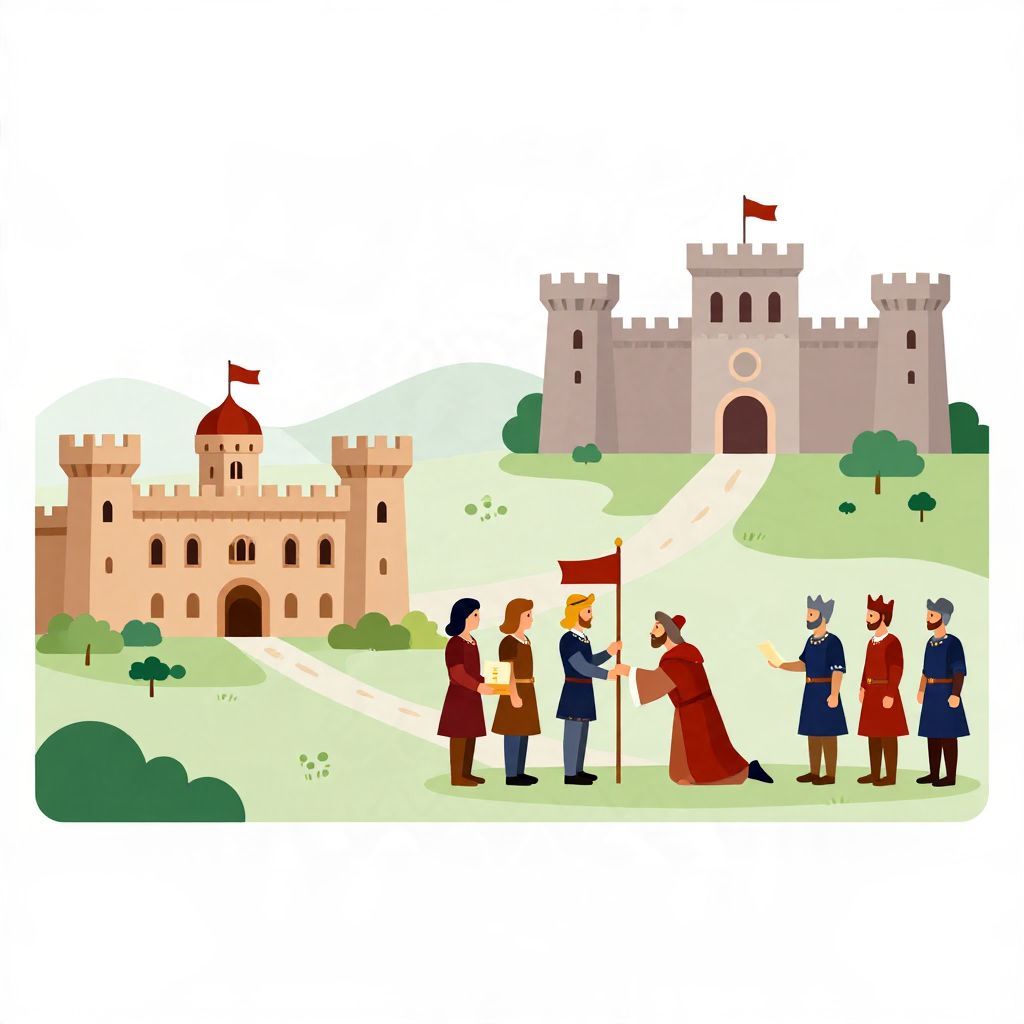
What is a vassal state, and why has the term appeared so often in the history of empires, kingdoms, and modern geopolitics? The phrase describes a territory or government that is formally subordinate to a stronger power, usually while retaining some local rule. It is a useful but flexible term, and its meaning changes depending on the era.
In practice, vassal states have existed in many forms: as tribute-paying kingdoms in the ancient world, client states under empires, or dependent regimes in more recent history. The central idea is unequal sovereignty—one side makes key foreign-policy or military decisions, while the other keeps limited autonomy.
What is a vassal state?
A vassal state is a political entity that is officially subordinate to a more powerful state or empire. It may keep its own ruler, laws, or administration, but it owes loyalty, tribute, military support, or diplomatic obedience to the dominant power. The term is often used for states with partial independence rather than full sovereignty.
The core idea: dependence without complete annexation
Unlike a province directly ruled by an empire, a vassal state usually remains separately governed. Unlike a fully independent country, however, it cannot act freely in major matters. Historians often use the term for arrangements where domination is indirect, negotiated, or strategically useful to the stronger power.
Why the term can be confusing
“Vassal state” is not always a strict legal category. In some periods it describes a formal treaty relationship; in others it is a broad label for dependency. Modern writers sometimes use it loosely or even polemically, so it is important to ask who used the term, in what context, and whether the relationship was formal or informal.
Where did vassal states come from historically?
The idea of subordinate political units is very old. Long before the modern nation-state, empires and kingdoms often ruled through local kings, governors, and tribute systems. These arrangements allowed large states to expand without administering every region directly, making vassalage a practical tool of empire-building.
Ancient Near Eastern and Mediterranean precedents
In the ancient Near East, powerful empires such as the Assyrian, Babylonian, and Persian empires often kept local rulers in place if they paid tribute and accepted imperial authority. Similar patterns appeared in the Hittite world, in parts of the eastern Mediterranean, and later under Rome, where allied kings and client rulers served imperial interests.
Medieval feudal relationships
The word “vassal” is also closely tied to medieval feudalism, where a vassal was a person who owed service to a lord in exchange for land or protection. This is not exactly the same as a vassal state, but the logic is similar: a weaker party accepts obligations to a stronger one in return for security, legitimacy, or autonomy. For a broader explanation of that system, see what a feudal system was.
How did vassal states work in practice?
Vassal states usually operated through a mix of obligation and autonomy. The stronger power wanted loyalty, taxes, troops, or strategic access; the subordinate ruler wanted survival, recognition, or protection from rivals. The exact balance varied widely, and many such relationships shifted over time as power changed.
Common obligations of a vassal state
- Tribute or taxes paid to the dominant power
- Military aid, including troops or support in war
- Foreign-policy limits, such as not making alliances independently
- Symbolic submission, like oaths, hostages, or ceremonial recognition
- Trade concessions or access to ports, roads, or resources
What the dominant power gained
For empires, indirect rule was often cheaper and more stable than direct occupation. A vassal arrangement could reduce rebellion, preserve local elites, and extend influence far beyond the empire’s administrative capacity. It also created buffer zones between rivals, which was especially valuable in contested frontier regions.
What the subordinate ruler gained
Local rulers did not always accept subordination simply because they were weak. Some used vassal status to preserve a throne, avoid destruction, or gain protection against enemies. In that sense, vassalage could be a calculated political choice, not only a sign of defeat.
Examples of vassal states across history
Because the concept is broad, there is no single historical model. Still, several well-known examples show how vassalage functioned in different periods and regions.
Ancient client kingdoms
Rome frequently governed border regions through client kings. These rulers were not Roman emperors, but they depended on Roman favor and had to support Roman strategic goals. Herod the Great in Judea is a well-known example of a ruler who maintained local authority while relying on Roman backing.
Tributary kingdoms in East Asia
In East Asian history, some neighboring states entered tributary relationships with larger powers such as imperial China. These were often diplomatic systems as much as political ones, involving ritual recognition, trade privileges, and symbolic hierarchy. They did not always mean direct control, but they did express unequal status.
Vassal principalities in medieval and early modern Europe
Many smaller principalities, duchies, and kingdoms in Europe existed under the shadow of stronger neighbors. Some paid tribute or accepted overlordship from larger monarchies or empires. The relationship could be temporary, contested, or largely ceremonial, depending on military strength and diplomacy.
Modern dependent states
In the modern era, the term has been applied to states under occupation, puppet governments, or heavily constrained allies. However, historians are cautious here, because modern international law emphasizes sovereignty more clearly than earlier political orders did. Not every unequal alliance is truly a vassal relationship.
Vassal state, client state, puppet state: what is the difference?
These terms overlap, but they are not identical. “Vassal state” usually suggests formal subordination with some retained autonomy. “Client state” often implies dependence on a stronger patron, especially in foreign policy. “Puppet state” usually means the subordinate government has little real independence and is controlled behind the scenes.
A simple comparison
- Vassal state: subordinate, but may keep local rule and some autonomy
- Client state: dependent on a stronger power, often through diplomacy or security ties
- Puppet state: controlled by an outside power with minimal genuine independence
These categories are sometimes used interchangeably in popular writing, but historians prefer precision. A state can be dependent without being entirely controlled, and a relationship can change over time from alliance to subordination or from vassalage to annexation.
Why did empires prefer vassal states?
Empires often ruled vast territories with limited administrative resources. Vassal states helped solve that problem by extending influence indirectly. They also reduced the costs of occupation and allowed rulers to govern through local elites who already understood the region’s language, customs, and political landscape.
Strategic advantages
Vassal states could serve as buffers against hostile neighbors, absorb first attacks in wartime, and provide intelligence or troops. They also helped empires project power without overextending themselves. In frontier zones, indirect rule was often more practical than direct annexation.
Economic advantages
Tribute, trade access, and resource extraction were major incentives. A dominant power might not need to administer every mine, market, or farm directly if a subordinate ruler could be made responsible for delivering wealth and maintaining order. This made vassalage a flexible imperial tool.
How did vassal states lose their status?
Vassal relationships rarely lasted forever. They could end through annexation, rebellion, dynastic change, war, or the collapse of the dominant empire. Sometimes a vassal state grew stronger and broke free; in other cases it was absorbed entirely into a larger political unit.
Common paths out of vassalage
- Independence after a successful revolt or diplomatic shift
- Annexation by the stronger power
- Regime change that altered alliances and loyalties
- Imperial collapse that removed the dominant authority
- Redefinition of the relationship into a treaty alliance or protectorate
Because these relationships were often based on power rather than fixed law, they could be unstable. A vassal state might remain subordinate for decades, then suddenly become independent when the balance of power shifted.
Is a vassal state the same as a colony?
No. A colony is usually directly controlled and administered by a foreign power, often with settlers, governors, or colonial institutions replacing local sovereignty. A vassal state more often keeps its own ruler or government, even though that ruler is subordinate. The distinction matters because it reflects different methods of control.
Direct rule versus indirect rule
Colonial systems usually involve direct governance, while vassal systems rely more on local intermediaries. In reality, the line can blur. Some empires used both methods at once, governing some regions directly and others through dependent rulers. That flexibility was one reason imperial systems could endure so long.
Why the concept still matters today
The idea of a vassal state remains useful because it helps explain how power can operate without full annexation. Modern politics still includes unequal alliances, security dependence, and limited sovereignty, even if the legal language has changed. The term also reminds us that independence and control are not always the same thing.
Use the term carefully
Because “vassal state” can be politically loaded, it should be used with care. It is most accurate when describing a clearly subordinate political entity that retains some local authority while owing obedience or tribute to a stronger power. When the evidence is mixed, it is better to describe the specific relationship than to force a label.
In short, a vassal state is a dependent political unit that remains partly self-governing while acknowledging the supremacy of a stronger power. The concept has deep roots in ancient empires, medieval politics, and modern diplomacy, and it helps explain how domination often worked through indirect control rather than outright conquest. For related background, you may also want to read about feudal systems and mercantilism.