
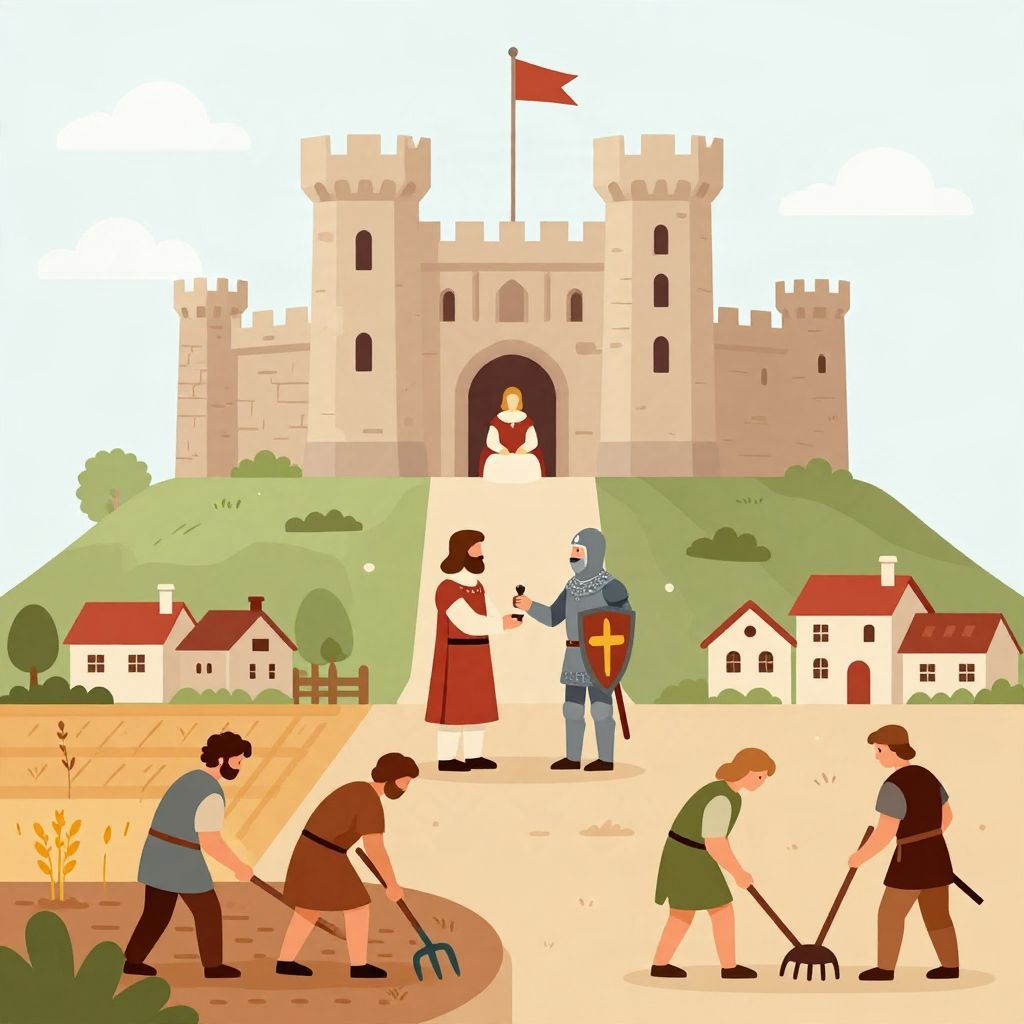
What is a feudal system? In simple terms, it was a way of organizing power, land, and military service in medieval societies, especially in Europe. Kings and great lords granted land to others in exchange for loyalty, support, and armed service, creating a network of personal obligations rather than a strong central state.
The term is often used broadly, but historians debate how exact or universal it really was. Feudal arrangements changed over time and looked different from place to place, yet they shaped politics, warfare, and landholding across much of medieval Europe.
What Is a Feudal System?
A feudal system was a hierarchical social and political order based on land ownership and reciprocal obligations. A ruler or lord granted land, called a fief, to a vassal in return for military service, advice, or other duties. Peasants, especially serfs, worked the land and supported the whole structure through labor and dues.
How Did Feudalism Work?
Lords, vassals, and fiefs
At the center of feudalism was a personal relationship. A vassal pledged loyalty to a lord through a ceremony of homage and fealty, and the lord provided protection and the right to use land. The land itself was not always owned outright; it was often held conditionally, meaning it could be lost if obligations were ignored.
Military service and protection
In a world with limited central government and frequent warfare, land-for-service arrangements made practical sense. Lords needed mounted warriors and local control, while vassals needed resources to equip themselves. Feudal ties helped organize defense, but they also fragmented authority because power was spread among many local rulers.
Peasants and the manorial economy
Most people in feudal societies were not lords or knights. They were peasants who farmed the land and paid rent, labor services, or a share of produce. Many lived on manors, estates controlled by a lord. This manorial system was closely connected to feudalism, though the two are not exactly the same thing.
Where Did Feudalism Come From?
Feudalism developed gradually in western Europe after the collapse of the Western Roman Empire in the fifth century. As Roman political structures weakened, local leaders became more important for protection and administration. Over time, especially from the ninth to the twelfth centuries, landholding and service relationships became more formalized.
Roots in late antiquity and early medieval Europe
Historians often trace feudal practices to a mix of Roman traditions, Germanic customs, and the realities of post-Roman insecurity. Roman patronage had already linked powerful patrons with dependents, while Germanic kings and warriors relied on personal loyalty. These older habits did not create feudalism overnight, but they helped shape it.
The Carolingian world
The empire of Charlemagne in the late eighth and early ninth centuries is often associated with early feudal development. The Carolingian rulers used land grants and local elites to govern a large territory. After the empire fractured, local lords gained even more power, especially as Viking, Magyar, and Muslim raids increased the need for local defense.
What Were the Main Features of Feudal Society?
Feudal society is usually described as a pyramid, though that image can oversimplify a complex reality. The main features were hierarchy, land-based wealth, personal loyalty, and decentralized power. Social rank mattered greatly, and rights and duties were tied to status rather than equality before the law.
- King: nominal ruler, often dependent on the loyalty of powerful nobles
- Great lords: controlled large estates and granted land to lesser nobles
- Knights and vassals: provided military service and local administration
- Peasants and serfs: produced food and labor that sustained the system
Knighthood and warfare
Knights became a key part of feudal military culture. They were usually mounted fighters who could be supported by land income. Over time, knighthood developed into both a military role and a social identity, with ideals of loyalty, honor, and service, although actual medieval warfare was often brutal and practical rather than chivalric.
Law and local authority
Because central governments were weak, local lords often exercised judicial and administrative power. They could collect dues, settle disputes, and enforce order on their estates. This meant that political authority was highly localized, and different regions could have very different customs and obligations.
Was Feudalism the Same Everywhere?
No. Feudalism is most commonly associated with medieval France and England, but related systems existed in other parts of Europe and beyond. Even within Europe, the details varied widely. The English version after 1066, for example, was shaped by Norman conquest and royal administration, while other regions retained different balances between kings, nobles, and local communities.
England after the Norman Conquest
After 1066, William the Conqueror redistributed land to his followers while keeping strong royal control. This made English feudalism distinctive: the king remained unusually powerful compared with some continental rulers. The Domesday Book of 1086 shows how carefully land, obligations, and wealth were recorded for royal oversight.
France and the fragmentation of power
In medieval France, royal authority was often weaker in practice than the ideal of kingship suggested. Great dukes and counts controlled substantial territories and could act almost like independent rulers. This fragmentation is one reason historians often use France as the classic example of feudal decentralization.
Beyond western Europe
Similar land-and-service systems appeared in places such as Japan, where samurai and daimyō formed a warrior-based order. However, historians are careful not to treat Japanese society as identical to European feudalism. The similarities are real, but the institutions, culture, and historical development were different.
Why Did Feudalism Develop?
Feudalism grew out of practical needs. After the fall of centralized Roman power in the West, rulers needed ways to govern, defend territory, and reward followers without large bureaucracies or standing armies. Land was the most reliable source of wealth, so it became the main currency of political loyalty.
Security in an unstable age
Medieval Europe faced repeated invasions, local violence, and uncertain communications. Strong local lords could offer protection more quickly than distant rulers. In return, they demanded service and labor. Feudalism was therefore not just an ideology; it was a survival strategy in a fragmented political landscape.
Land as wealth
In a largely agrarian economy, land produced food, income, and status. Because money was less central than it would become later, rulers often rewarded followers with estates rather than salaries. This tied political power directly to landholding and made social hierarchy deeply rooted in the countryside.
What Were the Limits of Feudalism?
Feudalism was never a perfect or complete system. Not every medieval person fit neatly into a feudal role, and not every region followed the same rules. Towns, merchants, church institutions, and royal officials all complicated the picture. For that reason, many historians prefer to use the term carefully rather than as a catch-all explanation for the Middle Ages.
Historians debate the term
Modern scholars sometimes criticize “feudalism” because it can blur together several different systems: land tenure, military obligation, social rank, and manorial agriculture. The word itself became widely used much later than the period it describes. Still, it remains useful as a broad way to understand a society built on land, loyalty, and hierarchy.
The role of the Church
The medieval Church was a major landholder and political force. Bishops, abbots, and monasteries owned estates and sometimes participated in feudal relationships. At the same time, the Church also offered an alternative source of authority that could challenge or support secular lords. This made medieval power even more layered and complex.
How Did Feudalism Change Over Time?
Feudalism did not last unchanged throughout the Middle Ages. From the twelfth century onward, kings in parts of Europe began building stronger administrations, using written law, taxation, and professional officials. Town growth, trade, and monetary economies also reduced dependence on purely land-based obligations.
- 5th–9th centuries: post-Roman fragmentation and local defense needs
- 9th–12th centuries: feudal relationships become more formalized
- 12th–15th centuries: monarchies, towns, and commerce weaken classic feudal patterns
- Later medieval and early modern period: feudal remnants survive in law and landholding
The decline of classic feudalism
Feudalism declined unevenly. In some regions, royal power grew and noble independence shrank. In others, noble privileges remained strong for centuries. The rise of gunpowder warfare, larger armies, taxation, and centralized states gradually made the old land-for-service model less important as a political system.
Why Does Feudalism Matter in History?
Feudalism matters because it helps explain how medieval Europe functioned after the collapse of Roman imperial power. It shaped the structure of kingship, noble privilege, rural life, and warfare. It also influenced later political ideas about hierarchy, obligation, and property, even after the system itself had changed.
Understanding feudalism also helps avoid oversimplifying the Middle Ages. It was not a single uniform machine, but a flexible set of relationships that developed in response to insecurity, weak central authority, and the economic importance of land. That is why the term remains useful, even if historians use it with caution.
In short, a feudal system was a medieval order built on land, loyalty, and layered authority. It was never identical everywhere, but it played a central role in shaping Europe’s political and social landscape. For related background, you may also want to explore broader medieval history on this history site.