
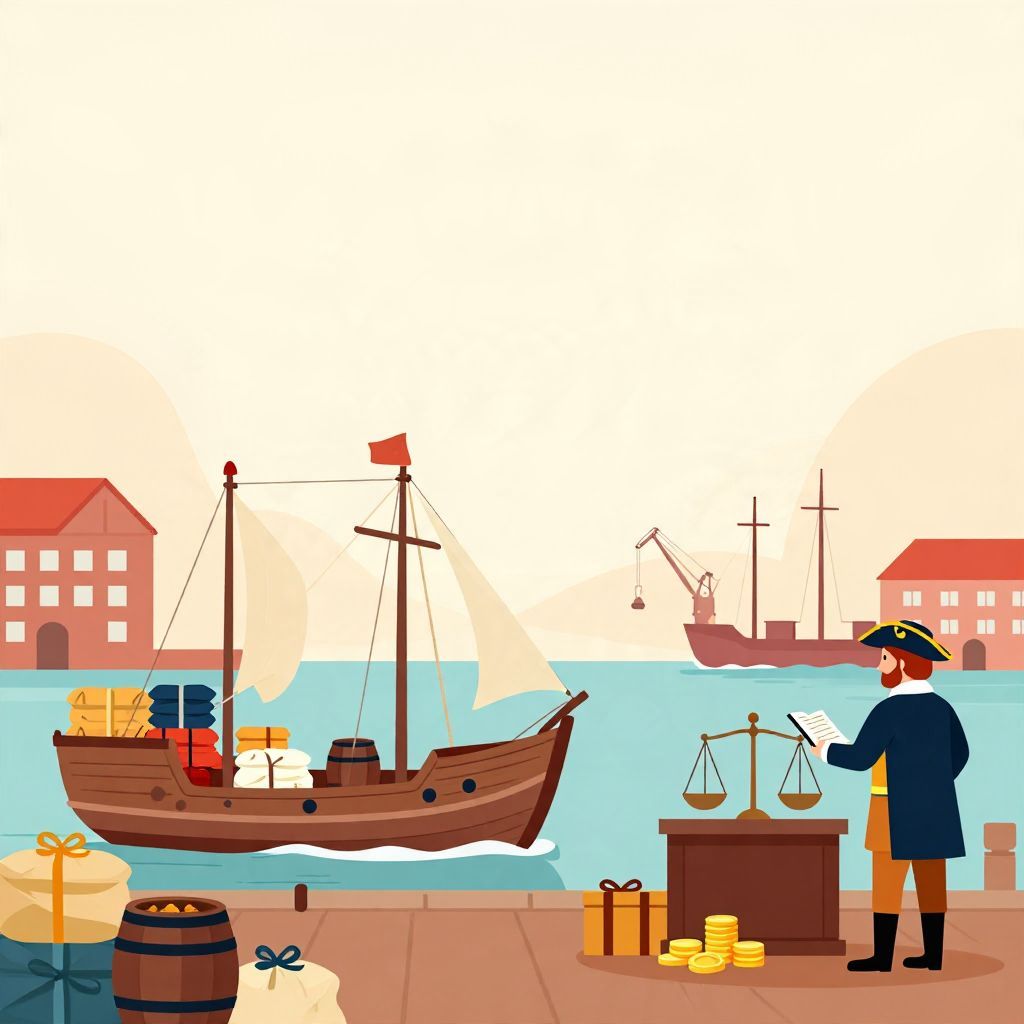
What is mercantilism? It was a major economic and political idea in early modern Europe, especially from the 16th to the 18th centuries, that held a nation’s power depended on accumulating wealth, especially gold and silver, and maintaining a favorable balance of trade.
Mercantilism shaped how states taxed goods, built navies, founded colonies, and regulated commerce. It was not a single fixed doctrine, but a cluster of policies and assumptions that influenced European empires and helped define the age of colonial expansion.
What Is Mercantilism?
Mercantilism was an early modern system of economic thought and state policy that treated trade, bullion, and imperial control as tools of national power. Governments sought to export more than they imported, protect domestic industry, and use colonies to supply raw materials and buy finished goods.
Background: Why Mercantilism Emerged
Mercantilism developed in Europe after the late medieval period, when kingdoms were becoming more centralized and long-distance trade was expanding. Monarchs needed revenue for armies, navies, wars, and administration, while merchants and states both benefited from stronger commercial networks. The rise of Atlantic trade, the influx of American silver, and competition among European powers all encouraged new thinking about wealth and power.
The shift from medieval to early modern economies
In the Middle Ages, economic life was still deeply local in many places, and political authority was fragmented. By the 1500s, however, larger states in Spain, France, England, and the Dutch Republic were trying to strengthen their finances and military reach. Trade was no longer just a matter of local markets; it became tied to diplomacy, warfare, and empire.
Wealth, bullion, and state power
Mercantilist writers and officials often assumed that the amount of wealth in the world was limited, so one nation’s gain could be another’s loss. Gold and silver were especially prized because they could pay soldiers, settle debts, and support state power. This bullionist outlook did not mean all mercantilists agreed on every policy, but it did shape a broad belief that the state should actively manage economic life.
How Mercantilism Worked in Practice
Mercantilism was less a single theory than a set of policies. Governments tried to increase exports, reduce imports of finished goods, control colonial trade, and direct commerce toward national advantage. These policies were often enforced through tariffs, monopolies, navigation laws, and chartered companies.
Common mercantilist policies
- Tariffs on imported goods to protect domestic producers.
- Export incentives to encourage sales abroad.
- Navigation laws that reserved trade for national ships or merchants.
- Colonial restrictions that forced colonies to trade with the mother country.
- Chartered companies granted exclusive trading rights in certain regions.
- State subsidies and regulation to promote strategic industries such as shipbuilding or textiles.
Why colonies mattered
Colonies were central to mercantilist thinking because they could provide raw materials, serve as captive markets, and extend a state’s strategic reach. European powers often tried to ensure that colonies supplied sugar, tobacco, cotton, timber, furs, or metals while buying manufactured goods from the metropole. This system enriched some merchants and states, but it also constrained colonial economies and intensified exploitation, including enslaved labor in the Atlantic world.
Major Mercantilist Powers and Policies
Several European states adopted mercantilist policies, though each did so in its own way. England, France, Spain, Portugal, and the Dutch Republic all participated in the wider mercantilist world, but the details differed according to political structure, colonial empire, and commercial interests.
England and the Navigation Acts
England is one of the clearest examples of mercantilist policy. The Navigation Acts, beginning in the mid-17th century, tried to channel trade through English ships and English ports. These laws supported maritime power and helped England compete with the Dutch. Over time, they also tied the English economy more tightly to its growing Atlantic empire.
France and Colbertism
In France, mercantilist policy is often associated with Jean-Baptiste Colbert, finance minister under Louis XIV. Colbert promoted manufacturing, improved infrastructure, regulated quality standards, and supported trade companies. French mercantilism, often called Colbertism, aimed to strengthen royal power by increasing state revenue and reducing dependence on foreign goods.
Spain, silver, and imperial wealth
Spain’s empire in the Americas produced vast amounts of silver, especially from mines such as Potosí in present-day Bolivia and Zacatecas in present-day Mexico. Yet silver alone did not guarantee lasting prosperity. Much of it flowed into international trade, debt payments, and military spending. Spain’s experience showed one of mercantilism’s tensions: bullion could strengthen a state, but it did not automatically create a balanced or diversified economy.
Key Thinkers and Intellectual Origins
Mercantilism was not invented by one person. It emerged from a broad conversation among merchants, administrators, and writers in the 16th and 17th centuries. Later historians use the term “mercantilism” to describe these related ideas, even though people at the time did not always use that exact label for themselves.
Thomas Mun and trade balance
One of the best-known English writers associated with mercantilist thought was Thomas Mun, whose work argued that a nation should aim to export more than it imported in order to bring wealth into the country. His ideas reflected the practical concerns of merchants and officials in a world of intense commercial rivalry.
Other influences
Mercantilist thinking also drew on older traditions, including medieval ideas about just price, moral regulation of trade, and the legitimacy of state intervention. It was shaped by experience as much as by theory: wars, colonial competition, piracy, precious-metal flows, and the growth of global trade all pushed governments toward interventionist policies.
Mercantilism and the Commercial Revolution
Mercantilism is closely linked to the Commercial Revolution, the period of expanding trade, financial innovation, and market integration that transformed Europe between roughly the 16th and 18th centuries. As merchants moved goods across oceans and states sought new revenue, economic life became more global and more politically contested.
Finance, banks, and credit
Mercantilist states needed credit to fund war and trade. This encouraged the growth of banking, public debt, stock companies, and more sophisticated taxation. The economic world of mercantilism was therefore not just about hoarding metal; it also depended on financial systems that could mobilize capital for state purposes.
Global trade networks
Mercantilism developed alongside the expansion of the Atlantic world, the Indian Ocean trade, and European colonial competition in Asia, Africa, and the Americas. The search for profit was tied to imperial rivalry, and economic policy became an instrument of geopolitical struggle.
Was Mercantilism Successful?
The answer depends on what one means by success. Mercantilist policies often helped states raise revenue, build navies, support strategic industries, and strengthen imperial control. They could also enrich merchants connected to state power. But they frequently created inefficiencies, encouraged smuggling, burdened consumers with higher prices, and provoked conflict with rivals and colonies.
Benefits for states
- Greater control over trade and customs revenue.
- Support for naval and military expansion.
- Growth of certain domestic industries.
- Stronger imperial administration and commercial reach.
Costs and contradictions
- Trade restrictions could distort markets and raise costs.
- Colonies often resisted limits on their economic freedom.
- Smuggling and illegal trade undermined enforcement.
- Wealth did not always translate into broad prosperity.
Mercantilism, Empire, and Slavery
Any history of mercantilism must also confront its connection to empire and slavery. European states used mercantilist systems to organize the Atlantic economy, including plantation production in the Caribbean and the Americas. Enslaved Africans were forced to labor in systems that generated profits for merchants, planters, and imperial states. Mercantilist policy did not create slavery, but it helped integrate slavery into a larger commercial and imperial framework.
The Decline of Mercantilism
Mercantilism did not disappear overnight. It gradually weakened in the late 18th and 19th centuries as new economic ideas gained influence, especially classical economics. Thinkers such as Adam Smith criticized the belief that wealth should be measured mainly by bullion and argued that free trade and specialization could increase prosperity more effectively than heavy state control.
Why the old system lost influence
Several forces undermined mercantilism: the growth of industrial capitalism, changing ideas about markets, the practical limits of trade restrictions, and the rise of arguments for freer commerce. Even so, states continued to regulate trade and protect strategic industries. In that sense, mercantilism faded as a dominant doctrine, but not as a complete practice.
Why Mercantilism Still Matters
Mercantilism matters because it helps explain how early modern states built power, how empires expanded, and why trade became so deeply tied to politics. It also shows that economic policy has long been used to serve national goals, not just private profit. Many modern debates about tariffs, industrial policy, and strategic trade still echo older mercantilist assumptions, even when the historical context is very different.
In short, mercantilism was the economic logic of a world where states, empires, and merchants competed fiercely for wealth and power. To understand it more fully, you may also want to read about the Commercial Revolution and American imperialism, both of which help place mercantilism in a broader historical context.