
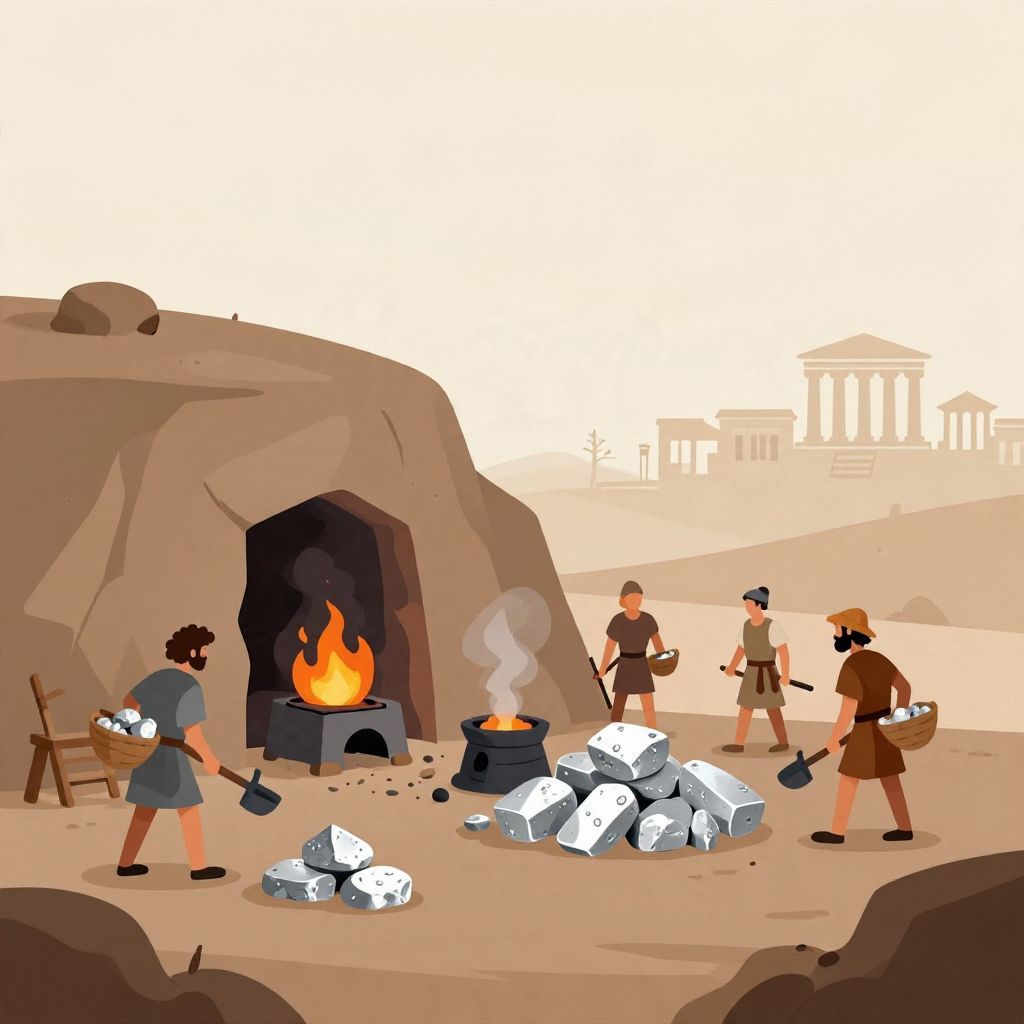
Where does silver come from? The short answer is that silver is a naturally occurring metal found in the Earth’s crust, usually in ore deposits rather than as pure metal. People have mined it for thousands of years, then refined it through smelting, chemical separation, and modern industrial processing.
Its history is as important as its geology: silver shaped ancient trade, coinage, empire building, and luxury culture long before modern science explained how it formed underground.
Where does silver come from?
Silver comes from mineral deposits in the Earth, most often as a byproduct of mining other metals such as copper, lead, zinc, and gold. In nature, it may appear as native silver, but more commonly it is locked inside ores like argentite and other silver-bearing minerals. Humans extract it by mining, crushing, and refining those ores.
How silver forms in nature
Silver is not “made” by people; it is a chemical element formed in cosmic processes long before Earth existed. Astronomers understand that heavy elements such as silver were created in violent stellar events, especially neutron-rich explosions and collisions. Those atoms later became part of the material that formed the solar system.
From stars to rocks
After Earth formed, silver was distributed unevenly through the planet’s crust. Geological forces such as volcanic activity, hydrothermal fluids, and tectonic movement concentrated it in certain places. Over millions of years, these processes created ore bodies that miners could eventually find and exploit.
This is why silver is not spread evenly across the globe. Instead, it tends to occur in deposits associated with specific geological settings, often alongside lead, copper, and zinc ores.
How people discovered and mined silver
Silver was one of the earliest metals used by humans because it could sometimes be found in recognizable form and because ancient metallurgists learned to extract it from ore relatively early. By the Bronze Age, people in the eastern Mediterranean and Near East were already mining and refining silver on a large scale.
Ancient mining and early refining
Ancient miners dug shafts and tunnels into ore-rich hillsides, then crushed the rock and heated it in furnaces. One of the most important early techniques was cupellation, a process that separated silver from lead. The lead was oxidized and absorbed, leaving silver behind. This method became central to ancient silver production.
In places such as Anatolia, the Aegean world, the Iberian Peninsula, and later parts of the Roman Empire, silver mining supported elite wealth, religious offerings, and state finance. Silver was valuable not only because it was beautiful, but because it was rare, durable, and easy to weigh and trade.
Silver in the ancient world
Silver played a major role in the economies of ancient civilizations. It was used for jewelry, vessels, temple offerings, and, increasingly, coinage. Once states began striking silver coins, the metal became even more important because it could serve as a trusted medium of exchange across large regions.
Mesopotamia, Greece, and Rome
In Mesopotamia, silver was often used as a standard of value long before widespread coinage. In the Greek world, silver mines became politically significant. The famous mines at Laurion near Athens helped finance the city’s naval power in the 5th century BCE, showing how mineral resources could influence warfare and state power.
The Romans expanded silver extraction across their empire. They used it to support coinage, military spending, and elite consumption. Roman mining methods were labor-intensive and often relied on enslaved workers, prisoners, or coerced labor, a reminder that silver’s beauty was tied to harsh extraction systems.
Where silver came from in the Americas
Before European colonization, Indigenous peoples in the Americas also worked silver and other metals, especially in parts of the Andes and Mesoamerica. After the 16th century, however, the Americas became the center of global silver production. The Spanish Empire’s mines in particular transformed the world economy.
Potosí and global silver flows
One of the most famous silver sources in history was Potosí, in present-day Bolivia, discovered in 1545. Together with other major mining districts such as Zacatecas in New Spain, Potosí helped flood global markets with silver. This silver moved through Spanish imperial networks, across the Atlantic to Europe, and across the Pacific to Asia.
The scale of production was enormous by early modern standards, though exact totals vary by period and source. What is clear is that American silver linked the economies of Europe, Asia, and the Americas more tightly than ever before. It also brought devastating consequences: forced labor systems, environmental damage, and severe disruption to Indigenous societies.
How silver is extracted today
Modern silver comes from industrial mining and refining rather than from hand-dug shafts and simple furnaces. Today, silver is often recovered as a secondary product from mines whose main output is copper, lead, zinc, or gold. This means that much of the world’s silver supply is tied to the economics of other metals.
Modern mining and refining methods
After ore is extracted, it is crushed and processed to separate valuable minerals from waste rock. Depending on the ore, silver may be recovered through flotation, smelting, electrolysis, or chemical leaching. Refineries then produce high-purity silver for industrial use, jewelry, bullion, and coinage.
Because silver is often a byproduct, supply can change even when demand remains steady. If mines producing copper or lead slow down, silver output may fall too. That makes silver markets different from those of some metals mined primarily for their own sake.
Why silver mattered so much in history
Silver mattered because it sat at the intersection of money, power, and prestige. Societies valued it for ornament and ritual, but states valued it even more for taxation, trade, and coinage. A reliable silver supply could strengthen governments, fund armies, and connect distant markets.
Silver and coinage
Silver coins became one of the most important monetary tools in history. Their value rested on both the metal content and the authority of the issuing state. From ancient drachmas and denarii to later European thalers and colonial pesos, silver coinage helped standardize exchange over long distances.
Even after paper money and fiat currencies became dominant, silver remained important in bullion, jewelry, electronics, photography, and industrial applications. Its historical role as money, however, is what made the question “where does silver come from?” so politically significant for centuries.
Myths, legends, and misunderstandings about silver
Silver’s long history has produced many myths. Some traditions treated it as a pure, almost magical substance associated with the moon, healing, or protection against evil. Those ideas are part of cultural history, but they are not scientific explanations for silver’s origin.
Another common misunderstanding is that silver is rare because it is only found in a few famous mines. In fact, silver is present in many regions of the world; what matters is whether it can be mined profitably. Historical scarcity often reflected technology, labor, and transport costs as much as geology.
What the history of silver tells us
The history of silver shows how a natural resource can shape civilizations across thousands of years. It began as a metal formed in ancient cosmic events, concentrated by geology, and extracted by human labor. Then it became a driver of trade, empire, and monetary systems from antiquity to the modern era.
So, where does silver come from? It comes from the Earth’s crust, but also from a long human story of mining, refinement, exchange, and power. If you want to explore silver’s place in American coinage history, you may also like when quarters were made of silver and what year quarters stopped being silver.