
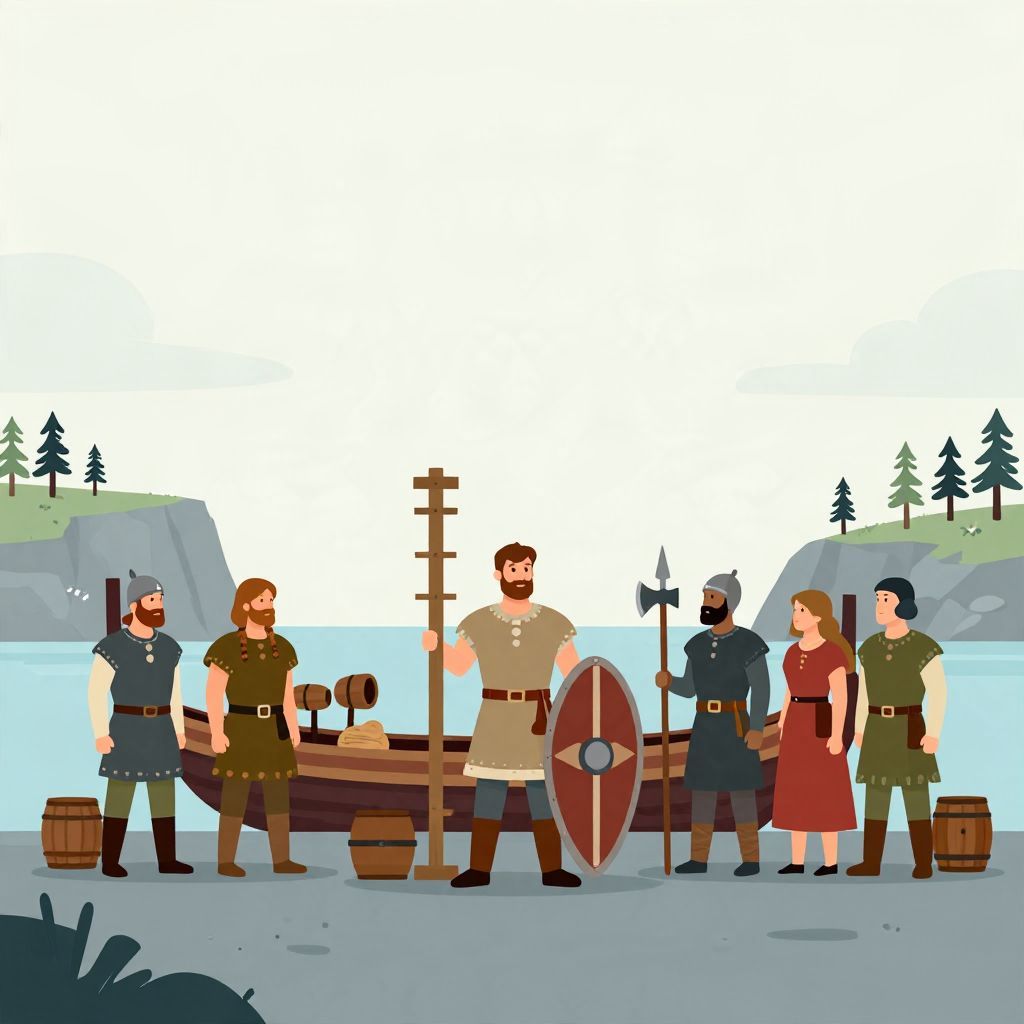
How tall were Vikings? The short answer is that most Viking-age men were not giants, but they were often a little taller than many people imagine. Based on skeletal evidence, average male height in Scandinavia during the Viking Age was roughly 5 feet 7 inches to 5 feet 8 inches (about 170–173 cm), with women averaging around 5 feet 1 inch to 5 feet 3 inches (about 155–160 cm).
That said, height varied by diet, health, region, and social status. The Vikings were a diverse people, and their height should be understood as part of wider medieval living conditions rather than as a fixed ethnic trait.
How tall were Vikings?
Most Viking-age men stood around 170–173 cm tall, while women were generally around 155–160 cm tall. These figures come from archaeological study of skeletons, not from sagas or modern myths. Some individuals were shorter and some taller, but the average Viking was only modestly taller than many other medieval Europeans.
What the skeletons tell us
Archaeologists estimate Viking height by measuring long bones such as the femur and tibia. These bones provide a reliable approximation of stature. Burials from Scandinavia and Viking settlements in places like Britain and Ireland show that height was fairly consistent with northern European populations of the early medieval period.
Why the evidence matters
Written sources rarely give exact body measurements, so bones are the best evidence. They also reveal that height was shaped by childhood nutrition and disease. A person who grew up with enough protein, fewer infections, and less physical stress was more likely to reach their genetic potential for height.
Average height was not the same as “all Vikings”
Vikings were not one uniform biological type. The term refers to people from Scandinavia in the Viking Age, roughly the late 8th to the 11th century, especially those involved in raiding, trading, settlement, and seafaring. Within that world, some communities had better access to food than others, and elite individuals could be taller than average.
Were Vikings taller than other people?
In many cases, yes, but only slightly. Viking-age Scandinavians were often taller than some contemporary populations in parts of Europe, especially where diets were poorer or childhood illness was more common. They were not dramatically taller than everyone else, and the difference was usually measured in centimeters, not inches of legend.
Why people may have seemed taller
Several factors may have contributed to the impression of large stature. Scandinavian diets could include fish, dairy, meat, and grains, depending on region and season. Coastal and farming communities sometimes had relatively good access to protein. Also, modern people may overestimate ancient heights because surviving armor, weapons, and burial goods can create a powerful image of physical strength.
Myth versus reality
Popular culture often depicts Vikings as towering warriors with enormous frames. That image is partly a product of 19th- and 20th-century romanticism, later reinforced by films and television. The historical Vikings were robust and physically demanding people, but they were not uniformly huge.
How tall were Viking men and women?
Men were generally taller than women, as in most populations. A useful estimate is about 170–173 cm for men and 155–160 cm for women, though local variation was real. These averages are broad and should not be treated as exact measurements for every settlement or generation.
Men in warrior culture
Some of the tallest men would have been especially noticeable in warfare, where height and strength could be advantages in close combat. But Viking success at sea and in battle depended on many other factors: training, teamwork, weapons, leadership, and experience. Height alone did not make a fighter effective.
Women in Viking society
Women’s skeletal remains show the same general pattern seen in other premodern societies: shorter average stature than men, with variation based on nutrition and health. Viking women were active participants in household production, textile work, farming, and family life, and their physical condition reflects the demands and limits of early medieval life.
Why weren’t Vikings much taller?
Premodern height was limited by childhood disease, food shortages, and hard labor. Even in relatively prosperous regions, people did not have the stable nutrition and public health conditions that support taller average height today. Viking-age Scandinavia was hardy, but it was still a world of seasonal scarcity and frequent illness.
Nutrition and disease
Children who contracted repeated infections often grew more slowly. In a society without modern medicine, even common illnesses could reduce growth. Food supply also fluctuated with harvests, weather, and local conditions. A strong adult build did not necessarily mean a person had enjoyed ideal growth in childhood.
Social status could make a difference
Archaeologists and historians sometimes find that elites were taller on average than poorer groups. Better access to food and less physically punishing childhood labor could improve growth. Still, status was only one factor among many, and it should not be overstated.
Did Viking armor and weapons fit tall people?
Not especially. Viking swords, spears, shields, and helmets were designed for practical use, not for unusually tall bodies. Surviving equipment suggests that most warriors were of ordinary medieval stature. The famous image of oversized fighters is more modern fantasy than archaeological reality.
What burial finds suggest
Burials containing weapons or high-status goods do not prove that the dead were exceptionally tall. Graves reflect identity, rank, and ritual as much as body size. When skeletons are preserved, they often show a range of heights rather than a single “Viking build.”
How historians know and why estimates vary
Height estimates depend on which skeletons are measured, how well they are preserved, and which formula is used to convert bone length into stature. For that reason, exact numbers can differ slightly between studies. The broad conclusion, however, is stable: Viking-age Scandinavians were moderately tall by medieval standards, not superhuman.
Limits of the evidence
Not every burial is representative. Some graves belong to particular communities, social groups, or time periods. Migration and intermarriage also complicate the picture, especially in Viking settlements outside Scandinavia. A person buried in Dublin, York, or Iceland may not reflect the average height of all Scandinavians.
Regional variation
Scandinavia itself was not uniform. Coastal Norway, Denmark, Sweden, and later overseas settlements all had different environments and food systems. Local conditions could influence growth, so it is safer to speak of general averages than of one fixed Viking height.
What Viking height tells us about their world
Height is more than a curiosity. It is a clue to diet, childhood health, social inequality, and living conditions. The fact that many Vikings were relatively tall suggests that some communities had decent access to protein and a physically demanding but not always nutritionally disastrous way of life. It also reminds us that medieval people were shaped by environment as much as by culture.
Beyond the stereotype
The Viking world was not just raiding and violence. It included farming, trade, shipbuilding, law, craft production, and family networks stretching across the North Atlantic and beyond. Physical stature was only one part of a much larger historical picture.
So, how tall were Vikings? Most were around average-to-above-average height for their time, with men typically near 170–173 cm and women around 155–160 cm. They were sturdy, hardworking people, but the legendary image of towering Viking warriors is exaggerated. If you want to explore their appearance further, see what Vikings looked like, or compare them with another famous figure in how tall Genghis Khan was.