
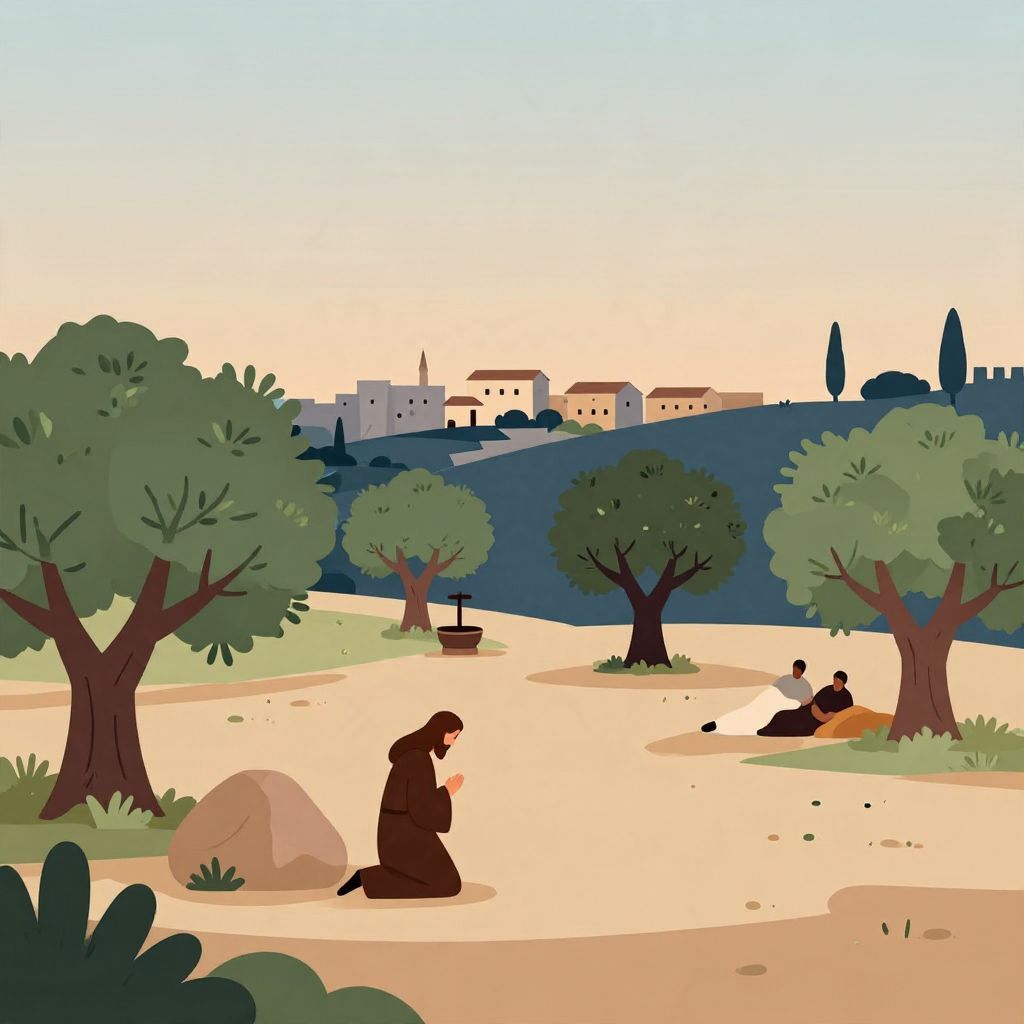
What does Gethsemane mean? The word is best understood as “oil press” or “olive press,” a name that reflects the olive groves that once covered the lower slopes of the Mount of Olives near Jerusalem. In Christian history, Gethsemane is also the place where Jesus prayed before his arrest, giving the name a powerful spiritual meaning beyond its original geography.
Its significance comes from both language and memory: a real agricultural site in ancient Judea became one of the most famous places in the New Testament. Understanding the name helps explain why Gethsemane matters in biblical history, Jewish geography, and Christian tradition.
What does Gethsemane mean?
Gethsemane means “oil press” or “olive press.” The name likely comes from an Aramaic or Hebrew phrase referring to a place where olives were pressed for oil. In the first century, such presses were common around Jerusalem, especially on the Mount of Olives. The name describes a working landscape, not originally a sacred one.
The language behind the name
Aramaic, Hebrew, and Greek forms
The word appears in the New Testament in Greek as Gethsēmaní, but scholars generally trace it back to a Semitic original. The most accepted explanation is that it comes from Aramaic, often understood as something like gath shemanim, meaning “oil press.” Some scholars note a Hebrew parallel as well. The exact original form is not absolutely certain, but the meaning is widely agreed upon.
This is typical of many place-names in ancient Palestine, where languages overlapped and names were passed through spoken usage before being written in Greek. The New Testament preserved the place-name in a Greek text, but the underlying meaning remained tied to local agricultural life.
Why the meaning matters historically
The name tells us something important about the ancient world: Gethsemane was not invented as a symbolic title. It was an ordinary place-name rooted in the economy of olive cultivation. Olive oil was essential in the ancient Mediterranean for cooking, lighting, medicine, ritual use, and trade. A place called “oil press” would have made immediate sense to people living near Jerusalem.
Where was Gethsemane?
Gethsemane was associated with the Mount of Olives, just east of Jerusalem, across the Kidron Valley. The precise boundaries of the original site are uncertain, because the area changed over centuries and later Christian tradition identified specific spots for devotion. Still, the broad location is clear: it lay in the olive-growing landscape facing the city.
The New Testament places Jesus there on the night before the crucifixion. Because of that, the site became one of the most important pilgrimage locations in Christian memory. Today, several churches and gardens on the Mount of Olives commemorate the event, though the exact ancient garden cannot be identified with certainty.
Gethsemane in the New Testament
The night before Jesus’ arrest
Gethsemane is most famous from the accounts of Jesus’ final night in the Gospels of Matthew, Mark, and Luke. After the Last Supper, Jesus went with his disciples to a place called Gethsemane to pray. There he experienced deep anguish and asked that, if possible, “the cup” pass from him, while also submitting to God’s will.
The scene is central to Christian theology because it presents Jesus as both distressed and obedient. The setting in a garden or olive grove adds emotional force: a place of pressing olives becomes, in Christian interpretation, a place of spiritual pressure and suffering.
John’s Gospel and the broader tradition
The Gospel of John does not use the name Gethsemane in the same way as the Synoptic Gospels, though it also places the arrest in the vicinity of a garden across the Kidron Valley. This difference is one reason historians are careful about the exact topography. The general location is strongly supported, but some details come from later tradition rather than direct, uniform textual evidence.
Why an olive press became so important
From ordinary place-name to sacred memory
Many ancient sites became holy because of events associated with them. Gethsemane is a strong example of that process. Its original meaning was practical and local, but Christian tradition transformed it into a place of remembrance, prayer, and pilgrimage. The name remained the same, yet its emotional and religious meaning expanded dramatically.
This transformation is historically significant. It shows how sacred geography develops: a real location with an everyday name can become a symbol of suffering, obedience, and divine purpose. In this case, the physical setting of olive presses and gardens became inseparable from the narrative of Jesus’ passion.
Symbolism of olives and pressing
Olives carried deep meaning in the ancient Mediterranean world. Olive trees were long-lived and valuable, and olive oil was a staple commodity. Pressing olives was labor-intensive, involving crushing and extracting oil from fruit. That image later resonated with Christian readers, who saw in Gethsemane an image of pressure, sacrifice, and submission.
It is important, however, not to overstate symbolism as if it were the original purpose of the name. The place was likely called Gethsemane because it had an oil press, not because it was meant to predict the Passion narrative. The symbolic reading came later, through religious interpretation.
What historians can say with confidence
- The name means “oil press” or “olive press.”
- The site was associated with the Mount of Olives near Jerusalem.
- The New Testament links Gethsemane to Jesus’ prayer before his arrest.
- The exact original spelling and precise location are not fully certain.
- Later Christian tradition made Gethsemane a major pilgrimage site.
These points are well supported by historical and textual evidence. What remains debated is not the broad meaning or importance of the name, but the exact archaeological footprint of the original site and the precise linguistic path by which the name entered Greek Gospel texts.
Gethsemane in Christian tradition and art
A place of prayer and suffering
Over time, Gethsemane became a powerful devotional symbol in Christianity. It represented the tension between human fear and faithful obedience. Preachers, theologians, and artists often returned to the scene to reflect on Jesus’ solitude, the sleeping disciples, and the coming betrayal.
Because of this, the word “Gethsemane” can mean more than a location in religious language. It can also evoke a moment of intense trial. In literature and speech, people sometimes use it metaphorically to describe a painful ordeal. That broader usage is later and figurative, not the original historical meaning.
Pilgrimage and sacred landscape
By the Byzantine period and later, Christians identified specific places on the Mount of Olives as Gethsemane. Churches and gardens were established to honor the memory of Jesus’ prayer. The modern Church of All Nations and nearby olive groves are part of this long tradition, though they do not prove the exact ancient spot.
This is a common pattern in religious history: memory attaches itself to landscape, and over centuries the remembered site becomes as meaningful as the original event. Gethsemane is one of the clearest examples in the Holy Land.
Common misunderstandings about the name
It is not a mysterious code word
Some readers assume Gethsemane must be a highly symbolic or secret term. In fact, it is a straightforward place-name with an agricultural meaning. Its importance comes from what happened there, not from hidden etymology.
It is not the name of a city
Gethsemane was not a city, kingdom, or region. It was a place associated with olive processing near Jerusalem. Confusing it with a larger settlement can lead to misunderstandings about the geography of the Passion narratives.
The exact site cannot be proven archaeologically
Although the general location is well known, archaeology has not definitively fixed the precise boundaries of the first-century Gethsemane. Later devotional sites reflect tradition, not absolute certainty. That does not weaken the historical significance of the place; it simply means historians distinguish between likely location and provable exactness.
Why the question still matters today
Asking what Gethsemane means opens a window into how language, landscape, and memory interact in history. A simple agricultural term became one of the most emotionally charged names in Christianity. The story shows how ancient place-names can survive for centuries while gaining layers of meaning from religion, literature, and devotion.
For readers interested in biblical history, it also highlights the value of language study. Knowing the original meaning of a name often reveals the everyday world behind sacred texts: farms, trade, trees, and labor. In that sense, Gethsemane is both a real place and a historical reminder that sacred history grew out of ordinary life.
In short, Gethsemane means “oil press,” and that humble meaning is part of what makes the name so powerful. If you want to explore the biblical setting further, you may also find it helpful to read about the original language of the Bible and related Holy Land traditions such as biblical places and their historical meanings.