
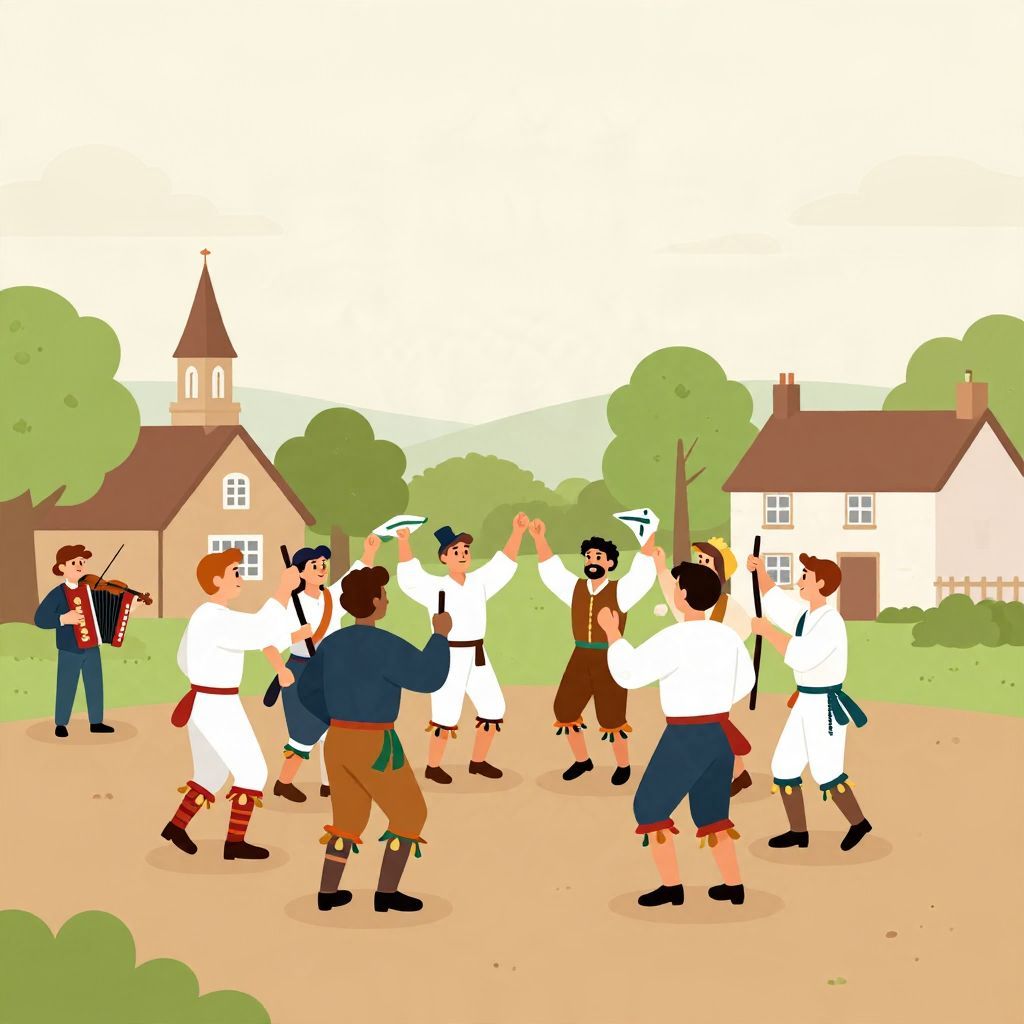
What is Morris dancing? It is a traditional English folk dance performed by groups of dancers, usually with bells, sticks, handkerchiefs, or swords, and often accompanied by music from a pipe and tabor, accordion, or fiddle. Today it is strongly associated with English village festivals, pubs, and seasonal celebrations.
Its exact origins are debated. Morris dancing is not a single ancient ritual preserved unchanged from the Middle Ages, but a living tradition that developed over centuries, especially in the early modern period. Historians generally see it as part of broader European folk performance, later reshaped by local custom, revival movements, and ideas about English identity.
What Is Morris Dancing?
Morris dancing is a form of English folk dance in which teams perform set patterns, steps, and figures, often with rhythmic accessories such as bells, sticks, handkerchiefs, or swords. It developed from older rural and courtly entertainments, became documented in the 15th and 16th centuries, and later survived through local custom and modern revival.
The basic idea of the dance
At its simplest, Morris dancing is a communal performance. Dancers move in coordinated patterns, sometimes in lines, circles, or paired formations, while a musician provides the tune. The dance is usually energetic rather than graceful in a ballet sense, and its appeal lies in rhythm, precision, and public display.
Different styles exist, but many share common features: jingling bells on the shins, white clothing or decorated kit, and props that create sound and visual drama. Some versions are performed by men, some by women, and many mixed sides now dance publicly, especially in modern revival traditions.
Where Did Morris Dancing Come From?
The origins of Morris dancing are not fully known, and no single founding moment can be identified. The name appears in English records by the late medieval period, but the dance likely grew out of a mixture of local festive customs, court entertainments, and wider European dance traditions rather than from one isolated source.
Early evidence in the historical record
References to “Morris” or “Morys” dancing appear in English sources from the 15th century onward. By the 16th century, the dance was visible in both village and elite settings. Court records, household accounts, and literary references show that it was already familiar enough to be recognized by name.
One important point is that early references do not prove a single unchanged tradition stretching back to antiquity. They show that by the late medieval and Tudor periods, Morris dancing had become part of English festive life. Its earlier development remains uncertain because ordinary rural customs were rarely recorded in detail.
Possible meanings of the name
The word “Morris” is often linked to “Moorish,” suggesting an old idea that the dance was exotic or foreign. That connection may reflect medieval and early modern fascination with imagined outsiders rather than a literal origin in North Africa. Scholars generally treat the name as evidence of how Europeans interpreted the dance, not as proof of where it began.
In other words, the name may reveal medieval cultural imagination more than historical fact. Like many folk traditions, Morris dancing accumulated stories about its origins that are difficult to verify. Some of these stories became popular because they gave the dance a dramatic and ancient pedigree.
How Did Morris Dancing Develop Over Time?
Morris dancing changed as English society changed. It moved between village entertainment, court performance, parish celebration, and later antiquarian revival. Rather than disappearing and reappearing unchanged, it adapted to new tastes, new social settings, and new ideas about tradition.
Late medieval and Tudor England
By the 15th and 16th centuries, Morris dancing was part of festive culture in England. It may have appeared at May Day celebrations, Whitsun events, weddings, and other communal gatherings. In this period, it was not yet a fixed “national tradition” in the modern sense, but one of several lively public performances.
Some evidence suggests that it could be performed in aristocratic households as well as in towns and villages. That matters because it shows that Morris was not simply a rustic survival. Elite patronage helped shape the dance, especially in the Tudor era, when pageantry and spectacle were highly valued.
Seventeenth-century change and decline
In the 17th century, English religious and political tensions affected many forms of festivity. Puritan critics often disapproved of dancing, holiday excess, and public revelry. This did not end Morris dancing everywhere, but it helped weaken some older customs and pushed others into more local or seasonal forms.
At the same time, the dance did not vanish. In some places it continued as part of village celebrations, especially around seasonal holidays. The survival of Morris depended on local memory, community use, and the willingness of performers and audiences to keep it alive.
Antiquarian revival in the 18th and 19th centuries
Interest in folk customs increased in the 18th and 19th centuries, when collectors and antiquarians began to record dances, songs, and rural traditions. This was a crucial moment in Morris history. What had once been a local custom became something people tried to define, preserve, and sometimes reconstruct as an “authentic” English heritage.
The Victorian period especially helped turn Morris into a symbol of national folklore. Some traditions were documented from living practice; others were revived from fragmentary evidence. As a result, modern Morris dancing is both old and new: rooted in historical custom, but also shaped by later reconstruction.
What Are the Main Types of Morris Dancing?
Morris dancing is not one uniform style. It includes several regional and historical varieties, each with its own steps, figures, costumes, and props. These differences reflect the local nature of folk tradition and the ways communities developed their own performance identities.
- Cotswold Morris – perhaps the best-known style, associated with villages in the Cotswolds and often danced by six or eight performers with handkerchiefs or sticks.
- Border Morris – a vigorous style from the English-Welsh border, often featuring face decoration, heavier stepping, and sticks.
- North West Morris – linked to industrial towns and processional dancing, usually performed by larger teams.
- Longsword – a sword dance tradition from Yorkshire and nearby areas, involving linked metal or wooden swords.
- Molly dancing – a related East Anglian tradition, often associated with plough Monday customs and sometimes with cross-dressing or comic performance.
Why the styles matter historically
These styles show that Morris dancing was never one fixed national script. Instead, it was a family of related customs. Some styles emphasize ritual procession, others competition or spectacle, and some were shaped by industrial or urban settings rather than rural villages alone.
What Does Morris Dancing Mean in English History?
Morris dancing is historically important because it reveals how ordinary communities created public culture. It connects labor, religion, seasonality, local identity, and entertainment. For historians, it is valuable not because it proves an unbroken ancient ritual, but because it shows how traditions are made and remade over time.
Seasonal and communal significance
Many performances were tied to the calendar: spring festivals, Whitsun, May Day, and other communal occasions. These moments mattered because they marked renewal, social bonding, and the transition between seasons. Dance helped transform ordinary streets and village greens into shared public space.
Morris dancing also depended on audience participation. It was not only something to watch; it was part of a wider social event that might include food, drink, fundraising, procession, and local celebration. In that sense, it belonged to the practical life of communities as much as to the history of art.
Identity and invention
In the 19th and 20th centuries, Morris dancing became tied to ideas of Englishness. Folklorists, revivalists, and performers often presented it as a distinctive national tradition. That claim has some basis, but it can also conceal the fact that folk culture is always changing and borrowing from many sources.
Modern Morris teams often see themselves as preserving heritage. Yet preservation itself is a historical process. Costumes, tunes, steps, and even attitudes toward gender and performance have changed over time. The tradition is therefore best understood as continuous adaptation rather than frozen survival.
Is Morris Dancing Really Ancient?
This is one of the most common questions about Morris dancing, and the safest answer is: not in the simple sense people often imagine. It is old, but not timeless. Its documented history begins in the late medieval period, while some of its customs may be older in origin or influenced by older European performance forms.
What historians can and cannot prove
Historians can show that Morris dancing was known in England by the 15th century and that it remained part of festive culture for centuries. They cannot prove that today’s Morris is a direct survival from pagan antiquity or from some single medieval source. Those claims are popular, but they go beyond the evidence.
That does not make the tradition less interesting. In fact, its history is richer because it shows how people repeatedly reinterpreted the past. Morris dancing has been medieval, Tudor, Georgian, Victorian, and modern in different ways. Each period left its mark.
How Is Morris Dancing Performed Today?
Today Morris dancing is performed by amateur teams across England and beyond, often at festivals, pubs, civic events, and seasonal celebrations. Some groups focus on historical reconstruction, while others emphasize creativity, inclusivity, or entertainment. The tradition remains alive because communities continue to find meaning in it.
Modern revival and public visibility
In the 20th century, Morris dancing benefited from folk revival movements, which encouraged collecting tunes, standardizing steps, and organizing teams. This helped preserve dances that might otherwise have faded. It also introduced new debates about authenticity, regional style, and who should perform the tradition.
Today, many Morris sides are open to dancers of any gender, and performances may be adapted for modern audiences. Some teams keep to older conventions, while others experiment with music, costume, and staging. This diversity is part of the tradition’s continuing history.
Common features you may notice
- Rhythmic stepping and repeated figures
- Bells worn on the legs
- Handkerchiefs, sticks, or swords
- A small live musical ensemble
- Outdoor performances in public places
Why Does Morris Dancing Still Matter?
Morris dancing matters because it is a living example of how history survives through performance. It is not a museum artifact. It is a tradition that has been argued over, revived, adapted, and reimagined for centuries. That makes it a useful case study in the history of custom and cultural memory.
For modern audiences, Morris dancing can seem quaint, eccentric, or charming. Historically, however, it was part of serious social life: a way of celebrating the seasons, expressing local identity, and bringing people together in public. Its endurance shows that traditions survive not by staying unchanged, but by being repeatedly made relevant.
So, what is Morris dancing? It is an English folk dance tradition with medieval roots, early modern documentation, and a long history of revival and reinvention. Its precise beginnings remain uncertain, but its cultural significance is clear: Morris dancing is one of the most recognizable ways England has turned communal celebration into history in motion. For more on festive traditions, you may also enjoy What Is A Brazilian Carnival? and What Is Carnival?