
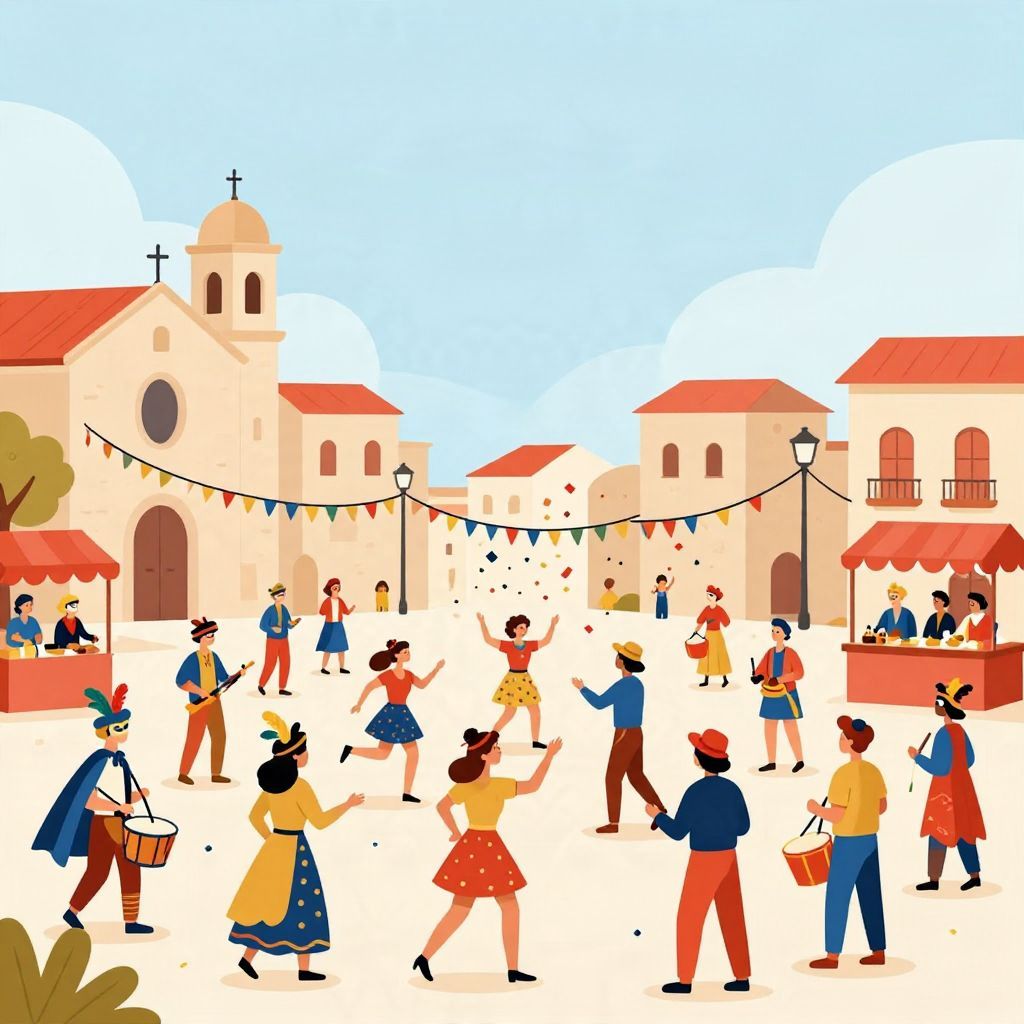
Carnival is a festive season of public celebration, music, costumes, dancing, and often satire that appears in many Christian societies and in places shaped by those traditions. It is not one single event but a family of celebrations that vary by region, from street parades to masked balls and local processions.
Historically, Carnival developed as a pre-Lenten period of feasting and release before the fasting and discipline of Lent in the Christian calendar. Over time, it absorbed older seasonal customs, local traditions, and urban spectacle, becoming one of the world’s most recognizable forms of popular celebration.
What Is Carnival?
Carnival is a festive season, usually held before Lent, marked by eating, drinking, masking, parades, dancing, and temporary social reversal. Its name is commonly linked to the idea of “farewell to meat” before fasting, though its exact origins are more complex and shaped by both Christian practice and older seasonal customs.
Where Did Carnival Come From?
Carnival did not begin in one single place or moment. Its history is tied to medieval and early modern Europe, especially regions where the Christian liturgical calendar structured daily life. The period before Lent became a time for using up rich foods, holding feasts, and enjoying public entertainment before a season of restraint.
Christian calendar and pre-Lenten customs
In Western Christianity, Lent developed as a period of fasting, prayer, and reflection before Easter. Because meat, fat, and other rich foods were traditionally restricted during Lent, communities often held a final round of feasting beforehand. This practical rhythm helped shape Carnival as a social and religious threshold.
Older seasonal traditions
Scholars also point out that Carnival drew on older winter and spring festivities from the Roman world and beyond. Celebrations such as Roman Saturnalia featured role reversals, gift-giving, and license, while local agricultural festivals marked the end of winter and the approach of spring. These older customs did not simply “become” Carnival, but they influenced its tone and imagery.
How Did Carnival Develop in History?
Carnival became especially visible in medieval Europe, when towns and cities used it as a major public festival. By the late Middle Ages and early modern period, it had grown into a structured season of entertainment, with masks, processions, guild participation, and theatrical excess. Different regions developed distinct styles.
Medieval towns and public festivity
In medieval urban life, Carnival offered a rare opportunity for collective release. People gathered in streets and squares, and communities staged processions, mock rituals, and dramatic performances. Because many societies were highly ordered and hierarchical, Carnival’s temporary looseness could feel both liberating and socially useful.
Renaissance and early modern spectacle
During the Renaissance, especially in Italian cities such as Venice, Carnival became associated with elaborate masks, costumes, and public display. Masks allowed anonymity and social mixing, at least temporarily, while rulers and elites sometimes supported festivities as a way to display civic wealth and control popular energy.
From local custom to global tradition
European expansion carried Carnival traditions to the Americas and other parts of the world. In colonial societies, European practices blended with African, Indigenous, and local traditions, producing new forms. This is why Carnival today can look very different in Brazil, the Caribbean, New Orleans, or parts of Europe, even though they share historical roots.
Why Is It Called Carnival?
The word “Carnival” is commonly associated with the Latin phrase carne vale, meaning “farewell to meat,” or with carne levare, meaning “to remove meat.” These explanations fit the season’s link to pre-Lenten fasting, though the precise linguistic history is debated. What is clear is that the name reflects the transition from indulgence to abstinence.
What Are the Main Features of Carnival?
Although Carnival varies widely, several features appear again and again: costumes, masks, music, dance, feasting, parody, and public procession. These elements are not random. They help create a temporary world in which ordinary rules are loosened and communities can celebrate, criticize, or invert social order.
- Masks and costumes: anonymity, transformation, and theatrical display
- Parades and processions: public visibility and communal participation
- Music and dance: rhythm, movement, and collective energy
- Feasting: using up rich foods before Lent or celebrating abundance
- Satire and mockery: playful criticism of authority, manners, or social norms
Social inversion and temporary freedom
One of Carnival’s most important historical meanings is inversion. For a short time, fools could be crowned, servants might mock masters, and the usual seriousness of social rank could be suspended. Historians often describe this as “licensed disorder,” though the degree of freedom varied and was never complete.
Was Carnival Always Religious?
Carnival has religious origins, but it has never been purely religious. It sits at the intersection of church calendar, local custom, and popular entertainment. In many places, church authorities tolerated Carnival because it preceded Lent, even while they sometimes criticized its excess, drunkenness, or moral disorder.
Church approval and church criticism
Some clergy saw Carnival as a practical outlet before the discipline of Lent. Others condemned it as sinful or unruly. This tension is part of Carnival’s history: it was both connected to Christian time and often viewed as a threat to Christian seriousness. That ambiguity helped keep it alive.
How Did Carnival Spread Beyond Europe?
From the 16th century onward, European colonization and migration carried Carnival traditions to the Americas and elsewhere. In places with enslaved African populations and Indigenous communities, Carnival became a site of cultural blending, resistance, and reinvention. Its history outside Europe is therefore also a history of empire, slavery, and adaptation.
Brazil
Brazilian Carnival grew from Portuguese colonial customs and later absorbed African musical and performance traditions. Over time, it developed into a massive national celebration with samba schools, street parties, and formal parades. Its modern scale reflects urban growth, cultural mixing, and the political use of public festivity.
The Caribbean and New Orleans
In the Caribbean and in New Orleans, Carnival traditions were shaped by French, Spanish, African, and local influences. Mardi Gras, for example, is the final day before Lent, but the broader Carnival season includes weeks of celebrations. These events often carry strong local identity and historical memory.
What Is the Historical Meaning of Carnival?
Carnival matters because it reveals how societies manage tension. It creates a controlled space for excess, humor, and inversion before returning to order. Historians study it not only as entertainment but also as a window into religion, class, urban life, and the politics of public space.
Order, release, and community
Carnival can be understood as a ritual of release. By allowing people to laugh at authority, wear disguises, and gather in large crowds, societies could channel energy that might otherwise become disruptive. At the same time, Carnival reinforced boundaries by making the return to ordinary life after Lent more meaningful.
Identity and belonging
Carnival also helps communities define themselves. Local styles of costume, music, and procession often express regional pride and historical memory. In modern times, Carnival can serve tourism and national branding, but it still carries older meanings of seasonal rhythm, collective participation, and cultural continuity.
Key Facts About Carnival
- Timeframe: usually the period before Lent, especially the final days or weeks before Ash Wednesday
- Origins: rooted in medieval Christian practice, with older seasonal and Roman influences
- Main traits: masks, costumes, parades, music, dance, feasting, and satire
- Historical function: a temporary suspension of normal rules before a penitential season
- Global forms: Venice, Rio de Janeiro, New Orleans, Trinidad, and many other regional traditions
How Has Carnival Changed in Modern Times?
Modern Carnival is often larger, more commercial, and more media-driven than its historical predecessors. In some places it has become a major tourist attraction, with organized parades, sponsorships, and international audiences. Yet many celebrations still preserve older features such as masking, satire, and neighborhood participation.
From village custom to mass spectacle
As cities expanded and mass media developed, Carnival shifted from a mainly local festival to a public performance watched by large crowds and, increasingly, by global audiences. This has brought both benefits and tensions: more visibility and economic support, but also debates about authenticity, commercialization, and cultural ownership.
Continuity and change
Even with these changes, Carnival remains recognizable because it still marks a threshold. It is a celebration of abundance before restraint, of performance before discipline, and of communal imagination before ordinary routine resumes. That basic structure has endured for centuries.
Conclusion: What Is Carnival in Historical Terms?
Historically, Carnival is a pre-Lenten season of celebration that combines Christian calendar time with older traditions of feasting, masking, and social inversion. It began as a local and religious custom, but over centuries it became a global cultural form with many regional expressions. For a closer look at one major tradition, see what Brazilian Carnival is, or explore other cultural history topics such as the role of a danna in geisha culture.