
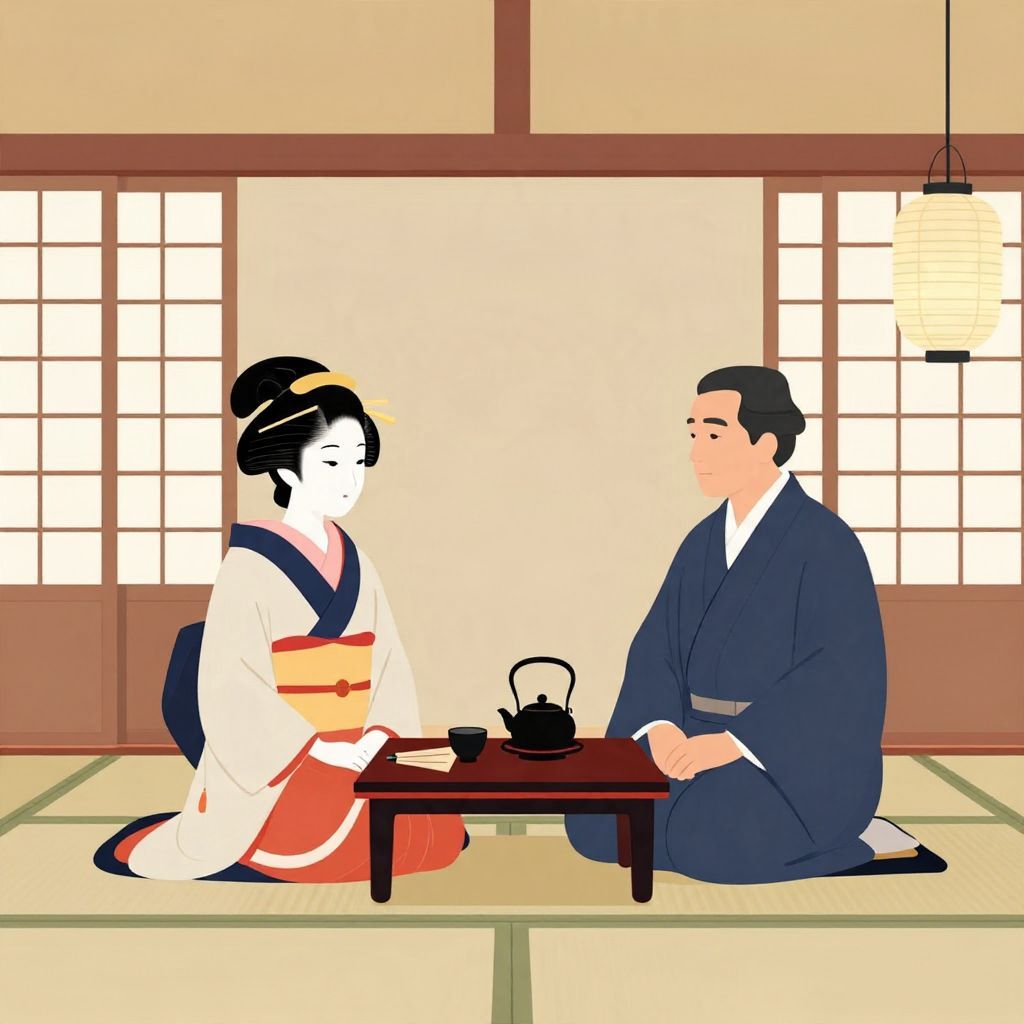
What is a danna to a geisha? In historical Japan, a danna was a wealthy patron who helped support a geisha financially, often in exchange for companionship, social prestige, and an exclusive personal relationship. The arrangement could be long-term and intimate, but it was not the same as marriage, and it was never a simple or universal feature of geisha life.
The idea of a danna belongs to the world of urban entertainment culture that developed in Japan from the Edo period onward. To understand it properly, you need to separate historical reality from modern myths about geisha, patronage, and relationships in the pleasure quarters.
What Is a Danna to a Geisha?
A danna was a patron, usually a man of wealth, who paid for a geisha’s support, expenses, and sometimes a private relationship. The arrangement could provide financial security for the geisha and social status for the patron. It was not a formal husband-wife bond, and many geisha never had a danna at all.
How the Danna Relationship Worked
Financial support and exclusivity
In practice, a danna might cover a geisha’s living costs, clothing, training debts, gifts, and entertainment expenses. In return, he often expected priority access to her time and attention. The relationship could be emotionally meaningful, but it was also shaped by money, reputation, and the codes of the geisha world.
Not the same as prostitution or marriage
Geisha were professional entertainers trained in conversation, music, dance, and etiquette. They were not defined by sexual services, even though individual relationships could become romantic or sexual. A danna arrangement was therefore distinct from both marriage and the common modern stereotype that geisha were courtesans.
Historical Origins of the Danna System
Urban pleasure culture in the Edo period
The danna relationship emerged within Japan’s early modern urban entertainment districts, especially during the Edo period (1603–1868). As merchant wealth grew in cities such as Edo, Kyoto, and Osaka, prosperous men sought refined leisure and status in licensed entertainment quarters. Geisha developed in this environment as skilled professionals serving elite and affluent clients.
Patronage as a social custom
Patronage was common in many premodern societies, and Japan was no exception. Artists, performers, and courtesans often depended on wealthy supporters. The danna system reflected this broader pattern, but it took a distinctive form in geisha culture, where taste, discretion, and cultivated elegance mattered as much as money.
Geisha, Okiya, and the Economics Behind the Relationship
The role of the okiya
Many geisha were affiliated with an okiya, or geisha house, which managed training, clothing, debts, and professional introductions. Becoming a geisha required years of apprenticeship and expense. A danna could ease that burden by paying debts or supporting the geisha’s household, but the arrangement also benefited the okiya and the wider social network around her.
Why a patron mattered
Geisha work involved costly presentation: silk kimono, hairstyles, accessories, lessons, and social obligations. A successful geisha might earn well, but the profession demanded investment. A danna represented a way to stabilize finances in a trade where appearance and reputation were essential.
What a Danna Was Not
Not every geisha had one
It is important not to assume that all geisha were attached to a patron. Many worked without a danna, especially if they were highly successful or preferred independence. The presence of a danna was one possible outcome of geisha life, not its defining feature.
Not a universal or fixed institution
The danna arrangement varied by period, region, and individual circumstances. Some relationships were long-lasting and publicly recognized within the entertainment world. Others were discreet, temporary, or financially motivated. Because records are uneven and personal arrangements were often private, historians must be cautious about treating the danna as a rigid institution with one standard form.
The Social Meaning of a Danna
Status for the patron
For a wealthy man, having a geisha as a danna could signal refinement, taste, and access to elite social circles. The relationship was not merely private; it could also function as a public marker of sophistication within urban high society. In that sense, patronage was as much about prestige as affection.
Security and autonomy for the geisha
For a geisha, a danna could offer economic security and a degree of independence. In a profession that depended on unstable income and social expectations, patronage could reduce financial pressure. At the same time, it could also create dependence, emotional complications, and limits on personal freedom.
How the Danna System Changed Over Time
Late Edo and Meiji Japan
As Japan modernized after the Meiji Restoration in 1868, social structures changed rapidly. New legal and economic systems altered entertainment culture, and the geisha profession adapted to modern urban life. The danna system did not disappear overnight, but it became less central and more variable as Japan’s society and economy transformed.
Twentieth-century decline
By the twentieth century, especially after World War II, the old patronage system weakened further. Changing gender norms, economic modernization, and shifting attitudes toward entertainment districts reduced the prominence of traditional danna relationships. Geisha culture survived, but in a more limited and specialized form.
Popular Myths and Common Misunderstandings
Myth: A danna was simply a husband
Although some relationships were emotionally close, a danna was not automatically a husband. Marriage and patronage were different social arrangements, with different expectations and legal meanings. A geisha could remain unmarried, marry outside the profession, or maintain a separate patron relationship depending on circumstances.
Myth: Geisha were the same as sex workers
This confusion is one of the most persistent misunderstandings in popular culture. Geisha were trained entertainers, not prostitutes by definition. Sexual relationships sometimes existed, but they were not what made someone a geisha. The danna system should be understood within this broader professional and cultural context.
Myth: Every danna arrangement was romantic
Some were affectionate, some strategic, and some mixed both elements. Historical patronage often combined emotion, obligation, and economics. It is too simple to describe every danna relationship as either true love or pure transaction. In reality, it could be both, neither, or something in between.
Why the Danna Matters in Japanese History
A window into gender and class
The danna system reveals how gender, money, and status operated in premodern and modern Japan. It shows that women in entertainment professions could exercise skill and influence, but within a structure shaped by male wealth and social hierarchy. It also highlights the importance of urban consumer culture in Japanese history.
A reminder about historical nuance
Modern audiences often flatten geisha history into stereotypes. The danna relationship reminds us that historical institutions can be both practical and symbolic, both restrictive and enabling. It was part of a larger world of performance, patronage, and social performance in which appearance and reputation carried real economic value.
Key Facts About a Danna and a Geisha
- Danna means patron or supporter in this context.
- The relationship developed in Japan’s urban entertainment culture, especially from the Edo period.
- A danna often provided money, gifts, and long-term financial support.
- The arrangement could be exclusive and sometimes intimate, but it was not the same as marriage.
- Geisha were professional entertainers, not defined by sexual services.
- Not all geisha had a danna, and the system varied over time and place.
Conclusion
A danna to a geisha was a wealthy patron who supported her financially and socially, often within an exclusive relationship shaped by the customs of Japan’s entertainment districts. The arrangement reflected the economics of geisha life, the prestige of patronage, and the social world of Edo- and Meiji-era urban culture. To understand it accurately is to see both the sophistication and the constraints of historical geisha society.