
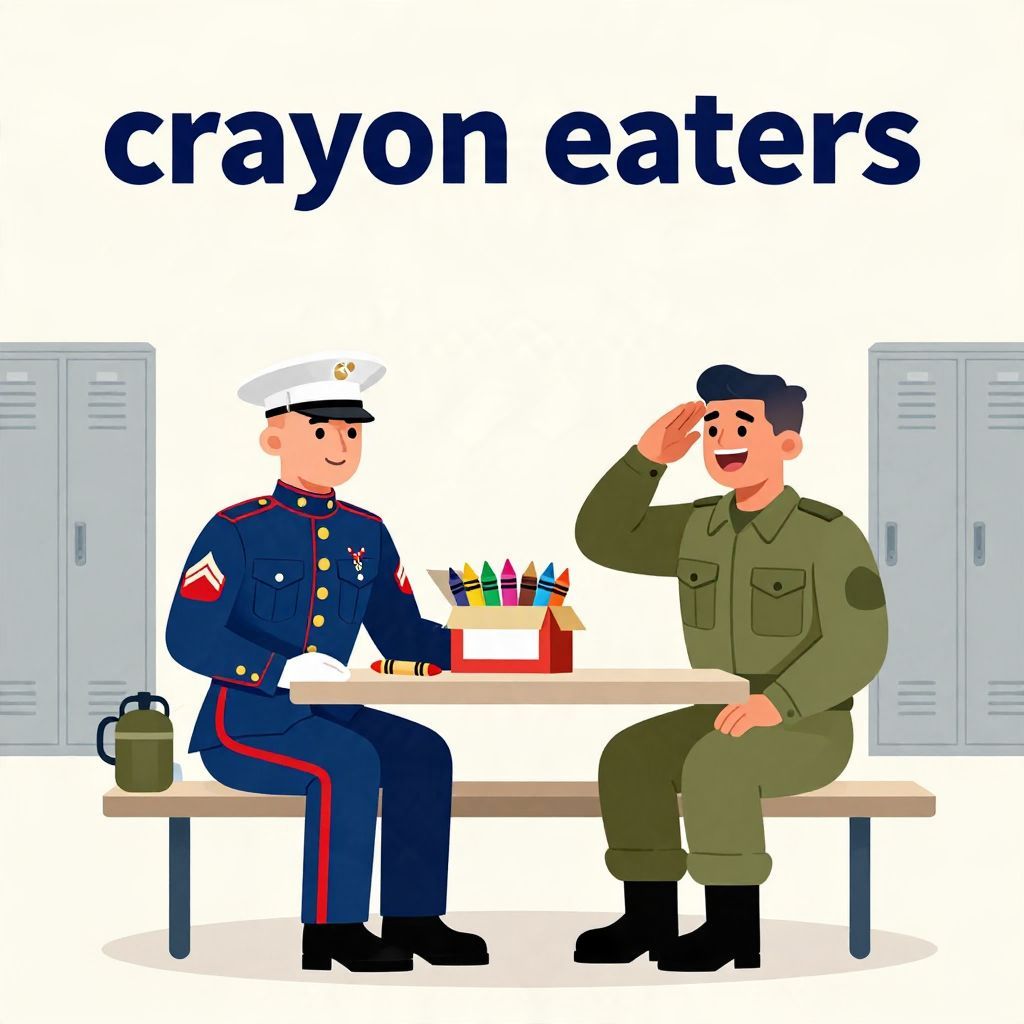
“Crayon eater” is a modern, joking nickname for U.S. Marines, not an official title and not a historical tradition from the Corps’ founding. The phrase grew from internet memes and military banter that portray Marines as tough, blunt, and a little self-mocking, with the added insult-joke that they “eat crayons” instead of thinking carefully.
The nickname is best understood as part of Marine Corps humor and inter-service rivalry. It is not a serious historical label, but it has become widely recognized because Marines themselves often repeat it ironically, turning a mock insult into a badge of identity.
Why are Marines called crayon eaters?
Marines are called “crayon eaters” because the phrase began as a playful insult and meme about their reputation for aggressive, straightforward behavior and supposed lack of academic polish. It is not based on any real practice. The joke spread widely in the 2000s and 2010s, especially online, and Marines often embraced it sarcastically.
The origin of the “crayon eater” joke
The exact first use is hard to pin down, but the nickname emerged from modern military slang and internet culture rather than from an older historical event. Like many service nicknames, it grew out of rivalry, humor, and stereotype. The joke depends on the idea that Marines are physically tough, direct, and sometimes portrayed as less concerned with refinement than other branches.
That stereotype is exaggerated for comic effect. Marines have long been associated with discipline, combat readiness, and a strong shared identity. The “crayon eater” label takes those traits and flips them into a childish image: a Marine so simple-minded, the joke implies, that crayons might seem like food. The humor works because it is obviously absurd.
From barracks humor to internet meme
Before social media, military branches traded jokes about one another in barracks, training environments, and mess halls. The Marine version of the insult became especially visible once memes and online forums amplified it. By the 2010s, “crayon eater” had become a recognizable shorthand in military-adjacent internet culture, often used by civilians, veterans, and service members alike.
As with many memes, repetition helped the phrase spread faster than any single origin story could. There is no well-documented founding moment, no official source, and no historical campaign that created the nickname. Instead, it evolved organically from informal speech and online humor.
Why the joke stuck to Marines in particular
Marines have long occupied a special place in American military culture. The Corps is smaller than the Army, Navy, or Air Force, but it has cultivated a distinct image of toughness, elite identity, and willingness to take on difficult missions. That image makes Marines especially visible in jokes, admiration, and rivalry.
The “crayon eater” meme fits several older stereotypes at once: the hard-charging infantryman, the unsophisticated brawler, and the person who solves problems through action rather than analysis. None of these stereotypes are fair as a general description, but they are useful in humor because they are instantly recognizable.
Inter-service rivalry and self-mockery
Every military branch develops jokes about the others. Such humor helps build group identity and relieve stress. In the Marine case, the joke became especially durable because Marines often repeat it themselves. When a group adopts an insult and uses it jokingly, the insult loses some of its sting and becomes part of the group’s culture.
That self-mockery is important. Many Marines do not reject the label outright; instead, they use it ironically, sometimes in the same spirit as other military in-jokes about toughness, discipline, or plainspoken behavior. The phrase therefore says as much about Marine culture as it does about outside perceptions of Marines.
Is there any historical basis for the name?
There is no evidence that Marines were ever officially called crayon eaters, nor that the nickname came from a formal tradition, a famous battle, or a documented incident in the early Corps. The phrase is modern and informal. Its power comes from stereotype, not from historical fact.
That said, the joke does connect to a long history of how militaries are imagined. Soldiers and Marines have often been described in popular culture through simplified traits: bravery, roughness, obedience, and physical strength. The “crayon eater” meme is simply a 21st-century version of that older habit of turning military identity into caricature.
Why crayons?
Crayons were chosen because they evoke childhood, immaturity, and simple-mindedness. They are colorful, harmless, and familiar, which makes the joke easy to understand immediately. The image is deliberately silly: it is not meant to be believable, only memorable.
In that sense, the crayon is a perfect meme object. It is harmless enough to be funny, childish enough to be insulting, and visual enough to spread quickly online. The phrase also benefits from absurdity; the more ridiculous the image, the more likely people are to repeat it.
How Marines responded to the nickname
Many Marines have adopted the label with humor, turning it into a form of identity signaling. You may see jokes about crayons on social media, in Marine-themed merchandise, and in casual conversation. The point is not to accept the insult literally, but to show that the Corps can laugh at itself.
This response reflects a broader pattern in military culture: ridicule can be defused by owning it. If outsiders call Marines crayon eaters, Marines can reply, in effect, “Yes, and what of it?” That transforms a mockery into a shared joke and reinforces group cohesion.
Humor as a cultural shield
Military humor often serves practical purposes. It builds camaraderie, reduces tension, and creates a common language. For Marines, who are trained to endure hardship and emphasize esprit de corps, joking about an absurd stereotype can strengthen the sense of belonging. The nickname survives partly because it is easy to repeat and easy to understand.
At the same time, the joke should not be mistaken for a serious assessment of Marine competence or intelligence. The Corps includes highly trained specialists, officers, technicians, and leaders. The meme flattens that reality into a single comic image, which is why it works as humor but fails as history.
What the nickname reveals about Marine identity
The popularity of “crayon eater” shows how strongly the Marine Corps identity is tied to public image. Marines are often portrayed as especially tough, physically demanding, and mission-focused. The joke exaggerates those traits into a caricature, but it also depends on the public already knowing that Marines are seen as formidable.
In other words, the nickname would not have stuck if Marines had not already carried a powerful cultural reputation. The insult is funny because it contrasts sharply with the real seriousness of Marine training, discipline, and combat history.
From stereotype to brand
Over time, the phrase has become part of a broader Marine “brand,” especially in online spaces. What began as a jab can be repurposed into merchandise, slogans, and social media banter. This is a modern example of how institutions can absorb outside ridicule and turn it into a marker of pride.
That process is not unique to the Marines. Many groups, from sports teams to professions, adopt nicknames that started as insults. The Marine version stands out because the contrast between the childish image and the serious military role is so sharp.
What is fact and what is myth?
Historically, the facts are straightforward: “crayon eater” is a recent, informal nickname; it is rooted in humor and internet culture; and it is not an official or traditional Marine term. The myth is that it reflects some real, longstanding characteristic of Marines as a group. It does not.
- Fact: The nickname is modern and unofficial.
- Fact: It spread through military banter and internet memes.
- Fact: Marines often use it jokingly themselves.
- Myth: It comes from a verified historical event or official Marine tradition.
- Myth: It describes actual Marine behavior rather than a stereotype.
The lasting significance of the nickname
“Crayon eater” matters because it shows how language, humor, and identity work in modern military culture. A phrase that began as a joke became a recognizable cultural marker, especially in the digital age. It also illustrates how service members can reclaim ridicule and turn it into camaraderie.
Historically, the nickname is less about crayons than about the social life of the Marine Corps: rivalry, toughness, self-image, and the ability to laugh at oneself. That is why the phrase endured. It is memorable, easy to repeat, and flexible enough to be used both as an insult and as a badge of belonging.
So, Marines are called crayon eaters not because of any real historical practice, but because a modern joke captured an old stereotype and spread it widely. The result is a piece of military slang that is more revealing about culture and humor than about facts. If you are interested in how military identity is shaped by language, you may also enjoy related history articles on U.S. Marine Corps history and military slang and traditions.