
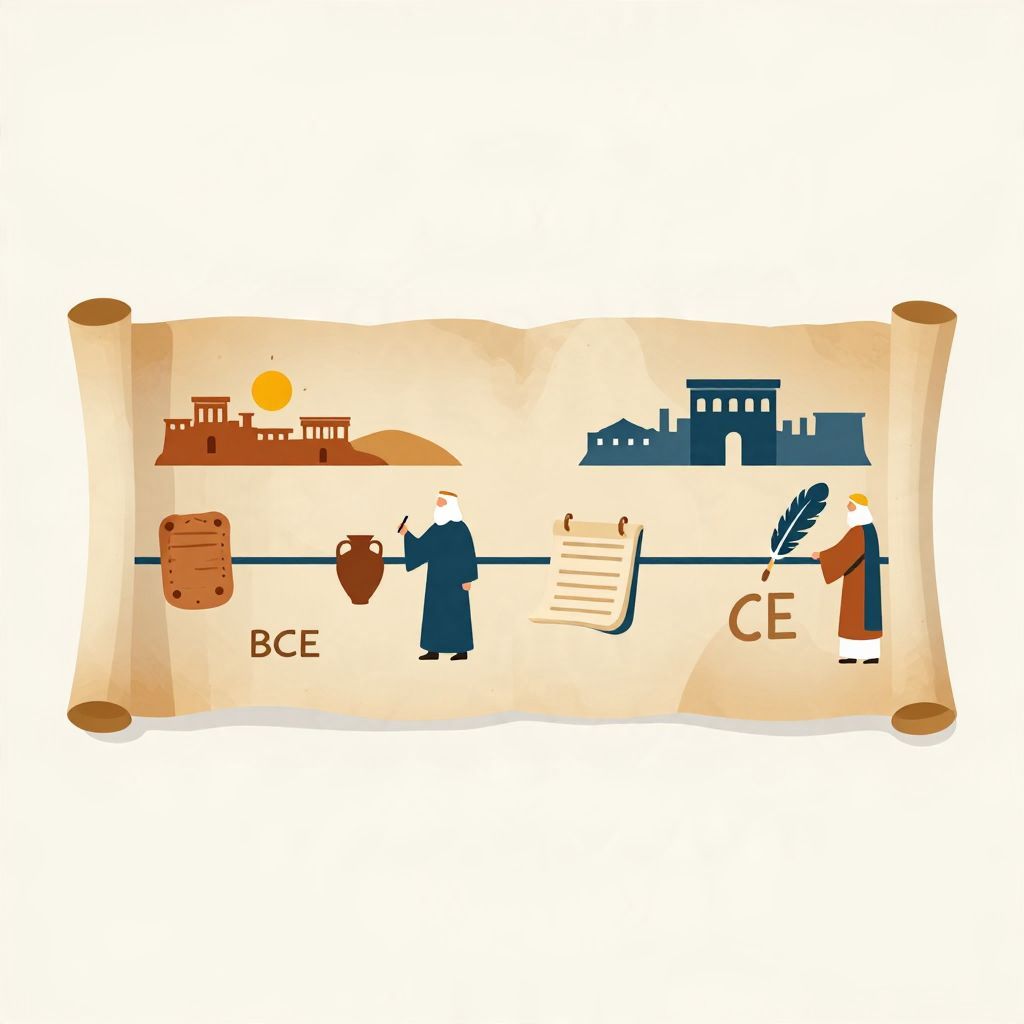
What is BCE and CE? These are modern calendar labels used in history to number years without referring directly to religion. BCE means “Before Common Era,” and CE means “Common Era.” They correspond exactly to BC and AD in the traditional Western dating system, but they are phrased more neutrally and are now widely used in scholarship, museums, and education.
Understanding BCE and CE helps readers place events on a timeline, compare sources, and read historical writing across different regions and traditions. The terms do not change the calendar itself; they change only the wording. Their rise reflects broader efforts to make historical chronology more inclusive while keeping the same year numbers.
What is BCE and CE?
BCE stands for Before Common Era, and CE stands for Common Era. They are the same year-counting system as BC and AD, but with different labels. For example, 300 BCE is the same year as 300 BC, and 2026 CE is the same year as AD 2026.
The basic meaning
The system counts years relative to a traditional starting point near the birth of Jesus Christ, though the exact historical year of that event is uncertain. In modern use, the labels BCE and CE avoid explicitly religious wording while preserving the familiar chronological framework used in Western historical dating.
How the labels compare
- BCE = the same as BC
- CE = the same as AD
- There is no year 0 in the traditional system
- 1 BCE is immediately followed by 1 CE
Why do historians use BCE and CE?
Historians use BCE and CE because the terms are clearer in global, multi-faith, and academic settings. They keep the familiar numbering system while avoiding the explicitly Christian abbreviations BC and AD. This makes them easier to use in classrooms, museums, and publications that serve diverse audiences.
A neutral way to date history
The calendar system itself developed in a Christian cultural context, but the labels BCE and CE are often preferred when writing about world history. They allow scholars to describe ancient Mesopotamia, classical Greece, imperial China, or pre-Columbian America using one shared timeline without implying that the calendar belongs only to one religion.
Not a different calendar
One common misunderstanding is that BCE and CE mark a different calendar. They do not. The year numbers remain the same. Only the wording changes. A document dated 500 BCE is dated in exactly the same year as one dated 500 BC.
Where did BCE and CE come from?
The labels BCE and CE emerged much later than the calendar they describe. The year-counting system was created in the early medieval Christian world, while the neutral terminology became common much later, especially in modern scholarship and education. The shift was gradual rather than sudden.
The older system: BC and AD
BC means “Before Christ,” and AD comes from the Latin Anno Domini, meaning “in the year of the Lord.” This system became increasingly common in medieval Europe after it was developed by Christian scholars who wanted a way to number years from the birth of Jesus. Over time, it spread through European record-keeping and later through global historical writing.
When BCE and CE appeared
Scholars began using alternative forms such as “Common Era” and “Before Common Era” in the early modern and modern periods. The exact origin is not tied to one single inventor, and different forms appeared in different places. Jewish scholars and other writers sometimes used similar neutral phrasing earlier than the modern standard, but the broad adoption of BCE and CE is largely a product of modern academic practice.
Why the change mattered
The shift was partly practical and partly cultural. As history writing became more international, many authors wanted terminology that could be used without requiring a specifically Christian vocabulary. BCE and CE offered continuity with established chronology while making the language more inclusive.
How BC, AD, BCE, and CE work on a timeline
The numbering system is simple once the labels are understood. Years count backward before the common era and forward after it. The transition happens between 1 BCE and 1 CE, with no year 0 in the traditional system. That detail matters when calculating spans of time.
Examples of the timeline
- 44 BCE — the year Julius Caesar was assassinated
- 4 BCE — often discussed in relation to the approximate birth of Jesus, though the exact date is uncertain
- 1 CE — the first year of the Common Era
- 1066 CE — the Norman Conquest of England
- 1776 CE — the American Declaration of Independence
Why no year 0 matters
Because the system moves directly from 1 BCE to 1 CE, calculations across the boundary can be tricky. For example, the span from 10 BCE to 10 CE is not 20 years by simple subtraction; it is 19 years because there is no zero year between them. This is a technical feature of the calendar, not a historical judgment.
Is BCE and CE religious or secular?
BCE and CE are usually described as secular or religiously neutral labels, but their history is more complicated. They are not tied to a new calendar system. Instead, they rename an older Christian-based chronology in a way that many users find more neutral and inclusive.
Why some people prefer BC and AD
Some historians, religious writers, and traditional users prefer BC and AD because they are longstanding and familiar. They may also argue that the system’s origin in Christian chronology should be acknowledged directly. In that view, changing the labels does not change the historical roots of the calendar.
Why others prefer BCE and CE
Others prefer BCE and CE because they reduce the need to reference Christianity when discussing world history. This can be especially useful in comparative history, archaeology, and interfaith contexts. For many writers, the choice is less about ideology than about audience and clarity.
How historians and educators use the terms today
Today, BCE and CE are widely used in academic history, archaeology, and many textbooks. They are especially common in contexts where the audience is international or religiously diverse. At the same time, BC and AD remain common in everyday writing, popular history, and some national traditions.
Common style differences
- Some style guides prefer BCE/CE for neutrality
- Others allow both systems, as long as one style is used consistently
- Many museums and universities use BCE/CE in exhibit labels and publications
- Some religious publications continue to use BC/AD
Consistency matters more than the label
For historians, the most important rule is consistency. A book or article should not switch randomly between BC/AD and BCE/CE without explanation. The labels themselves are less important than accurate dating, careful chronology, and clear communication.
What are the key facts to remember?
The most important thing to know is that BCE and CE are alternate labels for the same historical year system used with BC and AD. They do not represent a separate calendar, and they do not change the dates of historical events. Their main purpose is to provide a more neutral way to talk about time.
Quick facts
- BCE means Before Common Era
- CE means Common Era
- They match BC and AD year for year
- The system does not include a year 0
- The labels became popular in modern scholarly and educational use
- The dating system itself originated in Christian Europe
Why BCE and CE matter in historical study
BCE and CE matter because chronology is the backbone of history. Dates help historians connect causes and consequences, compare civilizations, and understand change over time. A shared system makes it easier to place the rise of empires, the spread of religions, the growth of cities, and the development of states on one timeline.
Beyond a naming debate
The BCE/CE question is sometimes treated as a culture-war issue, but historically it is mostly a matter of language and convention. The deeper story is how historical writing became more global and how scholars adapted inherited European dating practices for broader use. That makes BCE and CE a small but revealing example of how history is written.
In short, BCE and CE are simply the modern, more neutral names for the familiar BC and AD system. They help historians communicate across cultures while keeping the same chronology intact. If you want to explore related timeline questions, see what BCE means in history and learn how dates help place the oldest building in the United States in context.