
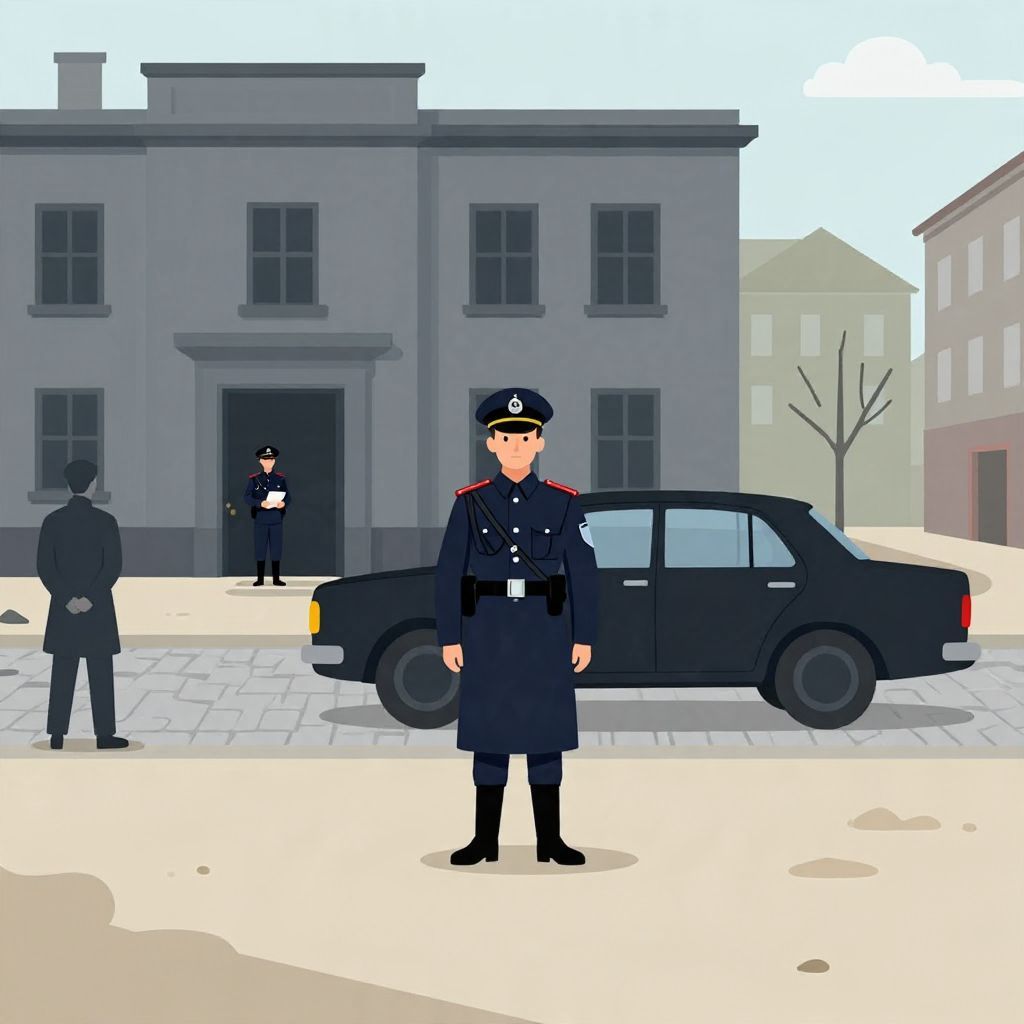
What does Gestapo mean? The word refers to the Nazi regime’s secret police in Germany, one of the most feared institutions of the Third Reich. It became a symbol of surveillance, intimidation, torture, and political repression under Adolf Hitler.
Understanding the term matters because it is often used loosely today. Historically, the Gestapo was not just a generic secret police force; it was a specific organization created and expanded by the Nazis to destroy opposition and enforce racial and political dictatorship.
What does Gestapo mean?
Gestapo is short for Geheime Staatspolizei, a German phrase meaning “Secret State Police.” It was the Nazi regime’s political police force, active from 1933 to 1945, and it played a central role in arresting opponents, monitoring society, and carrying out terror on behalf of the dictatorship.
Where did the Gestapo come from?
The Gestapo emerged soon after Hitler became chancellor of Germany in January 1933. At first, it developed in Prussia under Hermann Göring, then quickly came under the control of the Nazi state. By 1934, Heinrich Himmler and the SS had taken over the organization, turning it into a national instrument of repression.
The Nazi leadership wanted a police force that could act outside normal legal limits. The Gestapo was designed to identify enemies of the regime, including communists, social democrats, trade unionists, Jews, clergy, and anyone suspected of disloyalty. Its power grew as the Nazis dismantled democratic institutions and replaced them with a one-party dictatorship.
What did the Gestapo do?
The Gestapo investigated and suppressed political opposition, but its reach went far beyond ordinary policing. It relied on informers, surveillance, interrogations, intimidation, and arbitrary arrest. In the Nazi system, fear was a tool of governance, and the Gestapo helped make that fear real in everyday life.
Core functions of the Gestapo
- Tracking and arresting political opponents
- Investigating alleged “anti-state” activity
- Enforcing Nazi racial policy
- Hunting down resistance networks
- Assisting deportations of Jews and other targeted groups
- Using torture and coercion during interrogations
Although popular memory often imagines the Gestapo as an all-seeing force, historians note that it was not omnipotent. It was relatively small compared with the population it ruled and depended heavily on public cooperation, denunciations, and the wider Nazi security apparatus. Even so, its reputation for brutality made it terrifyingly effective.
How was the Gestapo connected to the Nazi state?
The Gestapo was not an isolated agency. It was part of a broader system that included the SS, the SD, the police, the concentration camp network, and Nazi civil administration. Over time, these institutions became increasingly intertwined, especially under Himmler’s control.
This mattered because the Gestapo’s authority came from the Nazi state itself. It was not simply a rogue secret police force; it was a legal and administrative expression of dictatorship. Courts, civil servants, and police structures were reshaped so that repression could appear routine and bureaucratic.
Key figures associated with the Gestapo
- Hermann Göring — helped establish the Gestapo in Prussia in 1933
- Heinrich Himmler — brought the Gestapo under SS control
- Reinhard Heydrich — helped organize the Nazi security and intelligence system
Was the Gestapo the same as the SS?
No, but the two were closely linked. The SS was a large Nazi organization that grew into a major power center, while the Gestapo was the secret state police. By the mid-1930s, the Gestapo was effectively absorbed into the SS-led security structure, which also included the Security Service and other police branches.
In practice, this meant Nazi repression became more centralized. The Gestapo did not operate alone; it worked with local police, party officials, and concentration camp authorities. The distinction mattered administratively, but for victims the system often felt like one unified machine of terror.
How did ordinary Germans experience the Gestapo?
For many people, the Gestapo was less a visible institution than a constant threat. Its power depended partly on uncertainty: people did not know who might report them, what might count as suspicious, or when a casual remark could lead to trouble. That uncertainty encouraged self-censorship and obedience.
Not every German came into direct contact with the Gestapo, but many knew stories of arrests, disappearances, and interrogations. The regime encouraged denunciation, meaning neighbors, coworkers, and even family members might report one another. This created a climate in which fear spread through everyday life.
Common reasons people were targeted
- Criticizing Hitler or the Nazi regime
- Listening to foreign radio broadcasts
- Helping Jews hide or escape
- Belonging to banned political groups
- Participating in resistance activity
- Violating Nazi racial or social laws
Did the Gestapo target Jews?
Yes. The Gestapo was deeply involved in Nazi persecution of Jews, especially as the regime moved from discrimination to deportation and mass murder. It helped enforce anti-Jewish laws, investigate “mixed” relationships under Nazi racial rules, and support arrests and deportations during the Holocaust.
It is important to be precise here: the Gestapo was not the only organization involved in the Holocaust, but it was one of the key instruments of persecution. Its role expanded as Nazi policy radicalized, especially during the war years, when deportations from Germany and occupied Europe accelerated.
How powerful was the Gestapo really?
The Gestapo’s power was enormous in practice, but not because it had limitless manpower. Historians generally emphasize that it relied on bureaucratic authority, fear, and cooperation from society. Its success came from a combination of legal immunity, political backing, and the willingness of others to assist or comply.
That said, the Gestapo could be brutally effective because it operated in a system where due process had been stripped away. Once someone was targeted, the chances of fair treatment were slim. Arrest could lead to prison, torture, concentration camp imprisonment, or death.
What happened to the Gestapo after World War II?
After Nazi Germany’s defeat in 1945, the Gestapo was dissolved. At the Nuremberg Trials, the organization was declared a criminal group because of its role in persecution, war crimes, and crimes against humanity. This legal judgment reflected the central place the Gestapo had occupied in Nazi repression.
Its legacy became a warning about how state institutions can be turned into tools of terror. The Gestapo is now remembered not simply as a police force, but as a symbol of what happens when law is subordinated to dictatorship, racism, and political violence.
Why does the word “Gestapo” still matter today?
The term remains powerful because it captures the danger of secret policing without accountability. In modern speech, people sometimes use “Gestapo” as a general insult for harsh authority, but historically the word refers to a very specific Nazi institution with a documented record of terror and persecution.
Using the term carefully matters. It should not be reduced to a casual synonym for strict law enforcement. The Gestapo was part of a regime that destroyed democracy, persecuted minorities, and helped carry out one of history’s greatest crimes.
Quick facts about the Gestapo
- Full name: Geheime Staatspolizei
- Meaning: Secret State Police
- Founded: 1933
- Ended: 1945
- Role: Nazi secret police and political repression
- Associated with: Hitler’s dictatorship, the SS, and Heinrich Himmler
So, what does Gestapo mean? It means “Secret State Police,” but historically it signifies much more: the machinery of Nazi terror. To understand the Gestapo is to understand how dictatorship used fear, bureaucracy, and violence to control society. For broader context on the Nazi war years, see what happened in 1941 and why Hitler invaded the Soviet Union.