
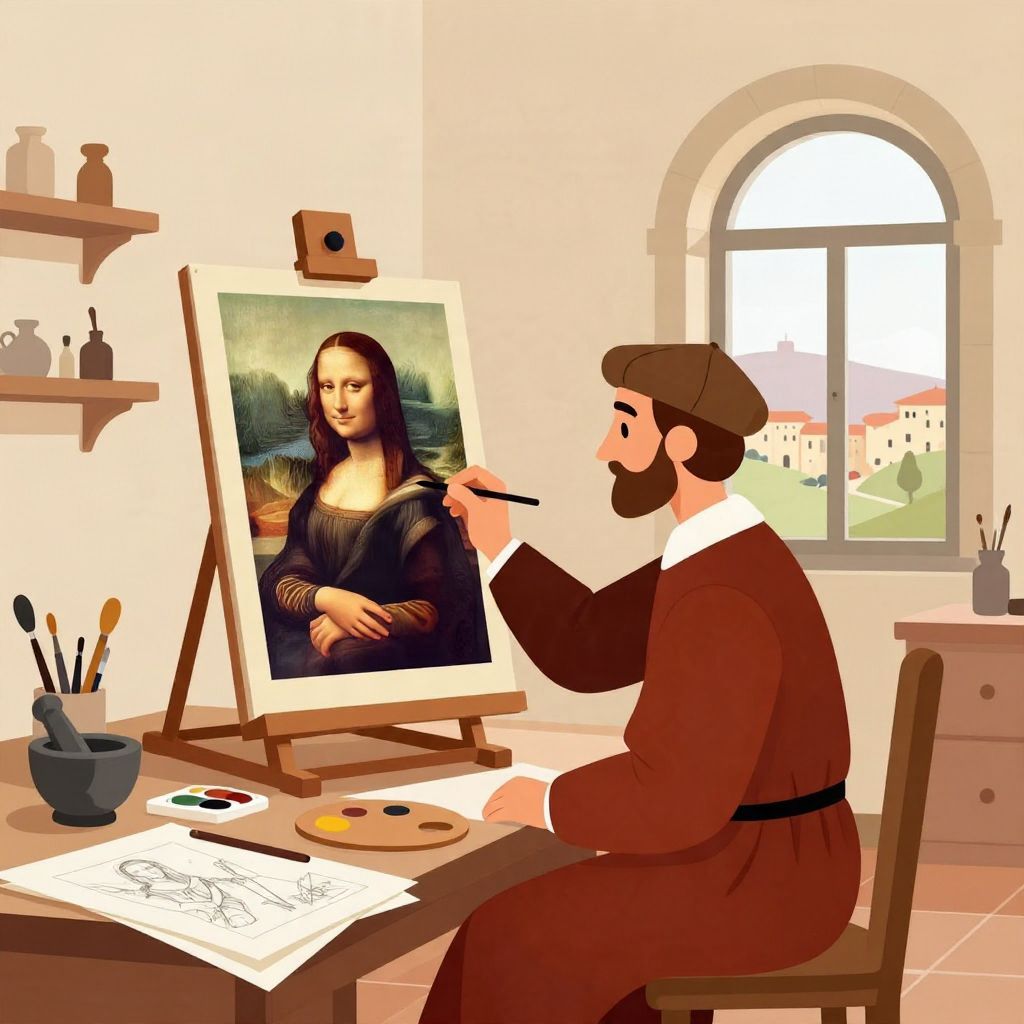
How long did it take to paint the Mona Lisa? The short answer is that Leonardo da Vinci likely worked on it for several years, probably beginning around 1503 or 1504 and continuing in stages into the 1510s. Because Leonardo rarely dated his paintings and often revised them over time, historians cannot give a single exact start-and-finish date.
What is clear is that the Mona Lisa was not produced quickly. Its slow, layered technique reflects Leonardo’s habit of careful experimentation, repeated retouching, and long periods of interruption rather than a single continuous painting session.
How Long Did It Take To Paint The Mona Lisa?
Most historians believe Leonardo da Vinci worked on the Mona Lisa for roughly 4 to 16 years, depending on how one defines “painting it.” The portrait likely began around 1503 or 1504 in Florence, but Leonardo seems to have kept refining it for years, possibly even after he left Italy for France in 1516.
Why historians cannot give one exact number
The uncertainty comes from the way Leonardo worked. He was famous for starting projects and then revisiting them later, sometimes leaving works unfinished. The Mona Lisa survives without a signed date, and there is no surviving contract that clearly states when he began or completed it. Much of the timeline is reconstructed from later testimony, stylistic analysis, and documentary clues.
What the evidence suggests
- 1503–1504: likely beginning of the portrait in Florence.
- 1506 onward: possible continued work, with interruptions.
- 1516–1519: Leonardo may still have been adjusting it in France.
Because of that, some scholars say the painting took only a few years of active work, while others argue Leonardo’s revisions stretched over more than a decade. Both views reflect the same basic fact: the portrait was a long-term project, not a quick commission finished in one sitting.
What do we know about the painting’s creation?
The most widely accepted identification of the sitter is Lisa Gherardini, the wife of Florentine merchant Francesco del Giocondo. That is why the painting is often called the Gioconda in Italian and the Mona Lisa in English, from “Monna Lisa,” an older form of “Madonna,” meaning “Lady Lisa.”
According to the early biographer Giorgio Vasari, Leonardo began a portrait for Francesco del Giocondo and worked on it for a long time. Vasari wrote in the mid-16th century, not at the time of the painting’s creation, so his account is valuable but not definitive. Still, it fits what is known about Leonardo’s working habits and the portrait’s style.
Why the portrait may have taken so long
Leonardo was not simply trying to capture a likeness. He was interested in light, anatomy, atmosphere, and subtle emotional expression. The Mona Lisa shows delicate transitions of tone, a soft modeling of the face and hands, and a landscape background built through careful glazing. Such effects take time, especially with oil paint, which dries slowly and allows repeated adjustments.
He also appears to have been unusually perfectionist. Rather than finishing quickly and moving on, Leonardo often revised details until the image matched his evolving artistic goals. In that sense, the long timeline tells us as much about Leonardo’s mind as about the sitter.
How Leonardo’s method affected the timeline
Leonardo’s technique helps explain why the painting took so long. He used thin layers of paint and subtle shading to create softness and depth. This approach, often associated with sfumato, avoids hard outlines and produces the famous hazy transitions that make the face seem alive and changing.
The role of sfumato
Sfumato is a painting technique in which tones and colors blend gradually, like smoke. It creates the illusion of atmosphere and volume, but it is time-consuming because each layer must be carefully built up. The effect is especially visible around the eyes, mouth, and cheek contours of the Mona Lisa.
That technique was not a shortcut. It required patience, repeated drying, and close observation. If Leonardo paused work for months or years, he could return later and continue refining the image without disrupting the overall effect.
Oil paint and slow revision
Unlike some faster media, oil paint gives an artist time to blend, adjust, and rework. Leonardo took advantage of this flexibility. He could soften features, deepen shadows, or alter expressions gradually. This makes the question “How long did it take to paint the Mona Lisa?” harder than it first appears, because the painting may have been in a state of ongoing revision rather than a single finished object.
Was the Mona Lisa ever truly “finished”?
That is one of the most interesting historical questions about the portrait. Many scholars think Leonardo may never have considered it fully complete. He carried the painting with him later in life, which suggests he continued to value it and perhaps keep working on it. The image we know today may therefore represent the final stage of a long process rather than a neatly completed commission.
In Renaissance art, “finished” did not always mean what it means now. Some artists produced works to satisfy a patron and then moved on. Leonardo, however, often treated painting as a field of experimentation. The Mona Lisa may have been a living project, shaped by repeated observation and revision over time.
What happened after Leonardo left Florence?
Leonardo eventually left Florence and spent his later years in other Italian courts before moving to France under the patronage of King Francis I. The portrait likely traveled with him. By the time Leonardo died in 1519, the painting was still in his possession, which supports the idea that he had not simply handed over a finished portrait decades earlier.
This matters because it suggests the work’s history was unusually prolonged. Instead of being delivered promptly to a client and then forgotten, the Mona Lisa remained with the artist through much of his later career. That long companionship may help explain the extraordinary refinement of the final image.
How long did the active painting take versus the total project?
It helps to separate two different answers:
- Active painting time: likely a few years of actual work, spread out over time.
- Total project span: possibly more than a decade, if revisions continued into Leonardo’s later years.
This distinction is important because artists do not always work continuously on one piece. Leonardo may have painted intensely for a period, set the portrait aside, and returned to it later. So the best historical answer is not a single number but a range that reflects both documented evidence and the realities of Renaissance workshop practice.
Why the painting’s long creation matters
The slow making of the Mona Lisa helps explain why it stands apart from many other Renaissance portraits. Its calm pose, ambiguous expression, and atmospheric landscape feel carefully judged rather than rushed. The painting’s fame today is partly tied to that sense of mystery, but its historical importance also lies in Leonardo’s methodical approach to art.
In a broader sense, the portrait shows how Renaissance masters could combine observation, science, and artistic invention. Leonardo was not merely painting a woman’s face; he was exploring how vision, emotion, and natural form could be represented on panel.
So, how long did it take to paint the Mona Lisa?
The most careful historical answer is that Leonardo da Vinci probably worked on the Mona Lisa for several years, beginning around 1503 or 1504, with possible revisions continuing into the 1510s. Because the work was revised over time and may never have been fully “finished” in the modern sense, the total span could be understood as anywhere from a few active years to more than a decade.
That uncertainty is part of the painting’s story. The Mona Lisa is not only famous because of who it depicts, but because its creation reflects Leonardo’s slow, experimental, and deeply patient way of working. If you want to explore more, see how da Vinci created a mood in the Mona Lisa and why the Mona Lisa became famous.