
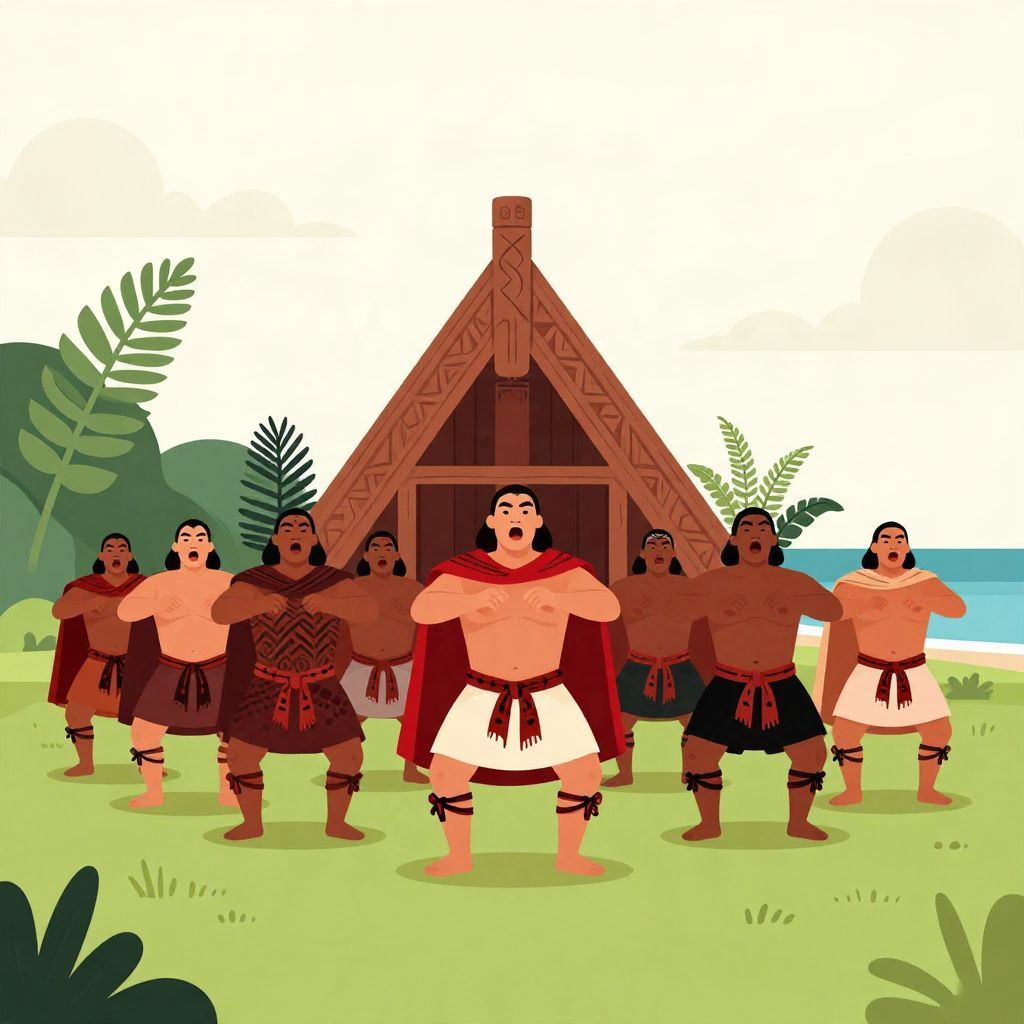
What is haka? Haka is a traditional Māori performance from Aotearoa New Zealand that combines chant, rhythm, posture, facial expression, and movement. It is best known today as a powerful group display, but it is much older than modern sport and has deep roots in Māori social, political, and ceremonial life.
Its meaning changes with context: haka can welcome guests, honor people, mark grief, challenge opponents, or express collective identity. Because it developed across many iwi and settings, there is no single “original” haka, but there is a rich historical tradition behind the form seen worldwide today.
What Is Haka?
Haka is a Māori performance tradition that uses voice, body movement, stamping, facial expression, and synchronized group energy to communicate emotion and intent. Historically, it was not only a “war dance” but a flexible cultural practice used in ceremonies, mourning, celebration, and challenge. Its modern fame comes largely from rugby, but its history is much broader.
Origins of Haka in Māori History
Haka emerged within Māori society after Polynesian settlers arrived in Aotearoa New Zealand, likely from the wider eastern Polynesian world, around the late 13th century. Like many Indigenous performance traditions, it developed over generations rather than appearing at one exact date. Oral tradition, genealogy, and communal memory preserved its forms and meanings.
Scholars generally understand haka as part of a larger Māori cultural system that linked speech, ritual, ancestry, and communal identity. It was not a separate entertainment art in the modern sense. Instead, it belonged to everyday and ceremonial life, where performance could reinforce relationships, authority, and spiritual presence.
Polynesian roots and local development
Some elements of haka likely have deep Polynesian roots, since rhythm, chant, and expressive movement were common across the Pacific. But haka as practiced in Aotearoa became distinctly Māori over time. Different iwi and hapū developed their own styles, words, and occasions for performance, so haka was never a single uniform tradition.
What Does Haka Mean in Māori Culture?
In Māori culture, haka is a way of making feeling visible and audible. It can show mana, the authority and prestige of a person or group, and it can strengthen unity before a major event. Depending on the type of haka, it may be celebratory, solemn, intimidating, or welcoming.
Because haka is tied to context, the same physical form can carry different meanings. A fierce expression may signal challenge in one setting, while a slower, more controlled performance may honor the dead or greet important visitors. The words, gestures, and purpose determine how it should be understood.
Common purposes of haka
- Challenge: to confront an opponent or show readiness.
- Welcome: to greet visitors and acknowledge their arrival.
- Mourning: to express grief and support the bereaved.
- Celebration: to mark success, achievement, or important events.
- Identity: to affirm shared ancestry and group solidarity.
Was Haka Always a War Dance?
No. The idea that haka is simply a war dance is a common simplification, especially outside New Zealand. Some haka were used before battle to stir courage or intimidate opponents, and those are the versions many people know. But many haka had nothing to do with warfare and were performed in peaceful, ceremonial, or social contexts.
This misunderstanding grew in part because European observers in the 19th century often focused on the most dramatic martial performances. That emphasis made haka seem narrower than it really was. In reality, Māori communities used haka in many settings, and the tradition was always more varied than the “war dance” label suggests.
Different kinds of haka
There are several broad categories, though naming and classification can vary by region and by community. Some haka are performed by men, some by women, and some by mixed groups. The differences are not just about gender or style; they also reflect the specific purpose of the performance and the authority of the occasion.
- Peruperu: a traditional war haka, often linked to battle preparation.
- Ngeri: a shorter, more flexible haka that may express emotion or challenge.
- Waiata-ā-ringa: action songs with coordinated movements, often performed in modern kapa haka.
- Manawa wera: haka associated with strong feeling, including grief or anger.
How Haka Developed Over Time
Haka changed as Māori society changed. Before European colonization, it was embedded in oral tradition, tribal politics, and ritual life. In the 19th century, colonization, land loss, warfare, and missionary pressure disrupted many Māori institutions, but haka survived and adapted. It remained an important way to maintain language, identity, and collective memory.
During the 20th century, haka also became a public expression of Māori cultural revival. Performances were increasingly seen on national stages, in schools, at community events, and later in international sport. This wider visibility helped preserve the tradition, though it also raised questions about authenticity, ownership, and respectful use.
Colonial encounters and change
European contact brought both documentation and distortion. Some settlers admired haka as a striking art form, while others misunderstood it through colonial stereotypes. Missionaries sometimes discouraged traditional practices they saw as pagan or disruptive. Even so, haka persisted because it served practical and emotional needs within Māori communities.
Over time, haka became both a cultural survival strategy and a public symbol. That dual role is important: it was never frozen in the past. Like many living traditions, it adapted while still preserving older forms of language, movement, and meaning.
Haka in Modern New Zealand
Today haka is one of the most visible expressions of Māori culture in New Zealand and abroad. It appears in schools, ceremonies, political gatherings, funerals, and sports. For many Māori, haka is a living link to ancestors and a way to assert cultural presence in modern society.
Its visibility has grown especially through rugby, where teams such as the All Blacks perform haka before matches. This has made haka internationally famous, but it has also sometimes reduced a complex tradition to a spectacle. Many Māori voices emphasize that haka should be understood first as a cultural practice, not merely a performance for outsiders.
Haka and rugby
Rugby helped turn haka into a global image of New Zealand, but the association is relatively modern compared with the tradition itself. Sports performance draws on the idea of collective unity and challenge, which fits some haka well. Still, the sporting version represents only one part of a much larger cultural history.
Because it is so widely broadcast, the rugby haka has influenced how people imagine Māori culture. That visibility can be positive when it encourages interest and respect, but it can also create oversimplification. The tradition deserves to be understood in its own historical and cultural terms.
Why Haka Matters Historically
Haka matters because it shows how performance can carry history, identity, and authority. It is not just movement set to sound; it is a social language. Through haka, Māori communities have expressed grief, challenged enemies, welcomed allies, and renewed bonds between people and ancestors.
Historically, haka also illustrates how Indigenous traditions survive colonial disruption. Rather than disappearing, it adapted to new circumstances while remaining recognizably Māori. That continuity helps explain why haka still has such force today: it is both an ancient practice and a living, changing one.
Key Facts About Haka
- Culture: Haka is a Māori tradition from Aotearoa New Zealand.
- Form: It combines chant, movement, posture, and facial expression.
- Meaning: It can welcome, challenge, mourn, celebrate, or unify.
- History: It developed over centuries within Māori communities after Polynesian settlement.
- Modern fame: It is widely recognized through New Zealand sport, especially rugby.
- Important nuance: Haka is not only a war dance; that is just one of its forms.
Conclusion
So, what is haka? It is a living Māori performance tradition with deep historical roots, varied forms, and powerful cultural meaning. From ancestral ceremonies to modern national visibility, haka has remained a way to speak through the body as well as the voice. To explore related cultural traditions, you may also be interested in what is capoeira and what is garba.