
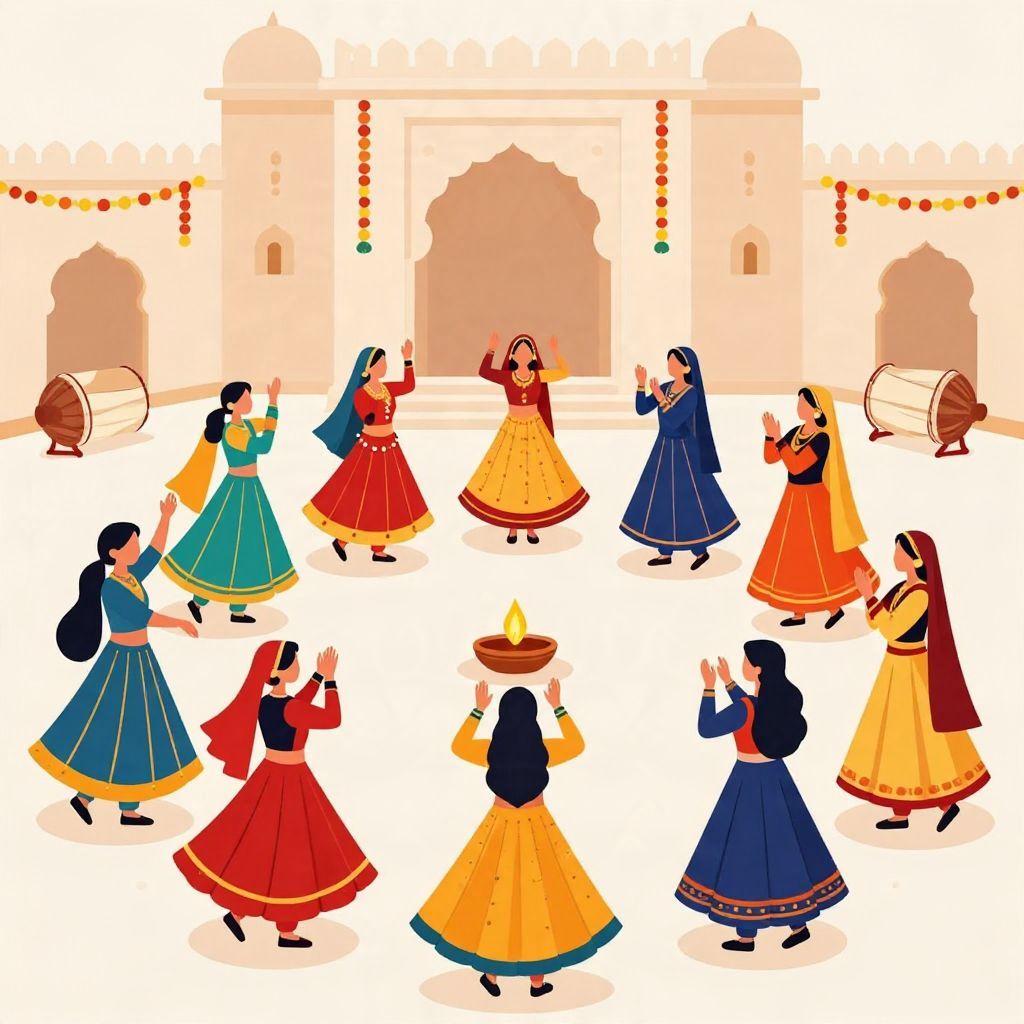
What is Garba? At its simplest, Garba is a traditional Indian folk dance and devotional performance associated most strongly with the western state of Gujarat. It is usually performed in groups, with dancers moving in circular patterns around a central lamp, image, or sacred symbol, especially during the festival of Navratri.
But Garba is more than a dance style. It is also a living cultural practice shaped by religion, community life, regional identity, and changing performance traditions. Its history reaches back through centuries of Gujarati devotional culture, even though many of the forms people recognize today are relatively modern.
What Is Garba?
Garba is a Gujarati folk dance and ritual performance traditionally linked to worship of the goddess Durga during Navratri. Dancers form circles, clap or use sticks in some styles, and move to rhythmic singing and drumming. Historically, Garba has been both a devotional act and a social gathering, bringing communities together through music, movement, and shared celebration.
The word garba is often connected to the Sanskrit term garbha, meaning “womb” or “embryo,” which helps explain the symbolic role of a lamp or goddess image placed at the center. In many interpretations, the central light represents life, divine energy, or the source from which creation emerges.
Where Did Garba Come From?
Garba developed in Gujarat, a region with long traditions of temple worship, village festivals, and devotional song. Its exact origins are difficult to date because it emerged from oral and community traditions rather than from a single documented founder or event. Historians generally see it as part of a wider South Asian pattern in which dance, song, and worship were closely linked.
What is clear is that Garba grew within a culture where religious observance and public celebration often overlapped. In villages and towns, women especially participated in seasonal devotional gatherings, singing hymns and moving in rhythmic patterns as part of worship. Over time, these practices became more stylized and recognizable as Garba.
Religious roots and symbolic meaning
Garba’s devotional dimension is central to its history. During Navratri, worshippers honor the goddess in her many forms, especially as a protector and source of power. The circular dance can be understood as a form of circumambulation, a common religious gesture in South Asian traditions, where moving around a sacred center expresses reverence and devotion.
The lamp, pot, or image placed at the center of Garba is not just decoration. It gives the dance its ritual focus. In some communities, a decorated clay pot with a lamp inside is used, reinforcing the association with fertility, life, and divine presence. This symbolism helps explain why Garba is often described as both a dance and a prayer in motion.
How Did Garba Develop Over Time?
Garba did not remain fixed. Like many folk traditions, it changed as society changed. The dance moved from village and temple settings into urban community spaces, and later into large public events, stage performances, and global diaspora celebrations. Its history is therefore one of continuity and adaptation rather than simple preservation.
From local devotion to public celebration
In earlier forms, Garba was closely tied to women’s devotional circles and seasonal village life. These gatherings were often modest in scale and rooted in local custom. As Gujarat became more urbanized and as public festival culture expanded, Garba became more visible and more inclusive, with men and women participating together in many settings.
By the 20th century, Garba had also begun to absorb influences from other performance traditions. Dandiya Raas, a stick dance associated with Krishna devotion, became closely linked with Garba in popular festival culture. Today, people often use “Garba” to describe the whole Navratri dance season, even though technically Garba and Dandiya Raas are distinct forms.
The role of music and performance
Music has always been central to Garba. Traditional songs often praise the goddess, describe divine stories, or celebrate seasonal and social life. The rhythm can be driven by handclaps, drums, and singing, creating a participatory atmosphere rather than a spectator-only performance. This is one reason Garba has remained so popular: it invites community involvement.
As Garba moved into modern entertainment spaces, its choreography became more elaborate. Costumes grew more colorful, stages became larger, and professional performers influenced the style. Yet the basic structure—circular movement around a sacred center—has remained a defining feature.
Garba and Navratri
Garba is most closely associated with Navratri, the nine-night festival dedicated to the goddess. In Gujarat, Navratri became the main public season for Garba performances. Each night of the festival offers a chance to gather, sing, dance, and honor divine feminine power. For many participants, the dance is both religious observance and social enjoyment.
Navratri celebrations vary by region and community, but in Gujarat the festival is especially famous for its large Garba events. Some are held in temples, others in neighborhood courtyards, and many now take place in organized public venues. The festival’s scale has helped Garba become one of the most recognizable cultural expressions of western India.
Why the dance is circular
The circular formation is one of Garba’s most important features. Circles suggest continuity, unity, and the cycle of life. They also allow many people to dance together without a strict front or hierarchy. In this sense, the form itself reflects the social and spiritual values of the tradition: shared participation, collective rhythm, and movement around a central sacred point.
Is Garba the Same as Dandiya Raas?
No. Garba and Dandiya Raas are related but not identical. Garba traditionally emphasizes circular movement, clapping, and devotional songs around a central object. Dandiya Raas uses decorated sticks, which dancers tap in coordinated patterns. In modern festival culture, the two are often performed together and sometimes treated as one event, which can blur the distinction.
This overlap is historically understandable. Both forms are associated with Gujarati celebration, music, and religious festivity, especially during Navratri. But if one is asking what Garba specifically is, the answer is that it is the circular devotional dance, not the stick dance.
What Does Garba Look Like in Practice?
Garba performances can range from intimate household gatherings to massive public festivals. The style may differ by region, age group, and event size, but several elements are common: rhythmic footwork, handclaps, rotating circles, bright clothing, and devotional music. The pace often increases over the course of the evening, creating a sense of energy and communal excitement.
Common features of Garba
- Central focus: a lamp, image, pot, or sacred space
- Circular movement: dancers move around the center in repeated patterns
- Rhythm: clapping, singing, drums, and sometimes other instruments
- Devotional content: songs often praise the goddess or invoke blessings
- Community participation: dancers of different ages join together
Garba is not only about technical skill. Participation matters more than perfection. That inclusiveness has helped it survive across generations and social changes.
How Has Garba Changed in the Modern Era?
In the 20th and 21st centuries, Garba expanded beyond its regional base. Migration from Gujarat carried the tradition to other parts of India and to Gujarati communities abroad, including in the United Kingdom, North America, East Africa, and the Middle East. In diaspora settings, Garba became a way to preserve cultural identity and connect younger generations to heritage.
At the same time, commercialization changed the scale and style of the dance. Ticketed events, amplified music, celebrity performers, and choreographed competitions became common in many cities. This has made Garba more visible than ever, but it has also raised questions about authenticity, religious meaning, and the balance between tradition and entertainment.
Tradition and adaptation
Scholars of culture often note that living traditions survive by adapting. Garba is a good example. It has retained its devotional core while absorbing new costumes, instruments, venues, and performance norms. Some people prefer older, more ritual-centered forms; others embrace modern festival culture. Both are part of Garba’s ongoing history.
Why Is Garba Historically Important?
Garba matters because it shows how religion, music, gender, and community life can come together in a single cultural practice. It is not just an entertainment form that appeared suddenly in the modern era. It reflects centuries of devotional life in Gujarat and the broader history of South Asian festival culture.
It is also important because it demonstrates how folk traditions can move from local settings to global ones without losing all connection to their roots. Garba today may be performed on large stages and in diaspora halls, but its central ideas—devotion, rhythm, circularity, and communal participation—remain recognizable.
Key Facts About Garba
- Region: most strongly associated with Gujarat, India
- Festival link: especially connected to Navratri
- Core form: circular dance around a sacred center
- Religious association: devotion to the goddess, especially Durga
- Related form: often performed alongside Dandiya Raas, but not the same dance
- Historical character: rooted in folk and devotional tradition, later adapted for modern public celebration
So, What Is Garba?
Garba is a Gujarati devotional folk dance that combines worship, music, and communal celebration, especially during Navratri. Its history lies in regional religious practice, village culture, and the symbolic power of circular dance around a sacred center. Over time, it has grown from local ritual into a major cultural tradition with regional and global reach.
For readers interested in how traditions evolve across societies, Garba offers a clear example of cultural continuity shaped by change. You may also want to explore what cultural divergence means and browse broader historical topics at My Life Is History.